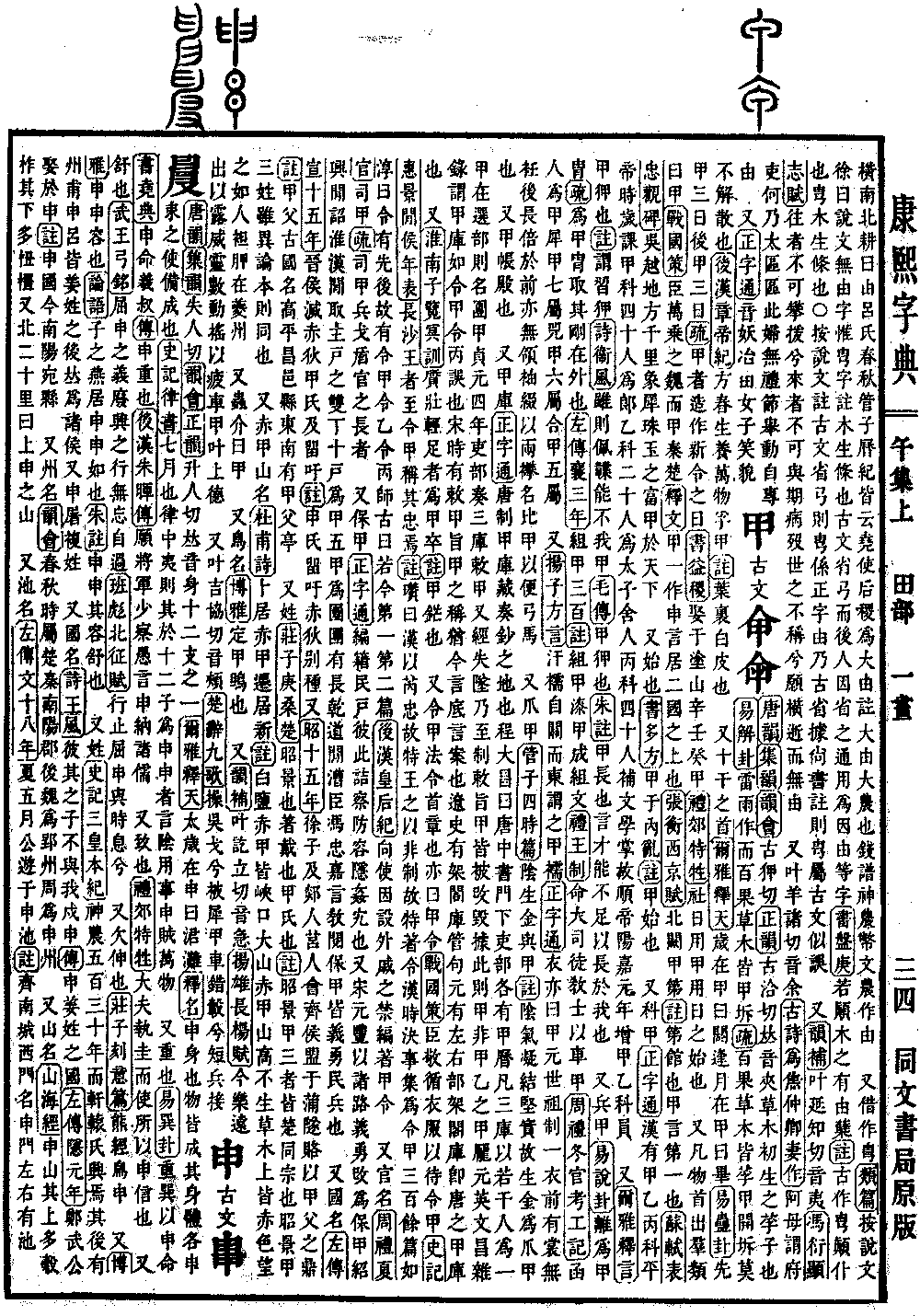
Wu Collection, Upper Volume. Radical: Field (tián); Kangxi stroke count: 5; Page 758, Entry 01.
Ancient text. Pronounced jia (rising tone). The outer skin that wraps a seed when plants and trees first begin to grow. Book of Changes (Yijing), Hexagram Jie: When thunder and rain arise, the outer skins of all fruit tree and plant seeds split open. Commentary: All such outer skins split; none fail to expand. History of the Later Han (Hou Hanshu), Annals of Emperor Zhang: It is the time of spring growth and nurturing of all things; all things sprout new buds. Note: The white skin inside the leaves.
It is also the first of the ten Heavenly Stems. Erya, Explanation of Heaven: When the Year Star is in jia, it is called yanfeng; when the month is in jia, it is called bi. Book of Changes (Yijing), Hexagram Gu: Three days before the jia day, three days after the jia day. Commentary: The jia day is the day for establishing new laws. Book of Documents (Shujing), Yi and Ji: Yu married the daughter of the Tushan clan, from the xin day to the jia day, totaling four days. Book of Rites (Liji), Jiao Te Sheng: The jia day is used for sacrificing to the Earth god because it is the beginning of the Heavenly Stems.
Anything that surpasses its peers and ranks first is called jia. Strategies of the Warring States (Zhan Guo Ce): I caused the State of Wei, which possesses ten thousand chariots, to rank above the states of Qin and Chu. Explanation of Text (Shiewen): Jia, also written as shen, means to rank above two states. Zhang Heng, Western Capital Rhapsody (Xijing Fu): The first-class residence beside the northern palace gate. Note: Di refers to quarters. Jia means the first. Su Shi, Stele for the Biao Zhong Temple: The region of Wu and Yue covers a thousand miles; its wealth in ivory, rhinoceros horn, pearls, and precious jade is the first in the world.
It also means the beginning. Book of Documents (Shujing), Many Regions (Duofang): Because it began with internal turmoil. Note: Jia means beginning.
It also refers to the ranks in the imperial examination. Zhengzitong: In the Han dynasty, there were Grade A, B, and C. In the time of Emperor Ping of Han, forty people were assessed as Grade A annually to serve as郎官 (langguan), twenty as Grade B to serve as attendants to the crown prince, and forty as Grade C to supplement literature posts. In the first year of the Yangjia era of Emperor Shun of Han, the quotas for Grade A and B were increased.
Also, Erya, Explanation of Words: Jia means to be intimate and familiar. Note: It refers to intimacy and familiarity. Book of Odes (Shijing), Odes of Wei: Though you wear an archer's ring, can you truly be intimate with me? Mao Commentary: Jia means intimacy. Zhu Commentary: Jia means long. It means that one's talent is not enough to surpass mine.
It also refers to armor and weaponry. Book of Changes (Yijing), Explanation of the Trigrams: The Li hexagram symbolizes armor and helmets. Commentary: Symbolizing armor and helmets takes the meaning of hardness on the exterior. Zuo Tradition (Zuo Zhuan), Third Year of Duke Xiang: The Chu army had three hundred men wearing zujia (lacquered, patterned armor). Note: Zujia is armor painted with patterned lacquered bands. Book of Rites (Liji), Royal Regulations: Order the Grand Minister of Instruction to train soldiers using war chariots and armor. Rites of Zhou (Zhouli), Winter Bureau of Craftsmen: The armor-maker crafts armor; rhinoceros hide armor uses seven pieces connected, s-ox hide armor uses six pieces, and combined armor (two layers of leather) uses five.
Also, Yangzi, Dialects (Fangyan): The garment worn against the skin is called jia in areas east of Hangu Pass. Zhengzitong: Clothing is also called jia. Emperor Shizu of the Yuan dynasty created a type of garment with a front skirt but no lapels, with the back twice as long as the front, having neither collar nor sleeves, fastened with loops; it was called bijia to facilitate riding and archery.
Also refers to fingernails. Guanzi, Four Seasons Chapter: Yin energy produces metal and fingernails. Note: Yin energy congeals and becomes solid, thus producing metal and fingernails.
Also refers to jiazhang (palatial halls) and jiaku (a type of repository). Zhengzitong: In the Tang dynasty system, the jiaku was a place to store copies of memorials. Cheng Dachang stated: The Tang Secretariat, the Chancellery, and the Ministry of Personnel each had jiali (record registers), totaling three repositories. A group of people formed one jia; in the Ministry of Personnel, this was called tuan-jia. In the fourth year of the Zhenyuan era, the Ministry of Personnel reported that the imperial edicts and records of the three repositories had been lost, leading to the tampering and destruction of edicts, decrees, and orders. According to this, jia does not mean the first of the Heavenly Stems. Pang Yuanying, Wenchang Miscellaneous Records, incorrectly suggests it is like "Order A" and "Order B." The Song dynasty had terms like chi-jia and zhi-jia, which are like modern master copies or case files. The History of the Liao mentions the post of archive custodian, and the History of the Yuan mentions left and right wing archives, which are the jiaku of the Tang.
Also, Huainanzi, Viewing the Obscure (Lanming Xun): Men with strong bodies and agile movements serve as armored soldiers. Note: Jia refers to the blade.
Also refers to lingjia (the first chapter of laws). Also called jia-ling. Strategies of the Warring States (Zhan Guo Ce): I respectfully tidy my clothes to wait for the promulgation of the law. Records of the Grand Historian (Shiji), Table of Marquises from the Hui and Jing eras: The King of Changsha (Wu Rui) was included in the law, praising his loyalty. Note: Chen Zan says: The Han dynasty specifically made Wu Rui a king because of his loyalty. Because it did not conform to the system, it was specifically written into the law. Han dynasty legal judgments were compiled into more than three hundred chapters of ling-jia. Ru Chun says: Laws have sequence, hence there are ling-jia, ling-yi, and ling-bing. Shi Gu says: It is like saying the first chapter, the second chapter. History of the Later Han (Hou Hanshu), Annals of the Empresses: If an injunction regarding the relatives of the empress had been established at the beginning and compiled into the primary law.
Also refers to a government title. Rites of Zhou (Zhouli), Summer Bureau: Si-jia. Commentary: Si-jia is the head official in charge of weaponry, shields, and other military equipment.
Also refers to the bao-jia system. Zhengzitong: Organizing households and registering people to supervise and investigate each other to prevent the harboring of criminals. In the Yuanfeng era of the Song dynasty, local militias were reorganized into the bao-jia system. In the Shaoxing era, an imperial decree ordered that between the Huai and Han rivers, households with two able-bodied men were to form one jia (ten households), and five jia formed one tuan (unit), which had a unit leader. In the Qiandao era, the Transport Commissioner Feng Zhongjia suggested training and reviewing the bao-jia, all of whom were local militia.
Also refers to a state name. Spring and Autumn Annals (Chunqiu), Sixteenth Year of Duke Xuan: The Jin people destroyed the Jia clan of the Red Di and the State of Liu. Note: The Jia clan and Liu are branches of the Red Di. Zuo Tradition (Zuo Zhuan), Sixteenth Year of Duke Zhao: The Duke of Xu met with the people of Tan and Ju to ally with Duke Jing of Qi at Puzui; they gifted the Jiafu tripod. Note: Jiafu is an ancient state name. There is a Jiafu Pavilion southeast of Changyi County in Gaoping Commandery.
Also refers to a surname. Zhuangzi, Gengsang Chu: The Zhao clan, the Jing clan, the Jia clan. Explanation of Text (Shiewen): One view is that Zhao, Jing, and Jia all share the same ancestral origin in Chu. Although the three surnames are different, their origin is the same.
Also refers to Chijia, a mountain name. Du Fu's Poetry: Choosing to reside in Chijia Mountain and moving to a new place. Note: White Salt Mountain and Chijia Mountain are both large mountains at the entrance to the gorges. Chijia Mountain is very high, devoid of vegetation, and reddish in color; seen from afar, it looks like a person with exposed shoulders. It is located in Kuizhou.
Also refers to crustaceans. Also refers to a bird name. Boya: Ding-jia is the danyi bird.
Also, rhyming supplement: Pronounced ji (rising tone). Yang Xiong, Changyang Rhapsody: Nowadays, music is used to display prestige, frequently mobilizing troops and exhausting horses and armor. Rhymes with the character "de" in the preceding line. Also, rhyming supplement: Pronounced jia (level tone). Songs of Chu (Chucui), Nine Songs: Hands grasping Wu spears, bodies covered in rhinoceros armor; chariot wheel hubs interlocked, short weapons clashing.