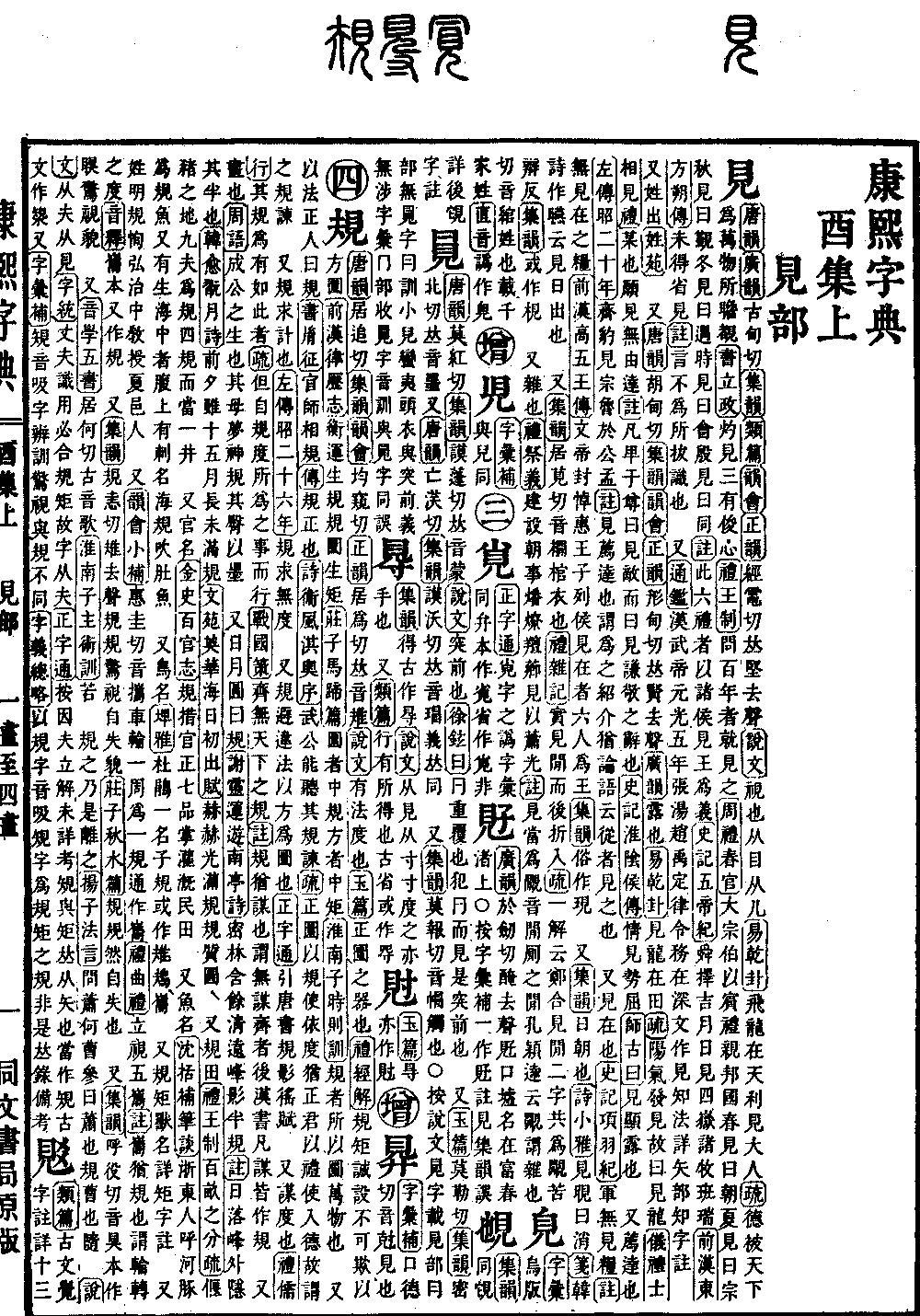
You Collection, Upper Volume
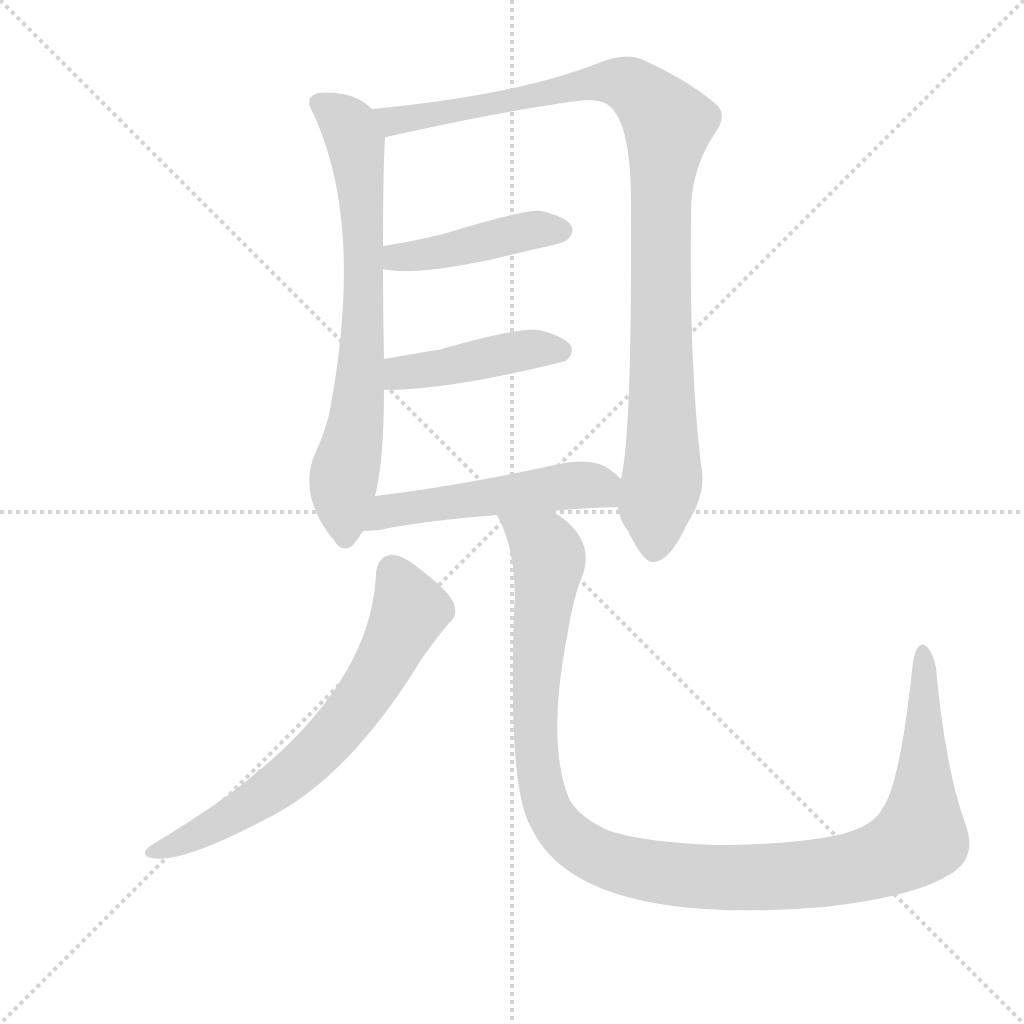
Radical: See (jiàn)
Page 1133, Entry 01
Pronounced jian (falling tone).
Shuowen Jiezi (Explanation of Simple and Compound Characters): To look at. Composed of the eye radical and the person radical.
I Ching (Book of Changes): A flying dragon is in the heavens; it is advantageous to see a great man. Commentary: Virtue covers all under heaven, and is looked upon by all things.
Book of Documents (Shujing): Clearly see the three who have talents and hearts.
Book of Rites (Liji): Inquire after a hundred-year-old person and go to see them.
Rites of Zhou (Zhouli): The Minister of Rites uses guest rites to foster relations with the states; an audience in spring is called chao, in summer is called zong, in autumn is called jin, in winter is called yu, at irregular times is called hui, and a grand audience is called tong. Commentary: These six rites are based on the feudal lords having an audience with the king.
Records of the Grand Historian (Shiji): Shun chose an auspicious month and day to see the Four Peaks and various shepherds to distribute jade tokens.
Book of Han (Hanshu): Not yet able to have an audience. Commentary: This means not being noticed or recognized.
Also, in the Comprehensive Mirror (Tongjian): In the fifth year of the Yuanguang reign of Emperor Wu of Han, Zhang Tang and Zhao Yu established statutes and ordinances, emphasizing strict interpretation, and created the law of jianzhi (knowledge of a situation). Detailed in the note on the character zhi under the arrow radical.
Also a surname. From Xingyuan (Garden of Surnames).
Pronounced xian (falling tone).
Guangyun (Broad Rhymes): To manifest or be exposed.
I Ching (Book of Changes): A dragon appears in the field. Commentary: Yang energy emerges and manifests, hence it is called appearing dragon.
Book of Etiquette and Ceremonial (Yili): I, so-and-so, wish to see you but have no way to reach you. Commentary: In general, to see those in a superior position is called jian, to see equals is also called jian; these are terms of modesty and respect.
Records of the Grand Historian (Shiji): Feelings are exposed and the situation is constrained. Shigu notes: Jian means to manifest or be exposed.
Also means to recommend or promote.
Zuo Tradition (Zuo Zhuan): Qi Bao recommended Zong Lu to Gongmeng. Commentary: Jian means to recommend or promote. It means acting as an intermediary for him, similar to the passage in the Analects (Lunyu) which says, the followers introduced him.
Also means currently present.
Records of the Grand Historian (Shiji): The army had no grain on hand. Commentary: No grain currently present.
Book of Han (Hanshu): Emperor Wen enfeoffed six sons of the Prince of Daohui as kings from those who were currently present as marquises.
Jiyun (Collection of Rhymes): Commonly written as the variant form (xian).
Also, Jiyun: Sunlight in the morning.
Classic of Poetry (Shijing): It appears to sunlight and then dissipates. Commentary: Han Shi writes it as the variant form (yan), saying jian means the sun coming out.
Pronounced jian (falling tone).
The covering of a coffin.
Book of Rites (Liji): Placing the inner coffin cover in the space, and then folding it in. Commentary: One interpretation says Zheng combined the two characters into one, pronounced bian (rising tone).
Jiyun (Collection of Rhymes): Or written as the variant form (jian).
Also means mixed.
Book of Rites (Liji): Establishing the morning rites, burning fragrant meats, mixed with artemisia light. Commentary: Jian should be read as the variant (jian), pronounced jian (falling tone) as in mixed. Kong Yingda said: Jian means to mix.