You Collection, Upper Volume
Radical: See (jiàn)
Kangxi Strokes: 7
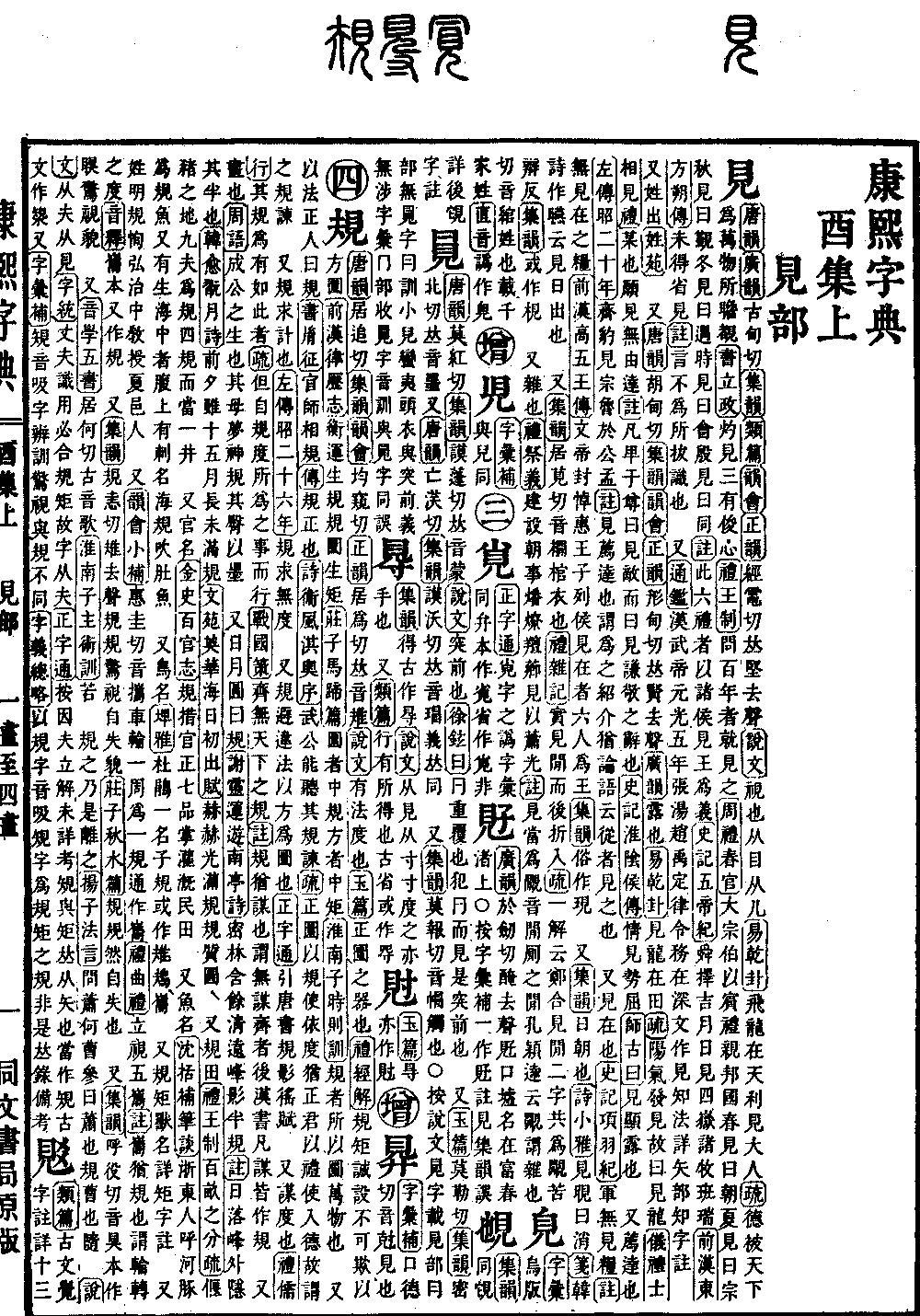
Page 1133, Entry 01
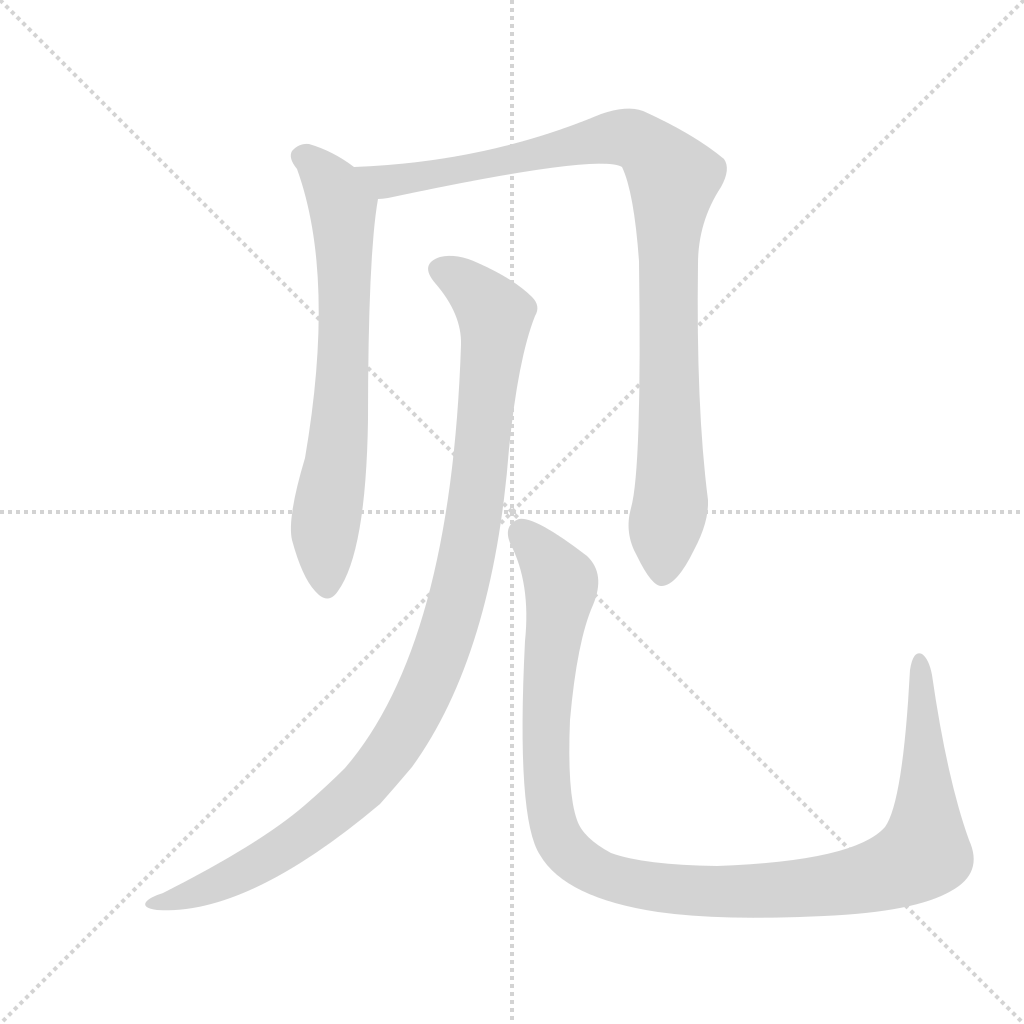
Pronounced jian (falling tone). As defined in the Explanation of Simple and Compound Characters (Shuowen Jiezi), it means to look. The character is composed of eye and legs.
Book of Changes (Yijing), Qian Hexagram: Flying dragon is in the sky, it is advantageous to see the great man. Commentary: Virtues cover the world and are looked upon by all things.
Book of Documents (Shangshu), Lize: Clearly seeing the outstanding hearts among the officials of the three residences.
Book of Rites (Liji), Royal Regulations: To console a centenarian, one must personally go to see him.
Rites of Zhou (Zhouli), Spring Officials: The Grand Minister uses guest rites to be close to the various feudal states. An audience in spring is called chao, in summer is called zong, in autumn is called jin, in winter is called yu, an irregular audience is called hui, and an audience of many feudal lords together is called tong. Commentary: These six types of rites all signify the feudal lords having an audience with the Son of Heaven.
Records of the Grand Historian (Shiji), Basic Annals of the Five Emperors: Shun selected a lucky month and day to receive the Four Mountains and local officials, and to issue auspicious jade.
History of the Former Han (Qian Hanshu), Biography of Dongfang Shuo: Unable to obtain an audience (with the Emperor). Commentary: It means he was not appreciated or promoted.
Comprehensive Mirror in Aid of Governance (Zizhitongjian): In the fifth year of the Yuanguang reign of Emperor Wu of Han, Zhang Tang and Zhao Yu established legal codes, striving for strictness, and formulated the Law of Knowledge by Observation (jianzhibi). See the annotations for the character zhi under the Arrow (shi) radical for details.
Also serves as a surname. Cited from the Collection of Surnames (Xingyuan).
Pronounced xian (falling tone). Meaning to reveal.
Book of Changes (Yijing), Qian Hexagram: The dragon is revealed in the field. Commentary: The yang energy is revealed, so it is said the dragon is revealed.
Book of Etiquette and Ceremonial (Yili), Rites for Officials Meeting: Someone wishes to pay a visit but cannot relay the message. Commentary: Using the word jian when referring to elders or peers is an expression of humility and respect.
Records of the Grand Historian (Shiji), Biography of the Marquis of Huaiyin: The true situation was revealed, and the power was weakened. Shigu says: Jian means to manifest.
Also refers to recommending or introducing.
Zuo Tradition (Zuozhuan), Twentieth Year of Duke Zhao: Qi Bao introduced Zong Lu to Gongmeng. Commentary: Jian means to recommend or introduce. It refers to introducing someone, similar to the phrase from the Analects (Lunyu): The followers introduced him.
Also indicates existing or present.
Records of the Grand Historian (Shiji), Annals of Xiang Yu: The army had no existing food supplies. Commentary: There was no food currently on hand.
History of the Former Han (Qian Hanshu), Biography of the Five Kings of the Gao Lineage: Emperor Wen of Han enfeoffed six of the sons of the Prince of Daohui who were currently existing as marquises.
Phonetic Dictionary (Jiyun): Commonly written as the variant form (xian).
Phonetic Dictionary (Jiyun): Refers to the sunrise.
Book of Odes (Shijing), Lesser Odes: Appearing as the sun warms them, they dissolve. Annotation: The Han interpretation writes it as a variant, stating that jian means the sun coming out.
Phonetic Dictionary (Jiyun): Pronounced jian (falling tone). Refers to the cover shroud on a coffin.
Book of Rites (Liji), Miscellaneous Records: Place the cover and the divider into the coffin, then fold the coffin lid inward. Commentary: One interpretation states that Zheng Xuan combined the two characters into one, pronounced like the word for bitterness and argument.
Phonetic Dictionary (Jiyun): Sometimes also written as a variant form (jian).
Also refers to intermingling or mixing.
Book of Rites (Liji), Meaning of Sacrifices: Displaying the morning offerings, the fragrance of burning cattle and sheep intestines and fat, mingled with the scent of mugwort. Commentary: Jian should be read as the character for mix. Kong Yingda says: Jian means to mix.