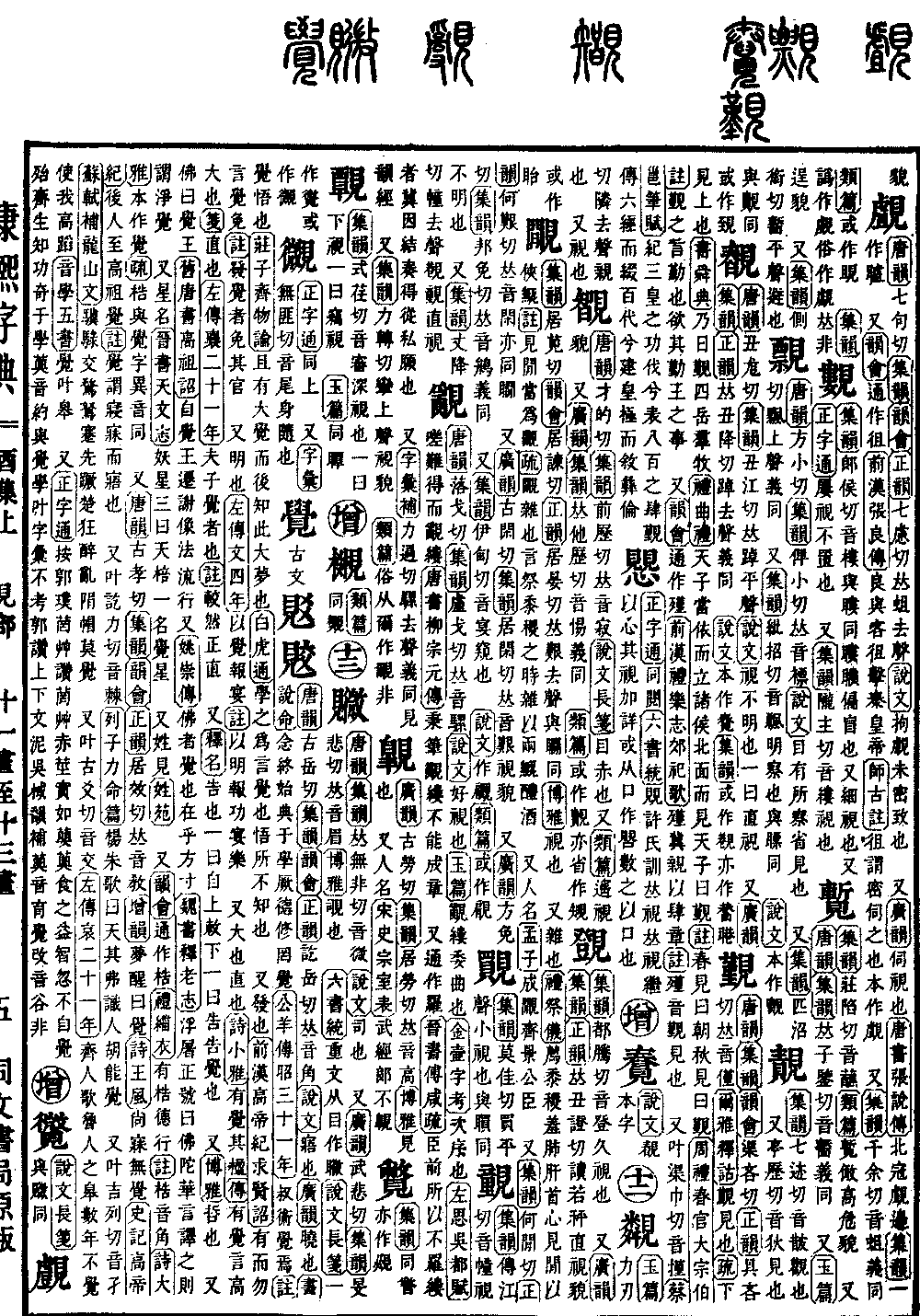
You Collection, Upper Volume
Radical: See (jiàn)
Kangxi Strokes: 20
Page 1137, Entry 23
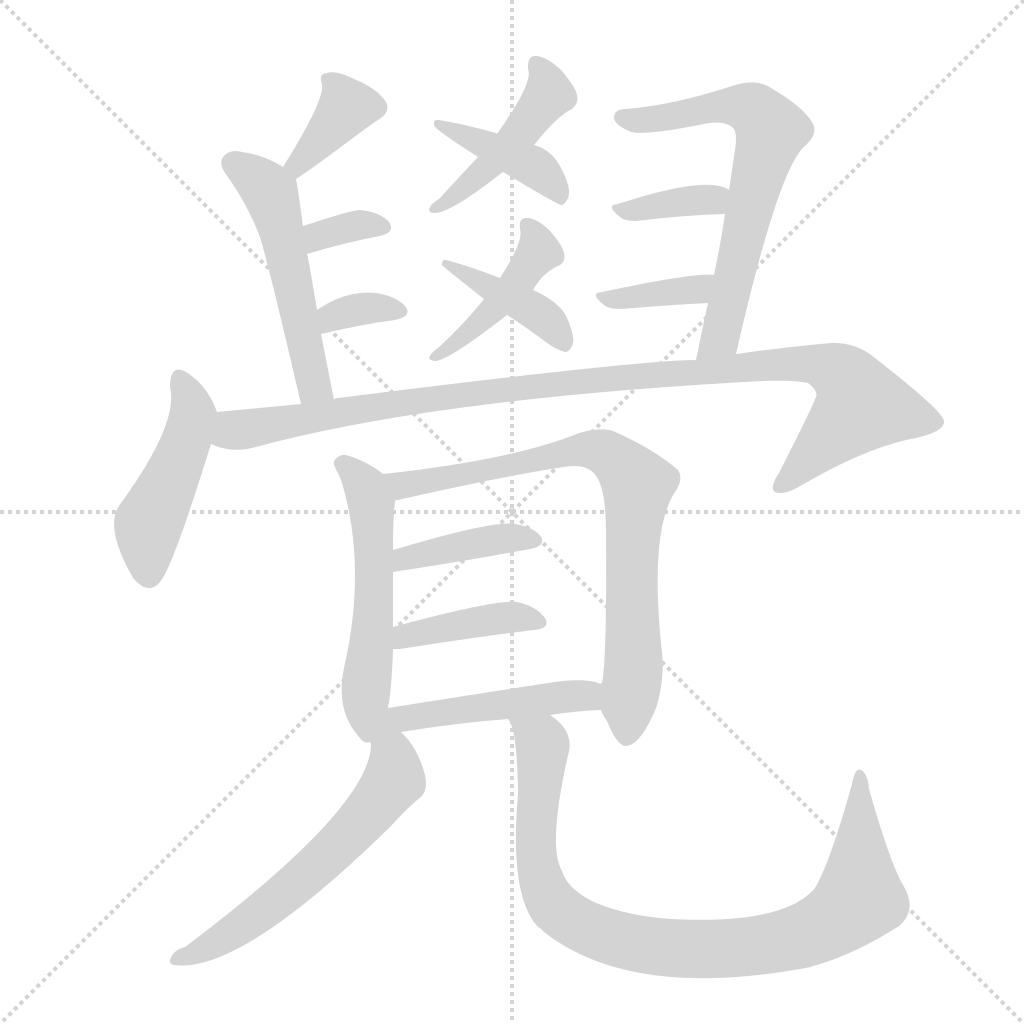
Ancient form is Jue (jué).
Tang Dynasty Rhyme Dictionary (Tangyun) states: pronounced jue (checked tone).
Collection of Rhymes (Jiyun), Rhyme Collection (Yunhui), and Orthodox Rhymes (Zhengyun) state: pronounced jue (checked tone).
Analytical Dictionary of Characters (Shuowen) states: to wake up.
Broad Rhymes (Guangyun) states: to understand.
Book of Documents (Shujing), Speech of Yue (Yue Ming): Always focus on learning from beginning to end, if one's virtue is cultivated, one will not fail to understand.
Gongyang Commentary (Gongyang Zhuan), 31st Year of Duke Zhao: Shu Shu woke up to the situation.
Annotation: Jue means to realize.
Zhuangzi, Discourse on Making All Things Equal (Qiwulun): Only after a great awakening can one know this is a great dream.
Comprehensive White Tiger Hall (Baihutong): The word for learning means to awaken; to realize what one did not know before.
Also, to expose.
Book of Han (Qianhan), Imperial Edict Seeking Worthy Men: If there is [a crime] and it is not reported, the person is dismissed.
Annotation: Those who expose [the matter] have their official positions removed.
Also, to clarify.
Zuo Commentary (Zuo Zhuan), 4th Year of Duke Wen: To clarify through rewards and banquets.
Annotation: To clarify by rewarding merit with banquets.
Also, large and straight.
Book of Odes (Shijing), Lesser Odes of the Kingdom (Xiaoya): Its pillars are straight and tall.
Commentary: Straight and tall means high and large.
Explanation: Straight.
Zuo Commentary (Zuo Zhuan), 21st Year of Duke Xiang: The Master is a righteous and upright person.
Annotation: Clearly upright and righteous.
Also, Explanation of Names (Shiming): To announce. One says it means to issue orders from above to those below. One says it means to announce, announcing to make aware.
Also, Extensive Elucidation (Boya): Wise.
Also, the Buddha is called the Awakened King (Jue Wang).
Old Book of Tang (Jiu Tangshu), Edict of Gaozu: Since the passing of the Awakened King, the Buddhist teachings have spread.
Also, Biography of Yao Chong: The Buddha is the Awakened One, existing within one's own heart.
Book of Wei (Weishu), Treatise on Buddhism and Daoism (Shilaozhi): The true title of the Buddha is Budda; translated into Chinese, it means Pure Awakening.
Also, a star name.
Book of Jin (Jinshu), Treatise on Astronomy (Tianwenzhi): The third ominous star is called the Heavenly Pestle. Another name is the Awakening Star.
Also, a surname, see Dictionary of Surnames (Xingyuan).
Also, Rhyme Collection (Yunhui): Commonly written in the variant form gu (gǔ).
Book of Rites (Liji), Black Ceremonial Robes (Ziyi): To have a refined and upright conduct.
Annotation: Gu is pronounced jue (checked tone).
Book of Odes (Shijing), Greater Odes of the Kingdom (Daya): Originally written as jue (jué).
Sub-commentary: The characters gu and jue differ in form but share the same pronunciation.
Also, Tang Dynasty Rhyme Dictionary (Tangyun) states: pronounced jiao (falling tone).
Additional Rhymes (Zengyun): Waking from a dream is called jue (jiao).
Book of Odes (Shijing), Odes of Wang (Wangfeng): I wish to sleep and not wake.
Records of the Grand Historian (Shiji), Annals of Gaozu: Later people arrived, and the High Ancestor awoke.
Annotation: Jue refers to waking from sleep.
Also, rhyming with the sound ji (checked tone).
Liezi, Power of Fate (Limingpian): Yang Zhu sang: If heaven does not know it, how can man be awakened?
Also, rhyming with the sound jie (checked tone).
Su Shi, Supplement to the Dragon Mountain Text (Bu Longshan Wen): The fine horses race together, the weary mules stumble first, the madman of Chu is drunk and confused, his hat falls and he is not aware.
Also, rhyming with the sound jiao (level tone).
Zuo Commentary (Zuo Zhuan), 21st Year of Duke Ai: The people of Qi sang: The people of Lu stand high, after several years they do not wake, making me walk proudly.
Five Books on Phonology (Yinxue Wushu): The character jue rhymes.
Also, Complete Compendium of Characters (Zhengzitong): Investigating the Praise of the Fang Plant (Fangcao Zan) by Guo Pu: The fang plant has a red stem, its fruit is like the wild grape. Eating it benefits the mind, suddenly one is unaware, it is almost equal to innate knowledge, its merit is stranger than learning. Yu is pronounced yue, which rhymes with jue and xue. The Dictionary of Characters (Zihui) did not examine the context of Guo's praise, [and is therefore] confused. Wu Yu's Rhyme Supplement (Yunbu) says the sound is yu, and that jue should be pronounced gu, which is incorrect.