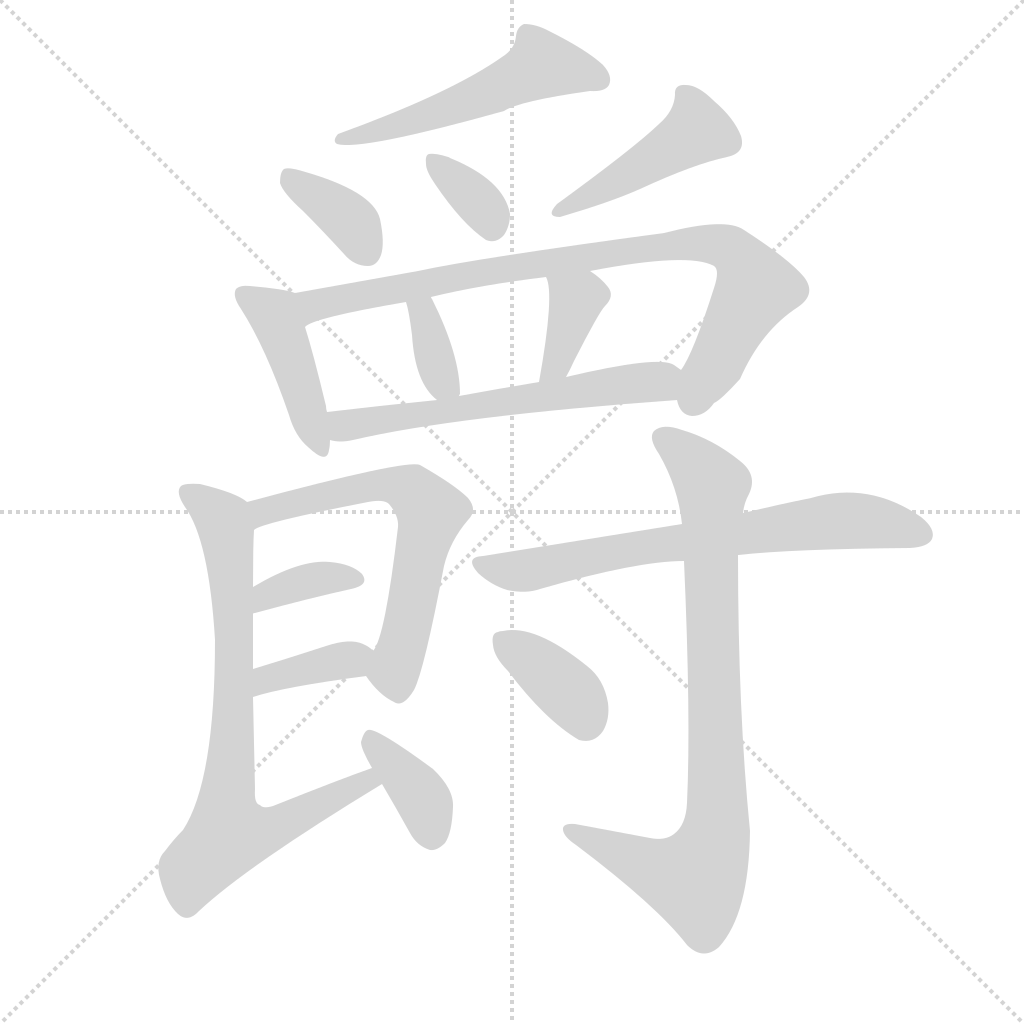
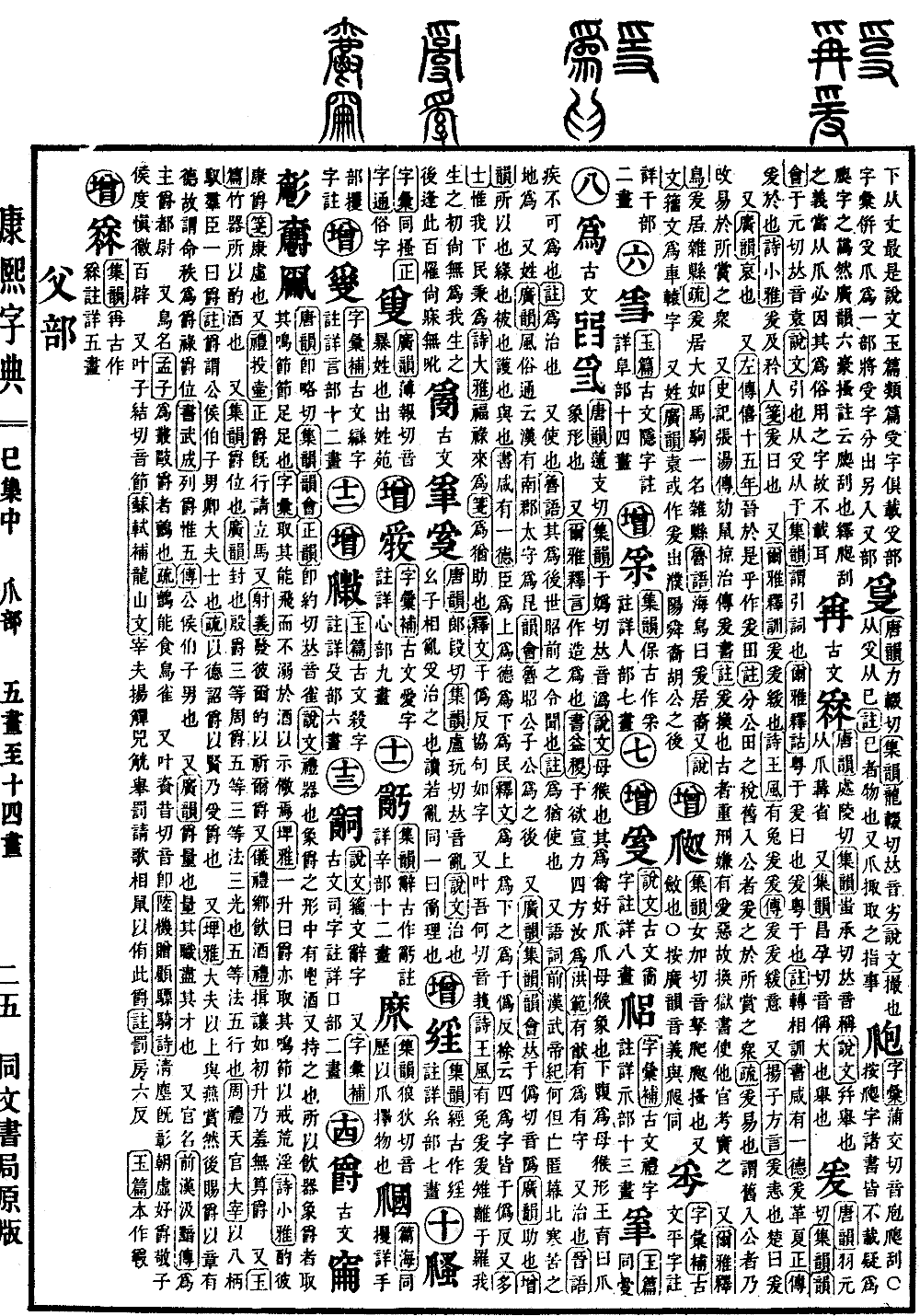
Si Collection, Middle Volume. Radical: Claw (zhǎo). Kangxi strokes: 18. Page 689, Entry 29.
In classical literature: According to the Tang Dynasty dictionary Tang Yun, and the rhyme dictionaries Jiyun, Yunhui, and Zhengyun, it is pronounced jue. It is read the same as the character for sparrow. The Shuowen Jiezi (Explanation of Simple and Compound Characters) explains it as a ritual vessel. Its shape mimics the sparrow bird. It is used to contain sacrificial wine (chang). It also signifies holding it with the hand; thus, it is a utensil for drinking. The imitation of the sparrow bird is intended to capture the rhythmic nature of its chirping. The footed base refers to the legs. The Zihui (Collection of Characters) states it is so named because the bird can fly without drowning in wine, serving as a warning. The Piya (Amplification on the Er Ya) states that a vessel with a capacity of one sheng is called a jue, also named for the bird's rhythmic chirping to warn against excessive indulgence. Book of Odes (Shijing), Lesser Odes of the Kingdom: Shoot arrows to hit the center of the target, pray that you may drink wine, and fill that empty cup. Zheng Xuan's commentary states that kang means empty. Also, in the Book of Rites (Liji), record of the Pitch-pot game: After the formal toasting ceremony ends, request the setup of a horse-shaped target. Also, in the Book of Etiquette and Ceremonial (Yili), record of the Village Drinking Ceremony: Bow and defer as one did at the beginning, ascend the hall to offer delicacies, and drink without counting the number of cups. The Yupian (Jade Chapters) records it as a bamboo vessel used for scooping wine. Jiyun defines it as an aristocratic rank. Guangyun defines it as an imperial enfeoffment. During the Yin Dynasty, titles were divided into three ranks. During the Zhou Dynasty, titles were divided into five ranks. The three ranks were modeled after the sun, moon, and stars. The five ranks were modeled after the five elements of metal, wood, water, fire, and earth. The Book of Rites (Zhouli), Office of Heaven, Great Minister: Records the use of eight powers to govern ministers, the first being the aristocratic rank. The commentary notes that ranks refer to the Duke, Marquis, Earl, Viscount, Baron, Minister, Grand Master, and Officer. The sub-commentary states that ranks are bestowed according to virtue, and only the capable may receive them. Also, Piya records: Those at the level of Grand Master and above participate in banquets and rewards, then are granted the jue to drink, honoring those with virtue, which is why official rank and salary are called jue-lu or aristocratic rank. The Book of Documents (Shangshu), Completion of the Martial Campaign: Records the arrangement of ranks into five grades. The commentary refers to the Duke, Marquis, Earl, Viscount, and Baron. Guangyun defines it as a measure: measure one's responsibilities to fully utilize one's talents. It is also an official title. The Book of Han (Qian Hanshu), Biography of Ji An: Records him serving as the Chief of the Jue (Zhu-jue Duwei). It is also the name of a bird. Mencius records: That which drives sparrows from the thicket is the sparrowhawk. The sub-commentary states that the sparrowhawk can eat sparrows. It is also pronounced ji (falling tone) in a rhyming variant. Lu Ji, Poem Gift to Cavalier General Gu: The clear dust is already held high, the imperial court leaves positions vacant awaiting excellent talent, respecting your official laws, cautiously making the hundred officials virtuous. It is also pronounced jie (falling tone) in a rhyming variant. Su Shi, Supplement to the Dragon Mountain Text: The steward raises the zhi-cup, the rhinoceros horn cup is raised to demand a penalty drink, requesting to sing the poem Sang Shu to urge the drinking of this cup of wine. The note states the character for penalty is pronounced fang-xue. The Yupian states it was originally written as a variant form.
Textual Research: Book of Odes (Shijing), Lesser Odes of the Kingdom: Pour that empty cup. The commentary says kang means empty. Also, in the Book of Rites (Liji), record of the Pitch-pot game: After the formal toasting ceremony ends, request the setup of a horse-shaped target. Also, Book of Rites (Liji), Meaning of Archery: Shoot at that target to pray for your drinking. I observe: "Shoot at that target" is also a reference to the Lesser Odes of the Kingdom, and the line should precede "Pour that empty cup," and the Meaning of Archery also cites the Book of Odes; thus, the original text of the Book of Odes should take precedence. I have revised it to: Book of Odes (Shijing), Lesser Odes of the Kingdom: Shoot arrows to hit the center of the target, pray that you may drink wine, and fill that empty cup. Zheng Xuan's commentary states that kang means empty. Also, Book of Rites (Liji), record of the Pitch-pot game: After the formal toasting ceremony ends, request the setup of a horse-shaped target. Su Shi, Supplement to the Dragon Mountain Text: The steward raises the zhi-cup, the rhinoceros horn cup is raised to demand a penalty drink, requesting to sing the poem Sang Shu to urge the drinking of this cup of wine. The note states the character for penalty is pronounced fang-xue. I have revised "fang-liu" to "fang-xue" in accordance with the original text.