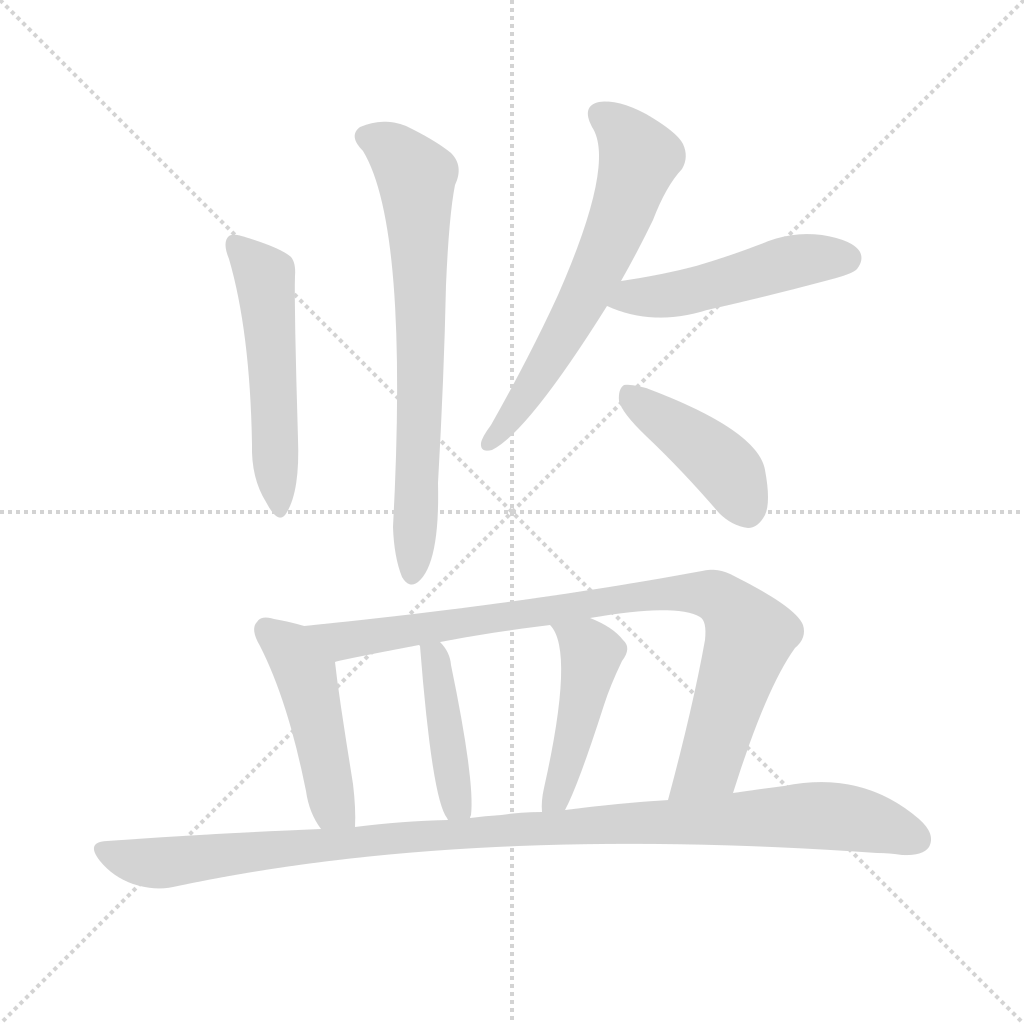
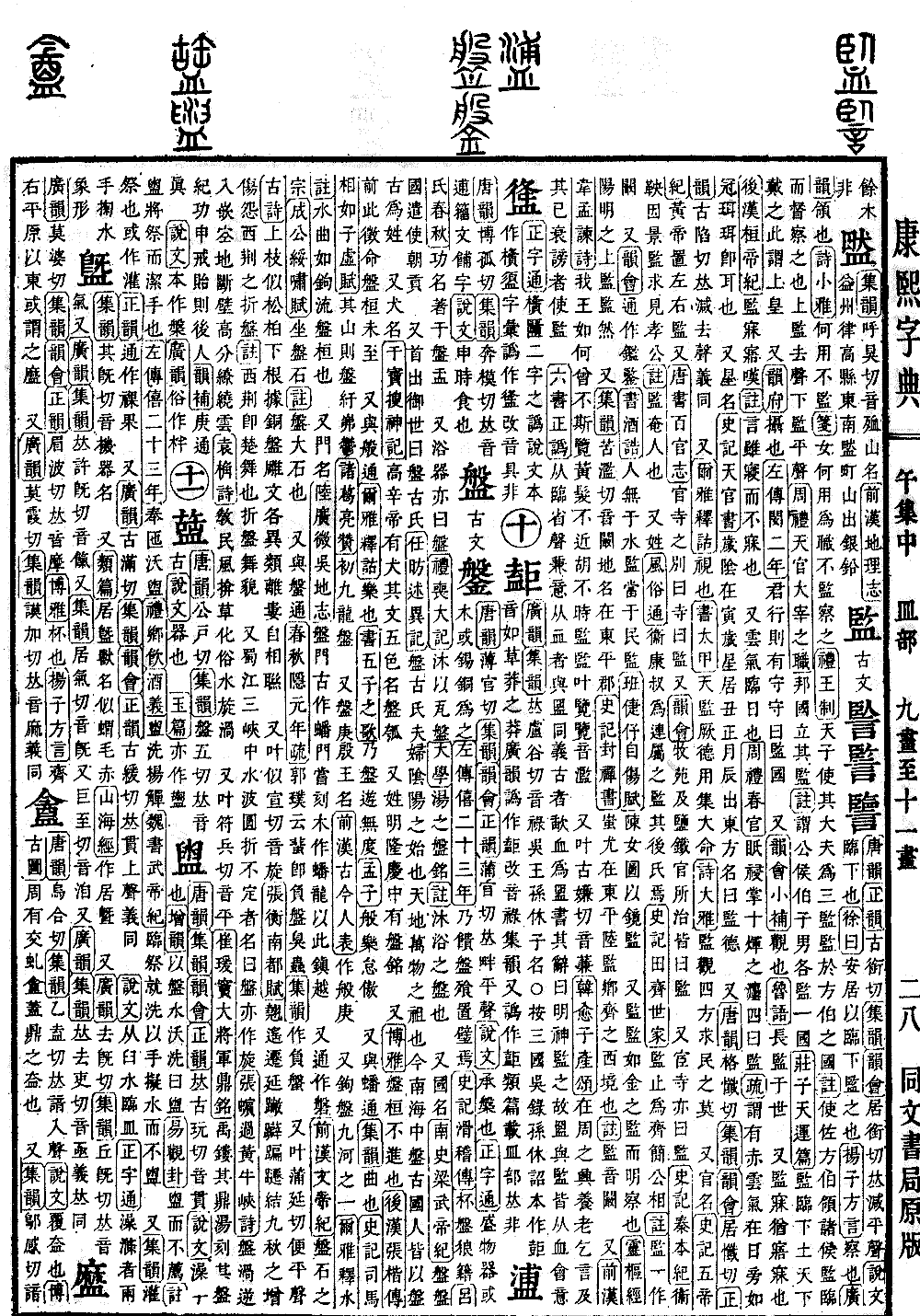
Wu Collection, Middle Volume. Radical: Vessel (mǐn). Kangxi strokes: 14. Page 796, Entry 02. Ancient form: Yan.
Pronounced jian (level tone). According to Tang Yun and Zheng Yun, it is pronounced xian; according to Jiyun and Yunhui, it is pronounced jian, level tone.
Shuowen Jiezi states it means to look down upon those below. Xu says it refers to residing securely to oversee those below, which is the meaning of monitoring.
Yangzi’s Dialects states it means to examine.
Guangyun states it means to lead.
Book of Odes (Shijing), Lesser Odes: Why would one not monitor? Commentary: Why are you in your position and not monitoring or examining?
Book of Rites (Liji), Royal Regulations: The Son of Heaven commands his ministers to be the three supervisors. They supervise the lands of the regional leaders. Commentary: They are commanded to assist the regional leaders, lead the various feudal lords, and supervise and inspect them.
The upper jian is in the departing tone; the lower jian is in the level tone.
Rites of Zhou (Zhouli), Offices of Heaven, Duties of the Grand Minister: The state establishes its supervisors. Commentary: This refers to the dukes, marquises, earls, viscounts, and barons, each supervising a state.
Zhuangzi, Heaven’s Operations chapter: Overseeing the land below, with the world honoring him, this is called the Supreme Emperor.
Also, according to Yunfu, it means to act as a regent.
Zuo Commentary (Zuozhuan), Min Year 2: When the ruler travels, there is a guardian; the guardian is called the supervisor of the state.
Also, according to Yunhui Xiaobu, it means to observe.
Discourses of Lu (Luyu): Long-term observation of the world.
Also, jian mei is similar to being awake or asleep.
History of the Later Han, Annals of Emperor Huan: Sleepless, sighing while awake. Commentary: This means that although he slept, he was not asleep.
Also, it refers to clouds obscuring the sun.
Rites of Zhou (Zhouli), Spring Offices: The Officer of Auspicious Signs manages the laws of the ten splendors; the fourth is called jian. Commentary: This refers to red cloud vapors at the side of the sun, like a cap or ear-ornament.
Also, the name of a star.
Records of the Grand Historian (Shiji), Treatise on the Celestial Offices: When the year-star is in Yin and the Jupiter-star is in Chou, it rises in the east in the first month; it is called the Virtue of Supervision.
Also, pronounced jian (departing tone). According to Tang Yun, it is pronounced ge chan; according to Jiyun and Yunhui, it is pronounced jian; according to Zheng Yun, it is pronounced gu xian. The meaning is the same.
Also, according to Erya, Explaining Words, it means to look.
Book of Documents (Shujing), Tai Jia: Heaven looks upon his virtue to gather the great mandate.
Book of Odes (Shijing), Greater Odes: Inspect and observe the four quarters to seek the tranquility of the people.
Also, an official title.
Records of the Grand Historian (Shiji), Annals of the Five Emperors: The Yellow Emperor appointed left and right supervisors.
Also, according to History of the Tang, Records of the Hundred Officials: The distinction between government offices includes temples and supervisorates.
Also, according to Yunhui, livestock farms and salt and iron offices are all called supervisorates.
Also, palace eunuchs are also called supervisors.
Records of the Grand Historian (Shiji), Annals of Qin: Wei Yang sought an audience with Duke Xiao through Jing Jian. Commentary: Jian is an eunuch.
Also, a surname.
Customs (Fengsu Tong): Wei Kangshu was the supervisor of the connective relations, and his descendants used it as a clan name.
Records of the Grand Historian (Shiji), Hereditary House of Tian Qi: Jian Zhi was the chancellor to the Duke of Qi. Commentary: Jian is sometimes written as Kan.
Also, according to Yunhui, it is commonly used interchangeably with mirror.
Book of Documents (Shujing), Announcement on Wine: People should not use water as a mirror; they should use the people as a mirror.
Ban Jieyu, Self-Sorrowing Ode: A woman uses a mirror for reflection.
Also, jian jian, like metal that is bright and observant.
Miraculous Pivot Scripture (Lingshu Jing): Above the Yangming, it is bright and observant.
Also, according to Jiyun, pronounced kan. A place name in Dongping commandery.
Records of the Grand Historian (Shiji), Treatise on Sacrifices to Heaven and Earth: Chiyou was at Lu Jian village in Dongping, in the western border of Qi. Commentary: Jian is pronounced kan.
Also, in the former Han, Wei Meng’s Admonition Poem: How is our king, not even glancing here? The gray-haired are not close; why not monitor at the right time? Jian rhymes with lan; lan is pronounced lan.
Also, rhymes with jian. Han Yu, Eulogy for Zichan: During the rise of Zhou, they supported the old and requested their words. When it became weak, the slanderers were allowed to supervise.
The Six Writings on Errors: It derives from the abbreviated sound of lin, with the meaning of jian. Using the blood character shares the same meaning. In ancient times, those who drank blood as a covenant wrote their vows saying: The bright spirits monitor this. Therefore, both xue and jian derive from blood, forming an ideographic compound.