Wei Collection, Lower Volume
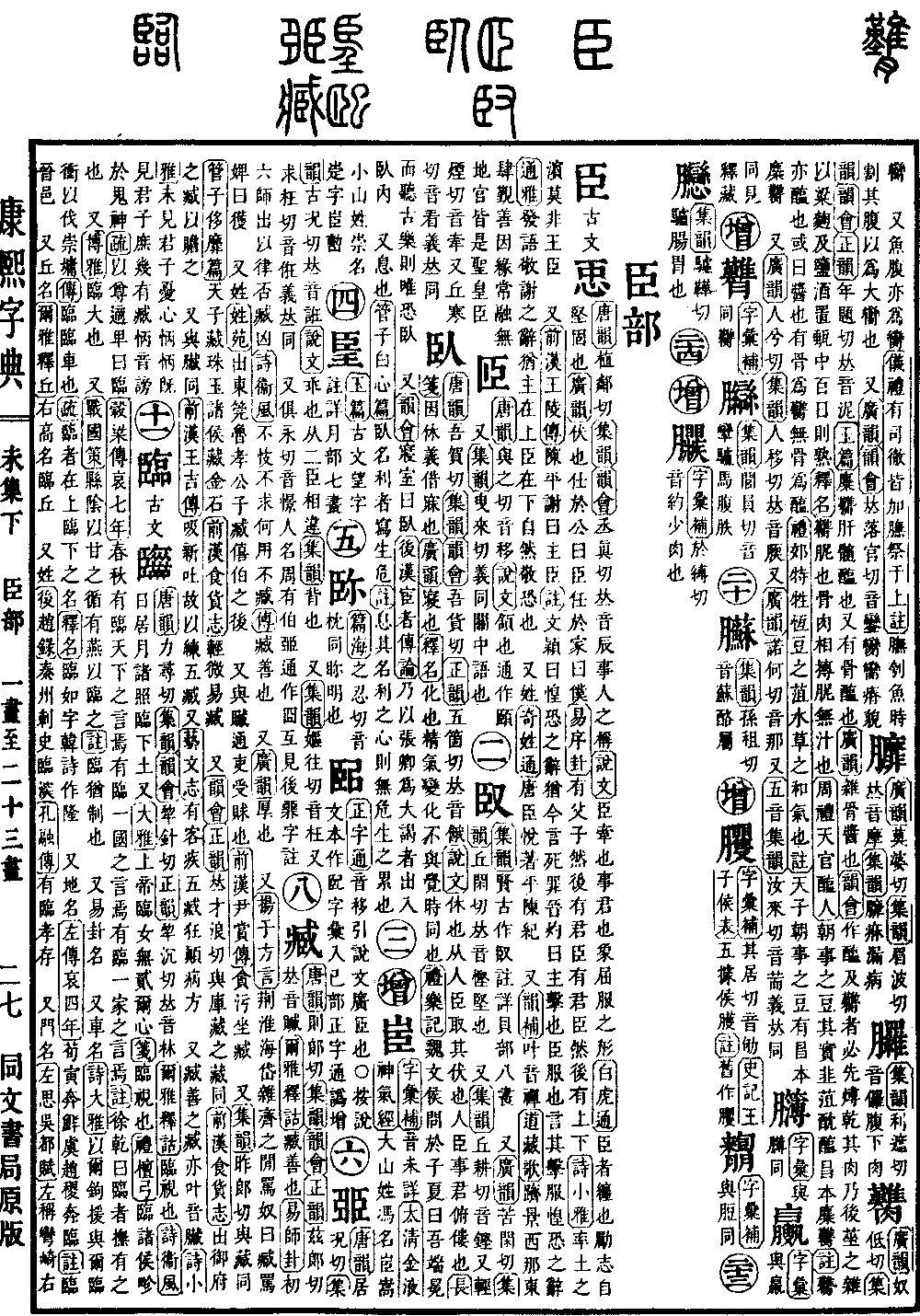
Radical: Minister (chén)
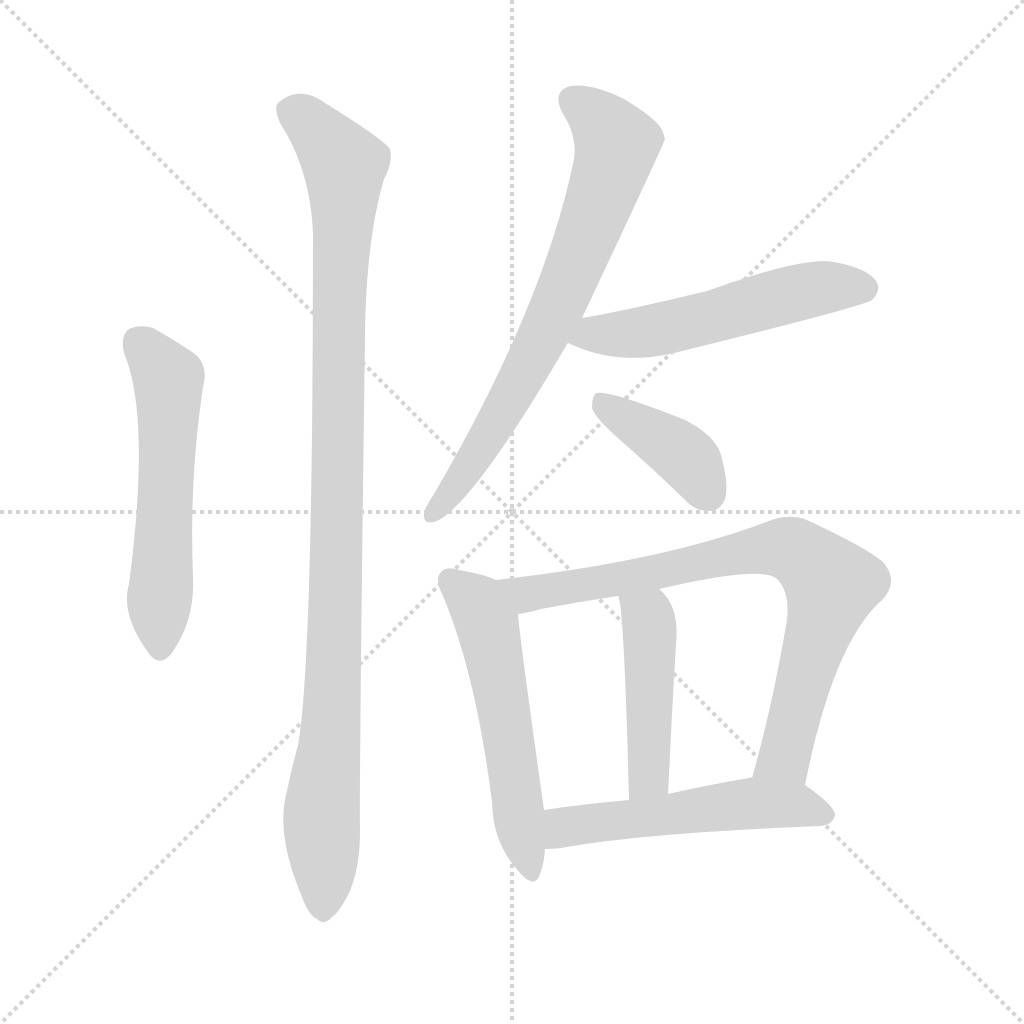
Lin
Kangxi Stroke Count: 17
Page: 999
Ancient form. Tang Dynasty Rhymes (Tangyun): li + xun = lín. Collected Rhymes (Jiyun), Rhyme Assembly (Yunhui): li + zhen = lín. Correct Rhymes (Zhengyun): li + chen = lín. Pronounced as lín.
Approaching the Refined (Erya): Lin means to look at or oversee.
Book of Odes (Shijing), Odes of Wei: O sun, O moon, which illuminate the earth below.
Also, Greater Elegantiae (Daya): God oversees you; do not have a double heart.
Commentary (Jian): Lin means to look at.
Book of Rites (Liji), Summary of the Rules of Propriety (Quli): When dealing with feudal lords, one must involve the ghosts and spirits.
Sub-commentary (Shu): Going from a position of honor is called lin.
Guliang Commentary (Guliang Zhuan), Seventh Year of Duke Ai: In the Spring and Autumn Annals (Chunqiu), there are sayings about governing the world, governing a state, and governing a family.
Note: Xu Qian says: Lin means to rule or govern.
Also, Refined Elegance (Boya): Lin means great.
Also, Strategies of the Warring States (Zhanguoce): Use gentle means to appease, and use the state of Yan to constrain.
Note: Lin is like the meaning of constraining.
Also the name of a hexagram in the Book of Changes (Yijing).
Also the name of a carriage.
Book of Odes (Shijing), Greater Elegantiae (Daya): With your scaling ladders and your siege engines, attack the walls of Chong.
Commentary (Zhuan): Lin refers to a siege carriage.
Sub-commentary (Shu): Lin is the name for looking down from above.
Explanation of Names (Shiming): Lin is read according to the character. In the Han version of the Odes (Hanshi), it is written as lóng.
Also a place name.
Zuo Commentary (Zuo Zhuan), Fourth Year of Duke Ai: Xun Yin fled to Xianyu, and Zhao Ji fled to Lin.
Note: Lin was a city in the state of Jin.
Also the name of a hill.
Approaching the Refined (Erya): A hill that is high on the right is called Linqiu.
Also a surname.
Records of the Later Zhao (Houzhao Lu): There was a Regional Inspector of Qinzhou named Lin Shen.
Biography of Kong Rong (Kong Rong Zhuan): There was a person named Lin Xiaocun.
Also the name of a gate.
Zuo Si, Rhapsody on the Capital of Wu (Wu Du Fu): On the left is Wanqi, on the right is Linxing.
Note: Wanqi and Linxing are names of palace gates. When the last ruler of Wu built the Zhaoming Palace, he opened two gates, Wanqi and Linxing, to the east of the Taichu Palace. Wanqi was the east gate, and Linxing was the west gate.
Also, Rhyme Assembly (Yunhui): li + zhen = lìn. Correct Rhymes (Zhengyun): li + jin = lìn. Pronounced as lìn in the departing tone.
Augmented Rhymes (Zengyun): Wailing at a funeral.
Yan Shigu says: Many people wailing together is called lin.
Zuo Commentary (Zuo Zhuan), Twelfth Year of Duke Xuan: The Viscount of Chu besieged Zheng for seventeen days. The people of Zheng divined for peace, but it was inauspicious. They divined for wailing in the ancestral temple and arranging war chariots in the streets, and it was auspicious.
Note: Lin means wailing.
Textual Explanations (Shiwen): Lin is read as lìn.
Also, Rhyme Supplement (Yunbu): Rhymes with lóng.
Book of Odes (Shijing), Greater Elegantiae (Daya): Hou Ji could not endure; God did not come to look upon him. The lower lands were destroyed; why have I met with this?
Sima Xiangru, Rhapsody on the Tall Gate (Changmen Fu): Holding empty words and hoping for sincerity; expecting him at the detached palace south of the city. Preparing simple food and setting it out myself; yet the King does not deign to visit.
Also rhymes with liáng.
Song of Qin Shi Huang Sacrificing at the Luo River: The waters of Luoyang are deep blue. Sacrificing to the Great Marsh, suddenly approaching from the south. Praying with wine by the Luo River, the radiance connects with the three lights.
Examination: In the Book of Rites (Liji), the section previously cited as Tan Gong is corrected to Summary of the Rules of Propriety (Quli). In the Rhapsody on the Tall Gate (Changmen Fu) by Sima Xiangru, the particle xi is corrected to hu.