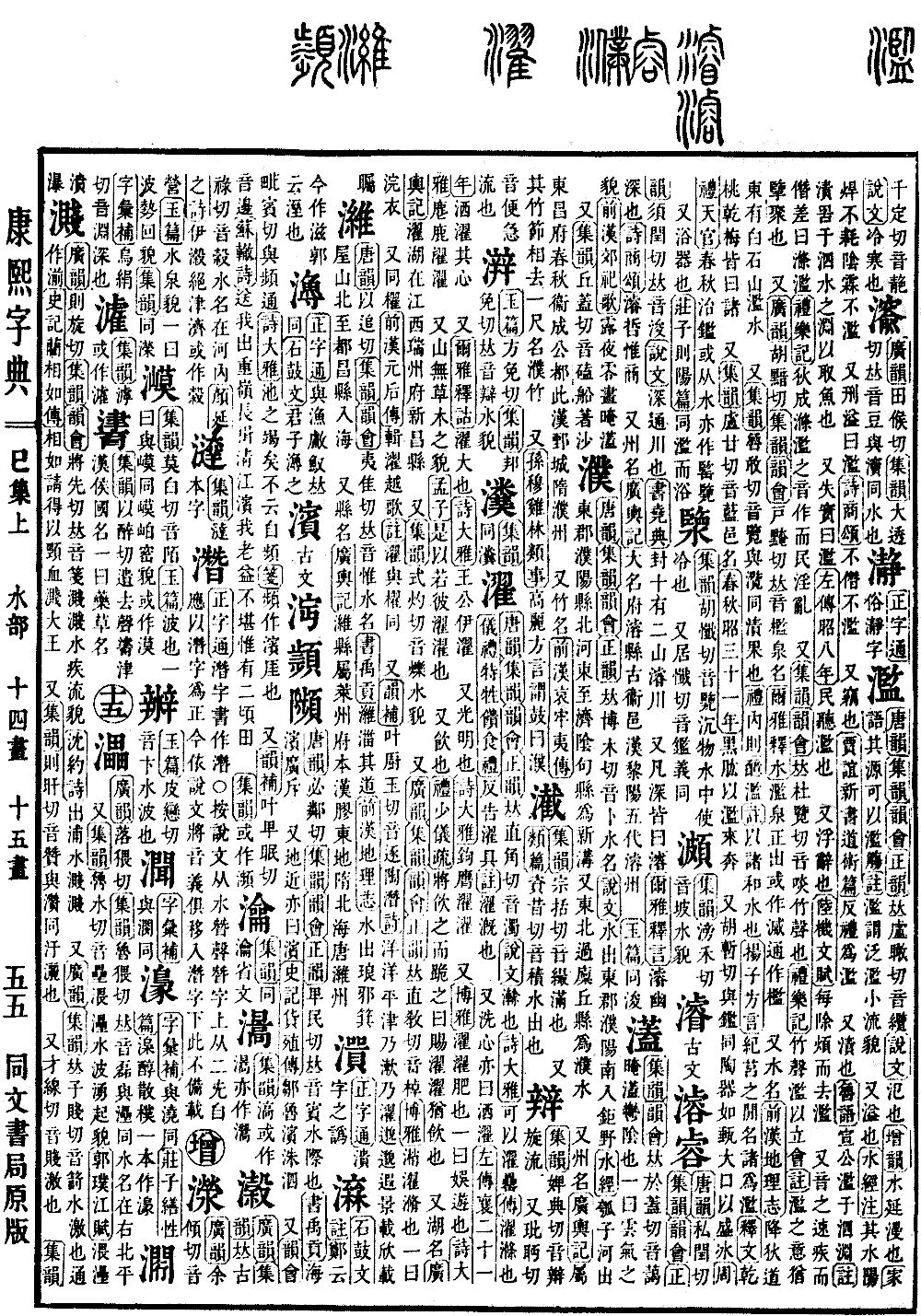
Si Collection, Upper Volume
Radical: Water (shuǐ)
Kangxi Strokes: 18
Page 657, Entry 01
Tang Rhyme (Tangyun), Collection Rhymes (Jiyun), Rhyme Meetings (Yunhui), Correct Rhymes (Zhengyun): Pronounced lan (falling tone).
Explaining Graphs (Shuowen): To overflow.
Added Rhymes (Zengyun): The spreading of water.
Family Sayings (Jiayu): Its source can be the start of a small flow.
Commentary: Lan refers to overflowing, the appearance of a small stream.
Also, to overflow.
Commentary on the Water Classic (Shuijingzhu): Its water does not deplete in a sunny drought, and it does not overflow during a cloudy deluge.
Also, to overflow is called lan.
Book of Odes (Shijing), Odes of Shang: Neither exceeding nor overflowing.
Also, to steal or usurp.
Jia Yi, New Book (Xinshu), Chapter on the Path and Arts: To turn against ritual is to be excessive.
Also, to soak.
Discourses of Lu (Luyu): Duke Xuan soaked his nets in the abyss of the Si River.
Commentary: Soaking nets in the deep water of the Si to catch fish.
Also, to lose reality is called lan.
Zuo Commentary (Zuozhuan), Eighth Year of Duke Zhao: The people's hearing is obscured.
Also, empty or flowery language.
Lu Ji, Rhapsody on Literature (Wenfu): Every time one removes the cumbersome and discards the excessive.
Also, music that is fast and lacking in discipline is called di-lan.
Book of Rites (Liji), Record of Music: The sounds of Di, Cheng, Di, and Lan arise, leading the people into dissipation and chaos.
Also, Jiyun and Yunhui: Pronounced dan (falling tone). The sound of bamboo.
Book of Rites (Liji), Record of Music: The sound of bamboo is lan-lan to establish the gathering.
Commentary: The meaning of lan is like gathering together.
Also, Guangyun: Pronounced han (falling tone). Jiyun and Yunhui: Pronounced han (falling tone). The name of a spring.
Erya, Explaining Water: The lan spring gushes straight out. Sometimes written as an alternative form. Commonly written as the character for cage (jian).
Also, the name of a river.
History of the Former Han (Qianhan), Treatise on Geography: In the east of Jiangdidao, there is White Stone Mountain and the Lan River.
Also, Jiyun: Pronounced lan (rising tone). The same as lan. To soak fruit.
Book of Rites (Liji), Inner Chapters: Beverages and soaked preparations.
Zheng Commentary: Lan uses various blended waters. Between the states of Ji and Ju, mixtures are called lan.
Explanation of Texts (Shiwen): Dried peaches and dried plums are both called zhu.
Also, Jiyun: Pronounced lan (level tone). The name of a town.
Spring and Autumn Annals (Chunqiu), Thirty-first Year of Duke Zhao: Heigong came to seek refuge with the territory of Lan.
Also, pronounced zan (falling tone). Same as the character for mirror (jian). An earthen vessel, like a bottle with a large mouth, used for storing ice.
Rites of Zhou (Zhouli), Offices of Heaven: In spring and autumn, manage the ice vessels. Sometimes written with the water radical; also written as an alternative form.
Also, a bathing vessel.
Zhuangzi, Section on Ze Yang: Bathe in the same basin.
Textual Research:
Book of Rites (Liji), Record of Music: The sound of bamboo is lan-lan to establish the gathering. Corrected according to the original text by adding the second lan character.
Book of Rites (Liji), Inner Chapters: Soaked preparations. Commentary: Uses various blended waters.
Yangzi, Dialect (Fangyan): Between the states of Ji and Ju, mixtures are called lan.
Note: The two sentences regarding the area between Ji and Ju appear in the commentary to the Inner Chapters, not in the Dialect. Corrected according to the original text to: Book of Rites (Liji), Inner Chapters, beverages and soaked preparations. Zheng Commentary: Lan uses various blended waters. Between the states of Ji and Ju, mixtures are called lan.