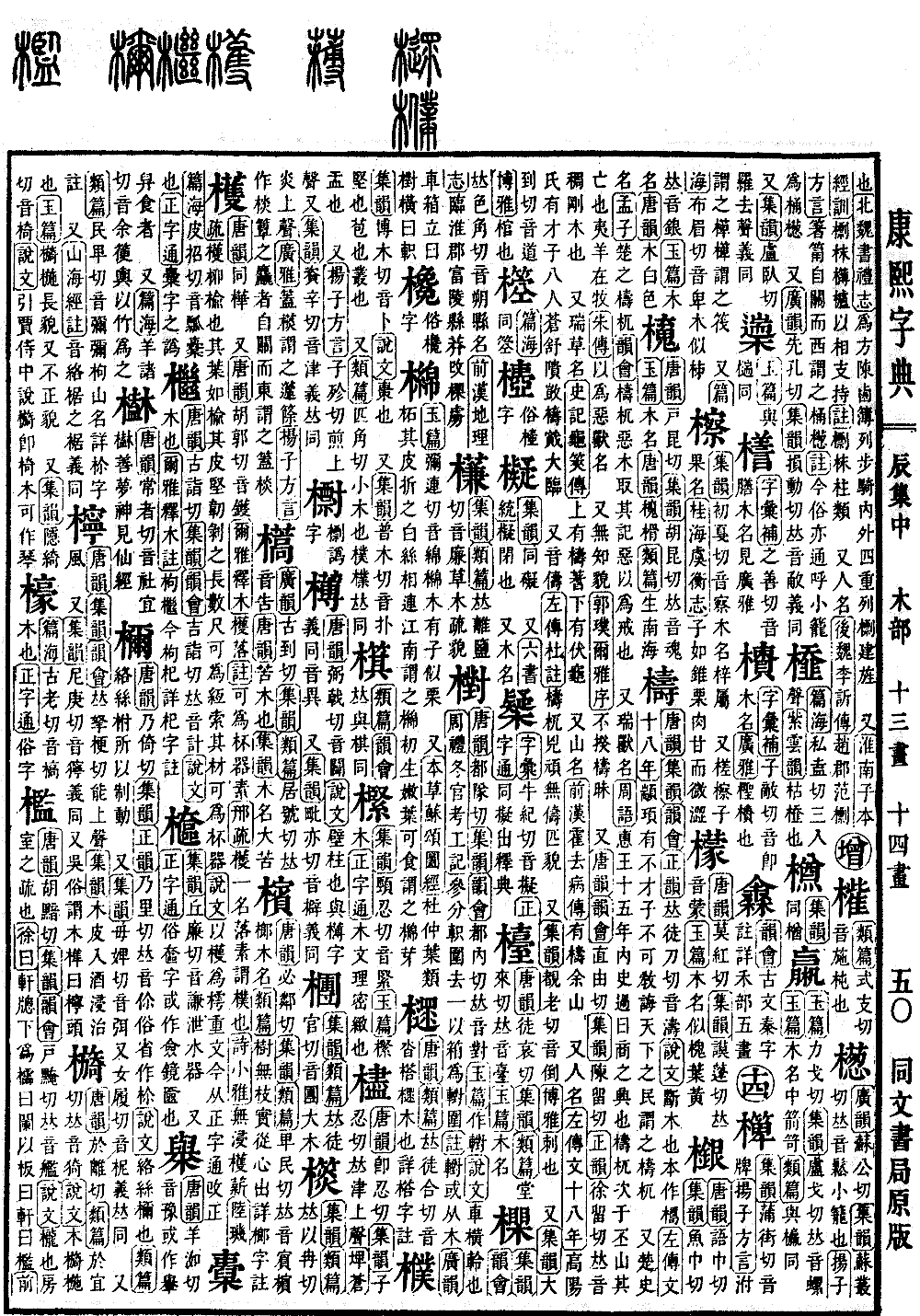
Chen Collection, Middle Volume
Radical: Tree (mù)
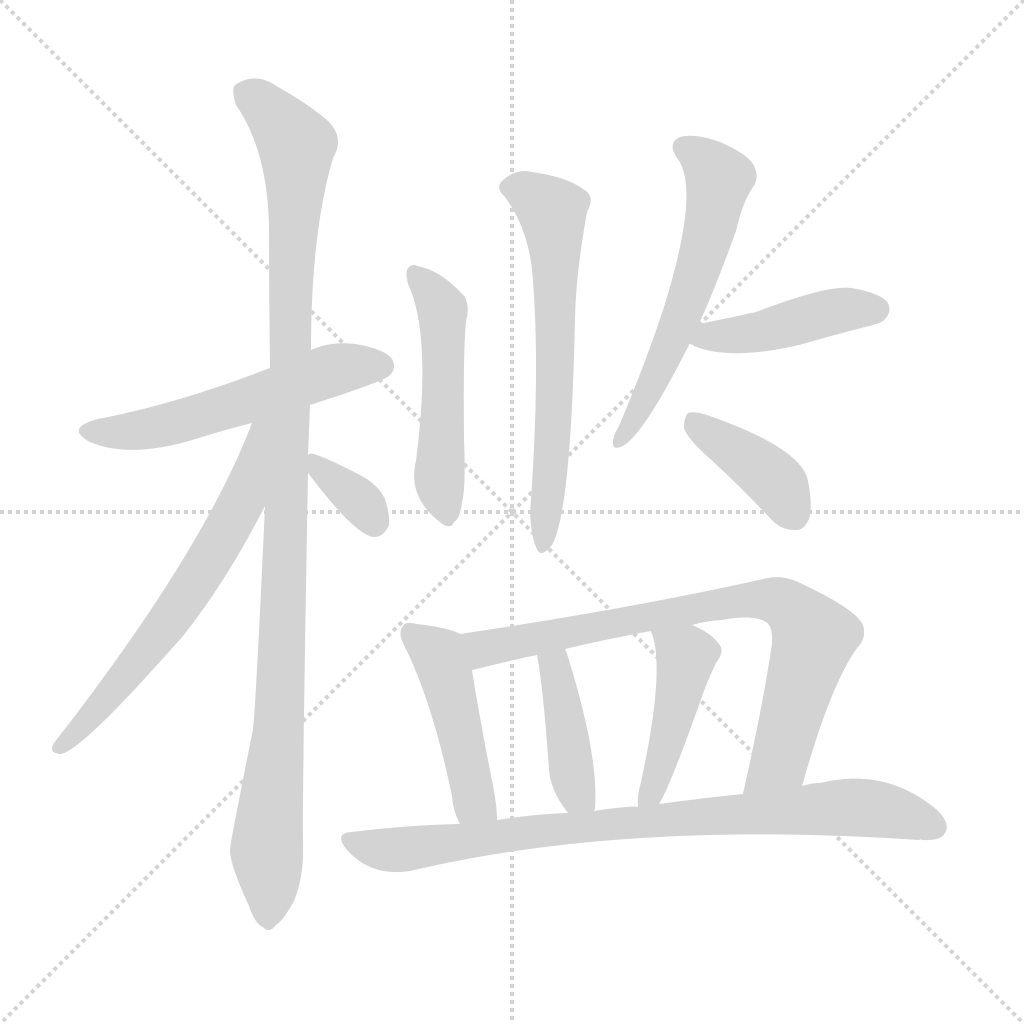
檻
Kangxi strokes: 18
Page 558, Entry 01
Pronounced jian (falling tone).
According to the Explaining Graphs and Analyzing Characters (Shuowen Jiezi), it refers to a trellis or the open, lattice-like structure of a room. Xu states that for a porch window, the lower portion with a trellis is called a lan, while the portion made with boards is called a xuan or a kan.
In the Biography of Zhu Yun in the Book of the Former Han (Qian Hanshu), it is written that he climbed the palace railing, and the railing broke. In the Western Capital Rhapsody (Xidu Fu) by Ban Gu, it is written that he leaned against the lattice railing.
According to the Jade Chapters (Yupian), it also refers to a balustrade. In the Summons for the Soul (Zhao Hun) in the Songs of Chu (Chuci), it is written: High halls and deep chambers, with balustrades and tiered porches. The commentary explains that vertical pieces are called kan, and horizontal pieces are called shun.
It also refers to a cage carriage. In the Biography of Chen Yu in the Book of the Former Han (Qian Hanshu), it is written that Guan Gao traveled to Chang'an in a cage carriage.
It also refers to an enclosure. Because enclosures are used to contain birds and beasts, they are called quan-kan (animal pens). In the Training in the Ruler's Art (Zhu Shu Xun) in the Huainanzi, it is written: Those who raise tigers, leopards, rhinoceroses, and elephants build pens and enclosures for them.
It also refers to the sound of a carriage in motion. In the Odes of Wang (Wangfeng) in the Book of Odes (Shijing), it is written: The great carriage rumbles (kan-kan).
It also refers to a spring flowing straight up, called a kan spring. In the Greater Odes (Daya) in the Book of Odes (Shijing), it is written: The bubbling kan spring.
It is also used interchangeably with lan. It refers to a bathing vessel. In the Ze Yang chapter of the Zhuangzi, it is written: Bathing in the same vessel. The commentary notes that one variant is written as lan.
According to the Standard Dictionary of Rhymes (Zhengyun), it has two pronunciations, one in the falling tone and one in the rising tone. The meaning of railing uses the falling tone, pronounced jian (falling tone). The meanings of the sound of a carriage and the kan spring use the rising tone, pronounced lan (rising tone).
It also rhymes with xing, dian (y sounds like xian). In the New Frost Poem by Ouyang Xiu, it is written: The banana trees and water chestnuts are not worth counting, their scattered remains only serve to soil the pool's edge. As the seasons cycle toward harvest and the year nears its end, ice and snow grow severe and gradually intensify.