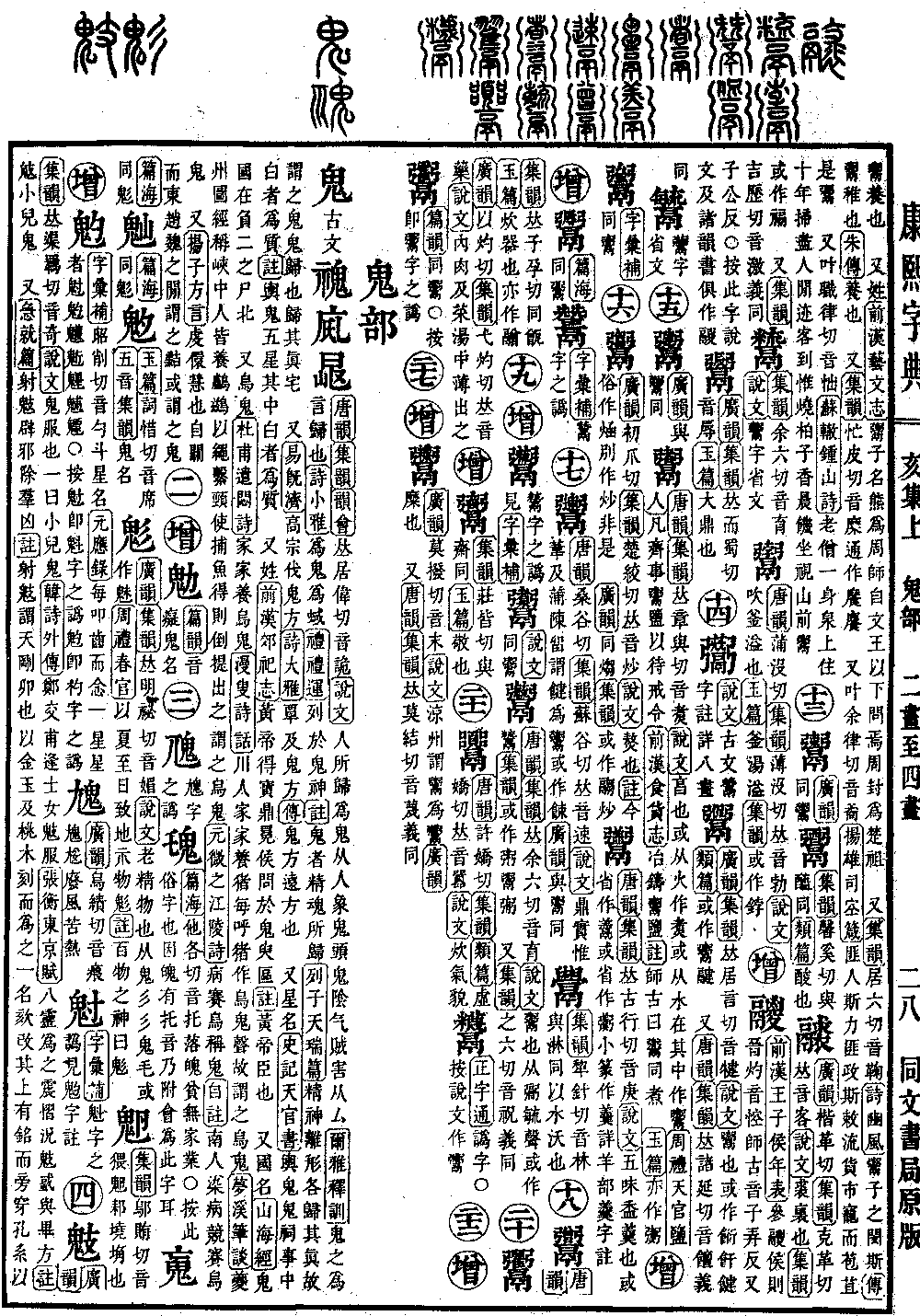
Hai Collection, Upper Volume
Radical: Ghost (guǐ)
Kangxi Dictionary stroke count: 10
Page 1460, Entry 30
Ancient phonology books record: Tangyun, Jiyun, and Yunhui all note the pronunciation as gui (third tone). Shuo Wen Jie Zi explains: The place to which one returns after death is called a ghost. The character form is composed of "person" and a component symbolizing a ghost's head. A ghost belongs to the yin qi and can harm people, which is why the character includes the component si. Erya (Shixun) states: The meaning of the character ghost is "to return." Book of Odes (Shijing), Xiaoya section, contains the line: "Becoming a ghost, becoming a yu." Book of Rites (Liji), Liyun section, mentions "listed among ghosts and spirits." The commentary explains: A ghost is the destination of the soul. Liezi (Tianrui) states: When the spirit leaves the physical form, each returns to its original state, thus they are called ghosts. Ghost means to return; it is returning to one's true abode.
Additionally, Book of Changes (Yijing), Jiji hexagram, contains "Gaozong attacked the Guifang." Book of Odes (Shijing), Daya section, contains "reaching as far as the Guifang." The commentary explains: Guifang refers to distant lands.
It is also the name of a constellation. Records of the Grand Historian (Shiji), Tianguan Shu, records: "The Yugui and Guici matters; the white one in the center is called Zhi." The commentary states: Yugui is a constellation composed of five stars, among which the white star is called Zhi.
It is also a surname. History of the Former Han (Qian Hanshu), Jiaosi Zhi, records: When the Yellow Emperor obtained the precious tripod, Mianhou consulted Gui Yuqu. The commentary states: Gui Yuqu was a minister to the Yellow Emperor.
It is also the name of a country. Classic of Mountains and Seas (Shanhaijing) records: The Ghost Country is located to the north of the corpse of Fu Er.
There is also the term "Black Ghost." Du Fu's Poem on Dispelling Melancholy contains "Every household raises black ghosts." Mansou Shihua states: Families in Sichuan raise pigs, and whenever they call the pigs, they make a sound like "black ghost," hence pigs are called black ghosts. Mengxi Bitan states: The Tu Jing of Kuizhou notes that people in the gorge regions all raise cormorants, tying their necks with strings to make them catch fish, and after they catch fish, they hold them upside down to retrieve the fish, calling them black ghosts. Yuan Weizhi's Jiangling poems contain "Sickness sacrifice to the black ghost." The author's own commentary states: Southerners, when afflicted with illness, compete to perform sacrifices to the black ghost.
Furthermore, Yangzi (Fangyan) records: Qian and Xuan mean intelligent. From the pass to the east, in the regions of Zhao and Wei, this is called xia, or also called ghost.