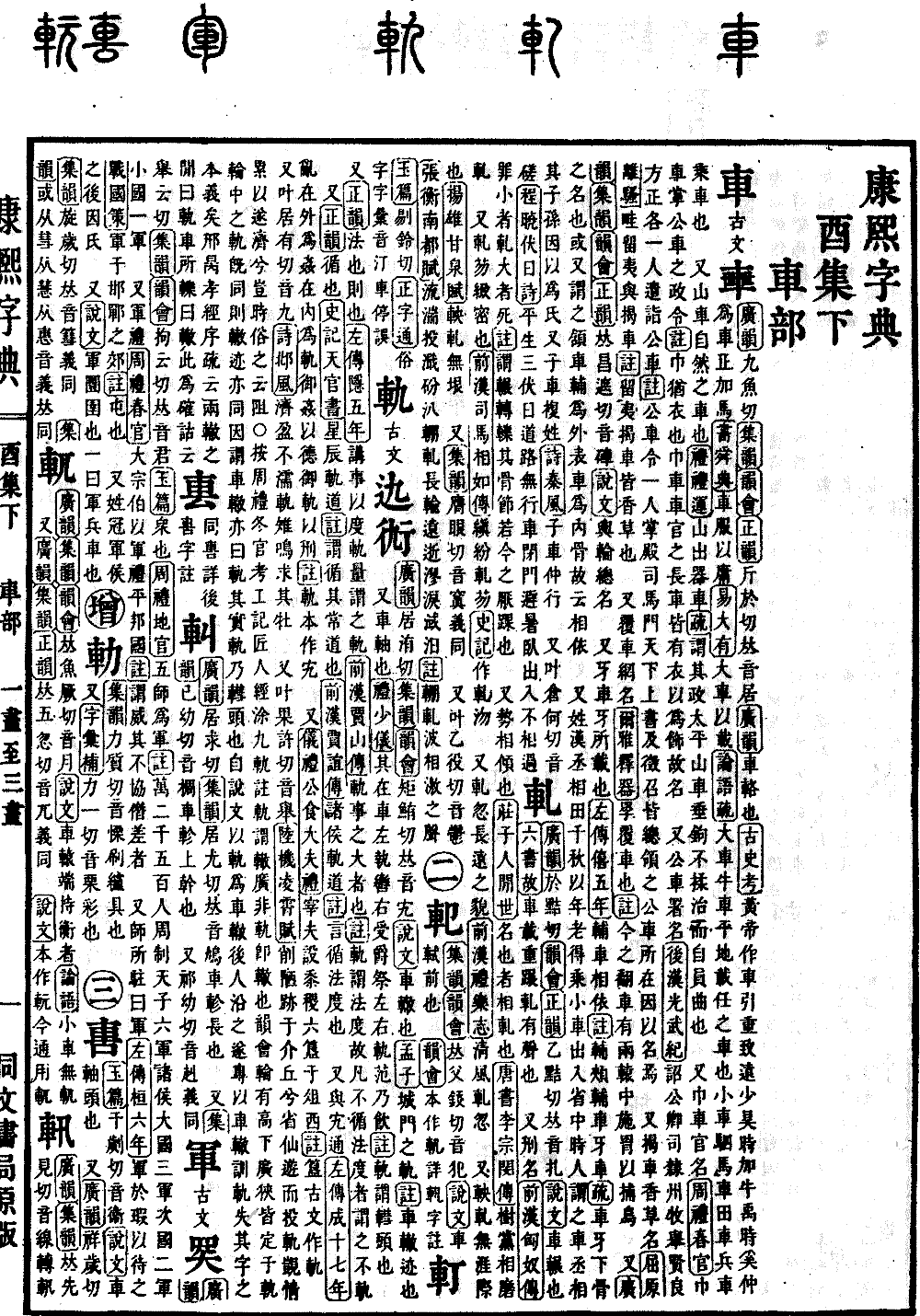
You Collection, Lower Volume
Radical: Carriage (chē)
Kangxi Strokes: 9
Page 1239, Entry 06
Ancient form. Broad Rhymes (Guangyun): Pronounced gui (rising tone). Collected Rhymes (Jiyun) and Rhymes Collection (Yunhui): Pronounced gui (rising tone).
Explaining Graphs and Analyzing Characters (Shuowen): The track of a carriage wheel.
Mencius (Mengzi): The carriage tracks at the city gate. Commentary: The trace of carriage wheels.
Also: The axle of a carriage.
Book of Rites (Liji), Shāoyí: When in the carriage, with the left hand hold the crossbar, with the right hand receive the wine cup, offer a sacrifice to the left and right wheel hubs (gui), then drink. Commentary: Gui refers to the ends of the axle (wèi).
Also: Standard Rhymes (Zhengyun): Law, rule, or model.
Zuo Commentary to the Spring and Autumn Annals (Zuo Zhuan), Year 5 of Yin: Organizing affairs according to established standards and measures is called gui.
History of the Former Han Dynasty (Qianhan), Biography of Jia Shan: Gui refers to the great matters of governance. Commentary: Gui refers to legal standards, therefore that which does not follow legal standards is called chaotic or lawless (bù guǐ).
Also: Standard Rhymes (Zhengyun): To follow or comply with.
Records of the Grand Historian (Shiji), Treatise on the Celestial Offices: The stars and celestial bodies have orbital paths. Commentary: This means they follow their regular paths.
History of the Former Han Dynasty (Qianhan), Biography of Jia Yi: The feudal lords follow the path (gui dào). Commentary: This means to follow the legal standards.
Also: Interchangeable with gui (evil/rebellious).
Zuo Commentary to the Spring and Autumn Annals (Zuo Zhuan), Year 17 of Cheng: Disorder from the outside is called criminal (jiān), and disorder from the inside is called rebellious (gui). Repel the criminal with virtue, repel the rebellious with... Commentary: Gui was originally written as the character for evil/rebellious (guǐ).
Also: Book of Etiquette and Ceremonial (Yili), Official Presentation of Food: The presiding official sets out six millet containers (guǐ) on the west side of the offering stand. Commentary: The character guǐ is written as gui in the ancient script.
Also: Rhyming with pronunciation jiu (rising tone).
Book of Odes (Shijing), Odes of Bei: The crossing is full but does not wet the axle; the pheasant cries seeking its mate.
Also: Rhyming with pronunciation ju (rising tone).
Lu Ji, Rhapsody on Scaling the Heavens (Lingxiao Fu): Cutting away base tracks at Jieqiu, I relinquish immortal travels and cast off my course. Hoping that worldly attachments will be resolved and I shall be saved, how could the common customs hinder me.
Note: In the Rites of Zhou, Winter Officials, Artificers' Record (Zhouli Kaogongji Jiangren): The main road is nine carriage widths wide. Commentary: Gui refers to the width of the tracks, which is incorrect. Gui is simply the tracks. The Rhymes Collection (Yunhui) states: The height and width of wheels are all determined by the axle. Since the axles within the wheels are the same, the tracks made by the wheels are also the same, thus the tracks are also called gui. In reality, gui refers to the ends of the axle. Since the Explaining Graphs and Analyzing Characters (Shuowen) defined gui as wheel tracks, later generations followed this, and eventually, the character was used exclusively to mean wheel tracks, losing its original meaning. The commentary by Xing Bing on the Preface to the Classic of Filial Piety (Xiaojing Xu) states: The space between the two wheel tracks is called gui, and what the wheels crush is called the track (zhè). This is the precise definition.