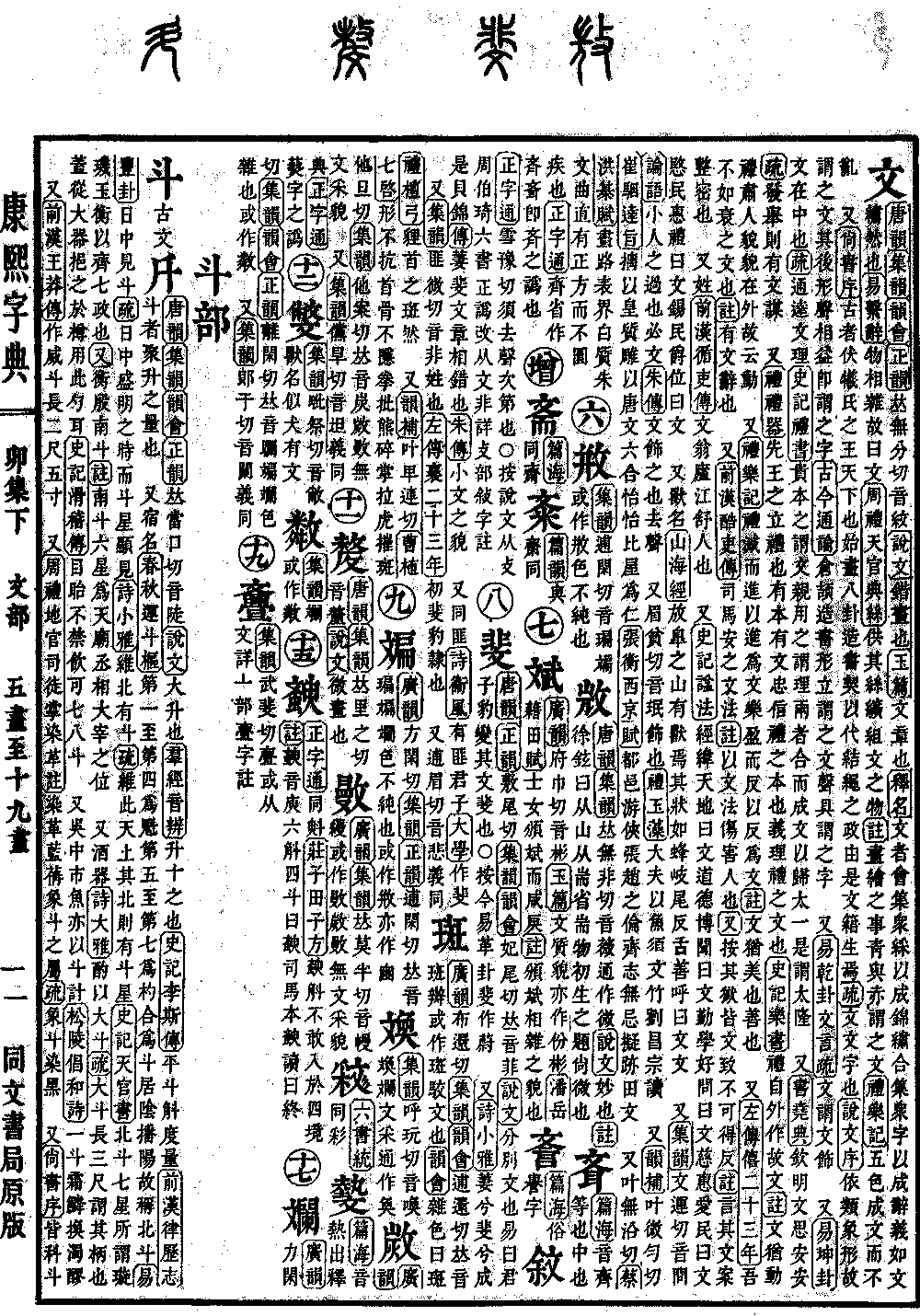
Mao Collection, Lower Volume
Radical: Dipper (dǒu)
Page 477, Entry 24
According to ancient phonetic dictionaries Tangyun (Tangyun), Jiyun (Jiyun), Yunhui (Yunhui), and Zhengyun (Zhengyun), the pronunciation is dang, which sounds the same as dou (steep). Shuowen Jiezi (Shuowen Jiezi) defines it as a large sheng (a unit of volume). Qunjing Yinbian (Qunjing Yinbian) states that it is a measure of ten sheng. Records of the Grand Historian (Shiji), Biography of Li Si, records the standardization of dou, hu, du, and liang (measures of volume, length, and weight). Book of Han (Hanshu), Treatise on Harmonics and Calendars, states that the dou is a unit of volume for collecting sheng.
It is also the name of a constellation. Chunqiu Yundoushu (Chunqiu Yundoushu) states that the first through fourth stars are called Kui, and the fifth through seventh are called Biao; collectively, they are called the Dou (Dipper). Because it occupies the yin position while disseminating yang energy, it is called the Northern Dipper. Book of Changes (Yijing), Hexagram Feng, contains the phrase, "At midday, the Dipper is seen." The Commentary (Shu) explains that even when the sun is at its most intense at noon, the Dipper constellation remains visible. Book of Odes (Shijing), Xiaoya, contains the phrase, "Only in the north is there a Dipper." The Commentary explains that in that part of the heavens, there is a Dipper constellation. Records of the Grand Historian, Treatise on the Celestial Offices, states that the seven stars of the Northern Dipper are those used to adjust the seven political affairs by means of the jade-adorned astronomical instruments. It further notes that the Heng star corresponds to the Southern Dipper. The Note (Zhu) explains that the six stars of the Southern Dipper are the heavenly temple, symbolizing the positions of the Prime Minister and Grand Minister.
It also refers to a wine vessel. Book of Odes, Daya, contains the phrase, "Ladled with a large dou." The Commentary explains that the large dou is three feet long, referring to its handle. It is likely a ladle used to transfer wine from a large container into a ritual wine vessel. Records of the Grand Historian, Biographies of the Jesters, mentions staring fixedly and being able to drink seven or eight dou of wine.
Furthermore, in the Wu region, fish is sold using the dou as a unit of calculation. Songling Changhe Shi (Songling Changhe Shi) contains the line, "One dou of frosty scales exchanged for turbid ale."
There is also a record in the Book of Han, Biography of Wang Mang, regarding the creation of a weapon called the Wei Dou, which was two feet and five inches long.
In addition, the Rites of Zhou (Zhouli), Earthly Offices, Preface to Official Duties, Note, mentions plants used for dyeing such as indigo, madder, and the xiang dou. The Commentary explains that the xiang dou is used to dye materials black.
The Preface to the Book of Documents (Shangshu Xu) refers to "tadpole characters." The Commentary explains that the tadpole is the name of an insect, and the script forms resemble it.
Records of the Grand Historian, Treatise on the Imperial Sacrifices, mentions Mount Cheng extending sharply into the sea. The Note explains that this describes the rugged and winding way the mountain enters the sea.
Han Yu, in his poem Responding to Zhang Eleven, uses the phrase, "I realize the frosted hair has increased by half."
According to Jiyun (Jiyun) and Zhengyun (Zhengyun), another pronunciation is zhong, which sounds the same as zhu. The character dou is sometimes written as a simplified form of dou. It refers to a ladle. The Rites of Zhou, Spring Offices, Record of the Sacrificial Wine Officer, mentions that for the Great Funeral rites, a dou must be provided during the great cleansing ceremony. The Note says it is used for pouring water to wash a corpse. The Explanatory Text (Shiwen) says the character dou, according to the Note, is pronounced zhu.
Verification: Rites of Zhou, Earthly Offices, Record of the Ministry of Education, Note, mentions plants used for dyeing such as indigo, madder, and the xiang dou. Corrected with caution to change Ministry of Education to Preface to Official Duties, and replaced both instances of the character for leather with the character for grass.