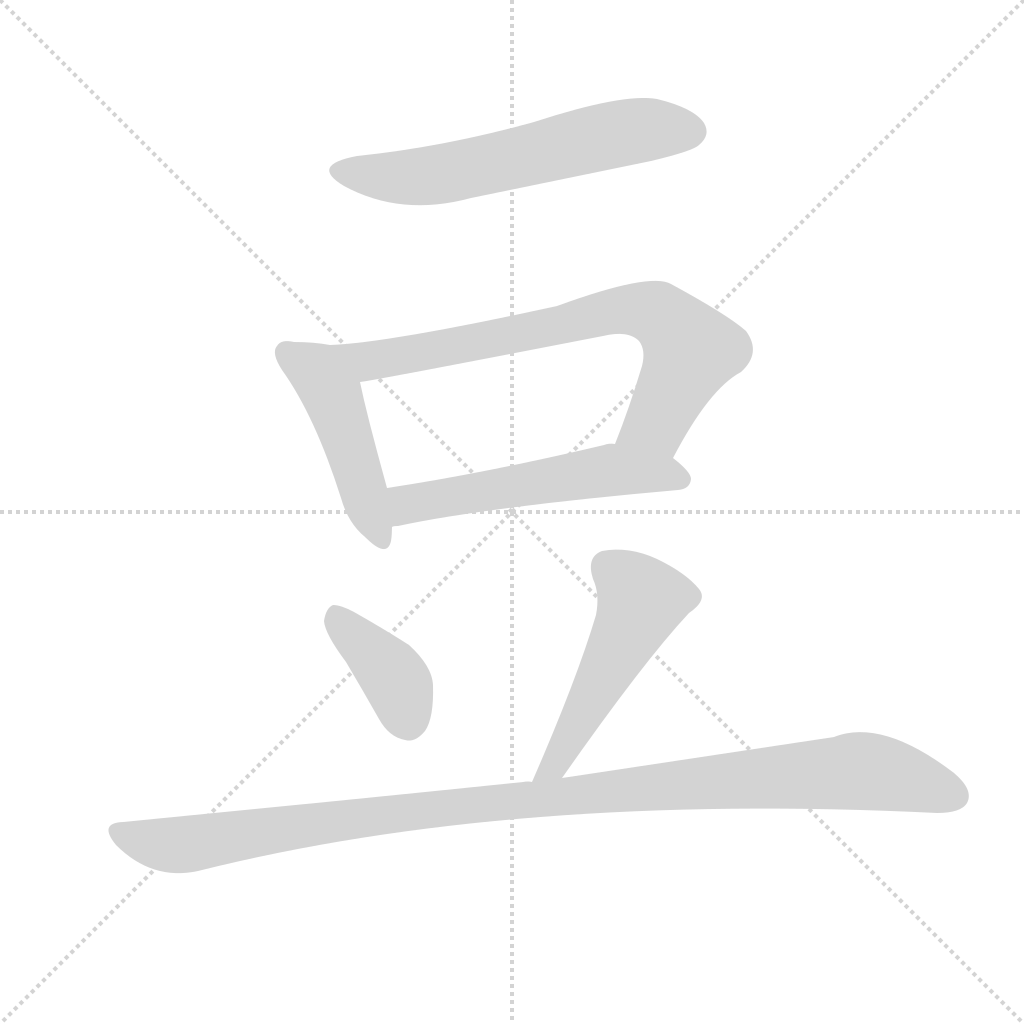
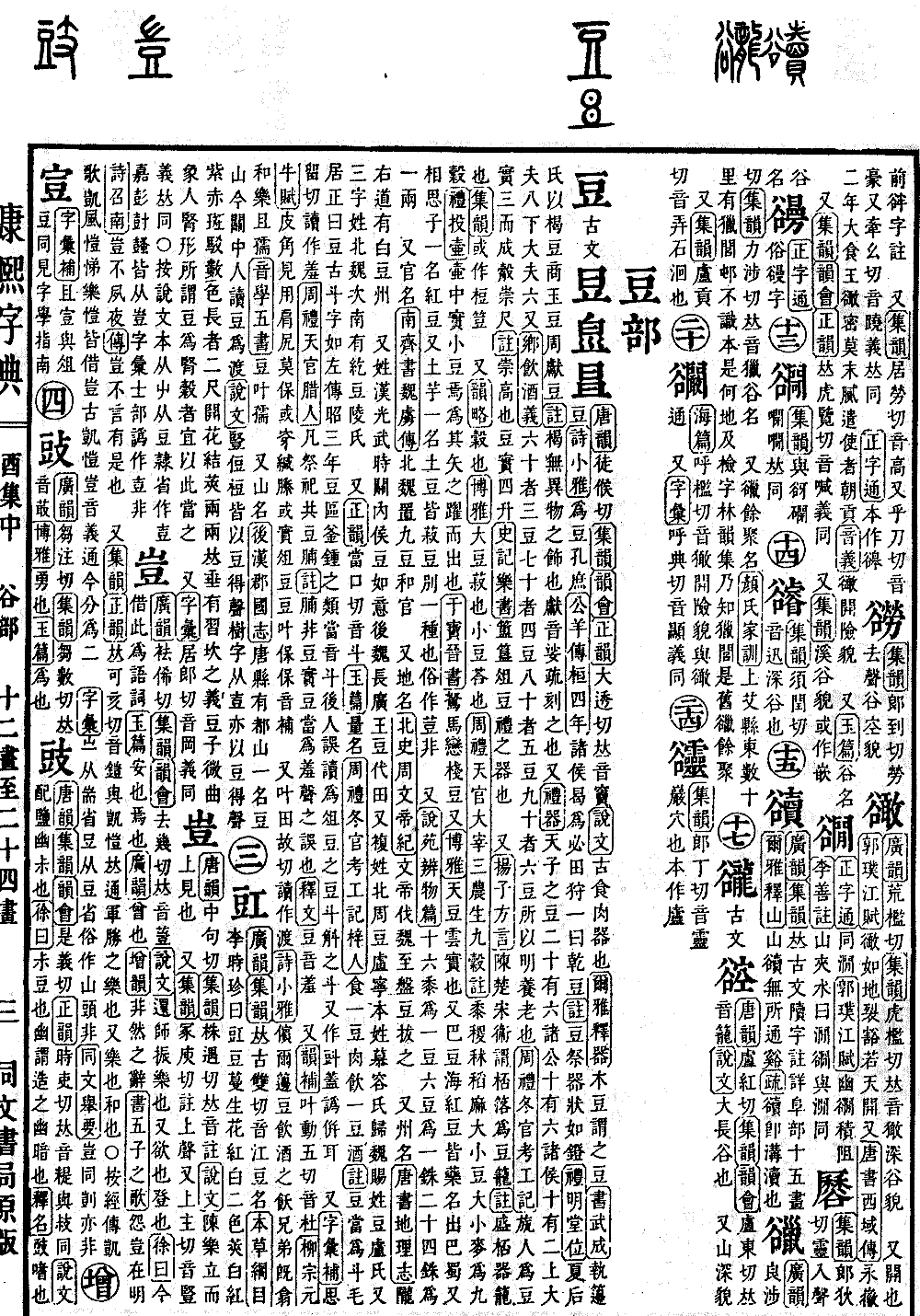
You Collection, Middle Volume. Radical: Bean (dòu). Kangxi brush strokes: 7. Page 1191, Entry 14.
Ancient form. Pronounced dou.
Shuowen Jiezi (Explanation of Writing and Analysis of Characters): An ancient vessel for serving meat.
Erya (Approaching Elegance/Shier): A wooden vessel is called a dou.
Book of Documents (Shangshu), Chapter on Military Completion (Wucheng): Holding the dou and bian (bamboo baskets).
Book of Odes (Shijing), Lesser Odes of the Kingdom (Xiaoya): The dou are very numerous.
Gongyang Commentary (Gongyang Zhuan) on the Annals of Spring and Autumn (Chunqiu), Duke Huan, Year 4: Why must the feudal lords engage in hunting? One reason is to provide dried meat for the dou. Commentary: The dou is a sacrificial vessel shaped like a lamp.
Book of Rites (Liji), The King's Hall (Mingtangwei): The Xia dynasty used unadorned dou, the Shang dynasty used jade dou, and the Zhou dynasty used献 (xian) dou. Commentary: The unadorned dou has no decorative attachments. Xian is pronounced suo, referring to vessels with carved patterns.
Also, in Ritual Vessels: The Son of Heaven uses twenty-six dou, dukes use sixteen, feudal lords use twelve, high officials use eight, and lower officials use six.
Also, in The Meaning of the Banquet for Local Officials (Xiangyinjiuyi): Those aged sixty are served three dou, seventy are served four, eighty are served five, and ninety are served six, as a way to show respect for the elderly.
Rites of Zhou (Zhouli), Winter Bureau of the Record of Trades (Kaogongji): The potter makes dou, which when filled measure three to reach a hu (a unit of capacity), standing one foot high. Commentary: Chong means height. A dou holds four sheng.
Records of the Grand Historian (Shiji), Treatise on Music (Yueshu): The fu, gui, zu, and dou are the vessels of ritual.
Yang Xiong’s Dialects (Fangyan): In the states of Chu, Song, and Wei, a cup is called a dou long. Commentary: A cage for holding cups.
Jiyun (Collection of Rhymes): Sometimes written as a variant form (tu).
Yunlue (Abbreviated Rhymes): Refers to grain.
Boya (Broad Refinements): Large beans are called shu; small beans are called da.
Rites of Zhou (Zhouli), Office of the Grand Minister (Dazai): The three categories of farming produce the nine grains. Commentary: Millet, broomcorn millet, glutinous millet, rice, hemp, large and small beans, and large and small wheat constitute the nine grains.
Book of Rites (Liji), Pitch-Pot (Touhu): Small beans are placed inside the pot so that when an arrow hits, they jump out.
Gan Bao’s History of the Jin Dynasty (Jinshu): A tired horse yearns for the stable beans.
Boya (Broad Refinements): Heavenly beans are called cloud fruit.
Also, the bado bean and sea red bean are both names of medicinal plants originating from the Ba and Shu regions.
Also, the love-seed is another name for the red bean.
Also, the earth yam is another name for the earth bean (potato). These are all distinct types of beans. The popular usage writing it with the bean radical on the right is incorrect.
Also, in Garden of Stories (Shuoyuan), Chapter on Distinguishing Things (Bianwu): Sixteen grains of millet make one dou, six dou make one zhu, and twenty-four zhu make one liang.
Also, a title for an official. In the History of Southern Qi (Nanqishu), Biography of Northern Barbarians: The Northern Wei established the Nine Dou Peace Official.
Also, a place name. In the Book of Northern Qi (Beishu), Biography of Emperor Wen of Zhou: When Emperor Wen attacked Wei, he reached Pandou and captured it.
Also, a prefecture name. In the Book of Tang (Tangshu), Treatise on Geography: There was a White Bean Prefecture in the Longyou Circuit.
Also, a surname. During the reign of Emperor Guangwu of Han, the Guan-Nei Marquis Dou Ruyi existed. In the Northern Wei, the Prince of Changguang was named Dou Daitian.
Also, a double-character surname. During the Northern Zhou, Dou Lu-ning originally had the surname Murong; upon returning to Wei, he was granted the surname Dou Lu.
Also, a three-character surname. In the Northern Wei, there was the He Dou-ling family.
Also, Zheng Yun (Correct Rhymes): Pronounced dou.
Yupian (Jade Lexicon): A unit of measure.
Rites of Zhou (Zhouli), Winter Bureau of the Record of Trades (Kaogongji), Chapter on Craftsmen (Ziren): Eat one dou of meat, drink one dou of wine. Commentary: Dou should here be read as dou (a measure). Mao Juzheng states: The dou is an ancient character for the measure dou. In cases like the Annals of Zuo (Zuozhuan), Year 3 of Duke Zhao, referring to a dou, a qu, a fu, and a zhong, it should be pronounced dou. Later people mistakenly read it as the dou for meat-serving vessels. The character for the dou/hu measure was also written with a different character, but this is a mistaken merger.
Also, in Zihui Bu (Supplement to the Collection of Characters): Pronounced xiu.
Rites of Zhou (Zhouli), Office of the Heaven (Daguan), Chapter on the Dried Meat Official (Laren): For all sacrifices, provide dou and dried meat. Commentary: Dried meat is not the content of a dou; dou should be xiu (delicacy), a mistake in sound.
Shuowen (Explication of Text): Dou is pronounced xiu.
Yunbu (Rhyme Supplements): Rhymes with the sound du.
Liu Zongyuan, Ode to the Ox (Niu Fu): Its skin and horns are utilized, its shoulders and rump cannot be preserved. Sometimes pierced with cords, sometimes filled with sacrificial vessels. The word dou rhymes with bao, where bao is pronounced bu.
Also rhymes with the sound du.
Book of Odes (Shijing), Lesser Odes of the Kingdom (Xiaoya): Presenting your bian and dou, drinking wine to one's fill. The brothers are all gathered, harmonious and happy like children. The Yinxue Wushu (Five Books on the Study of Sounds) notes that dou rhymes with ru.
Also, a mountain name. In the Book of the Later Han (Houhanshu), Treatise on Commandery and States: Tang County has Du Mountain, also called Dou Mountain. Today, the people of the Guanzhong region read dou as du.
Shuowen (Explication of Text): The characters for vertical, stand, and small garments all derive their phonetic from dou. The character for tree contains the component dou, which also acts as a phonetic.