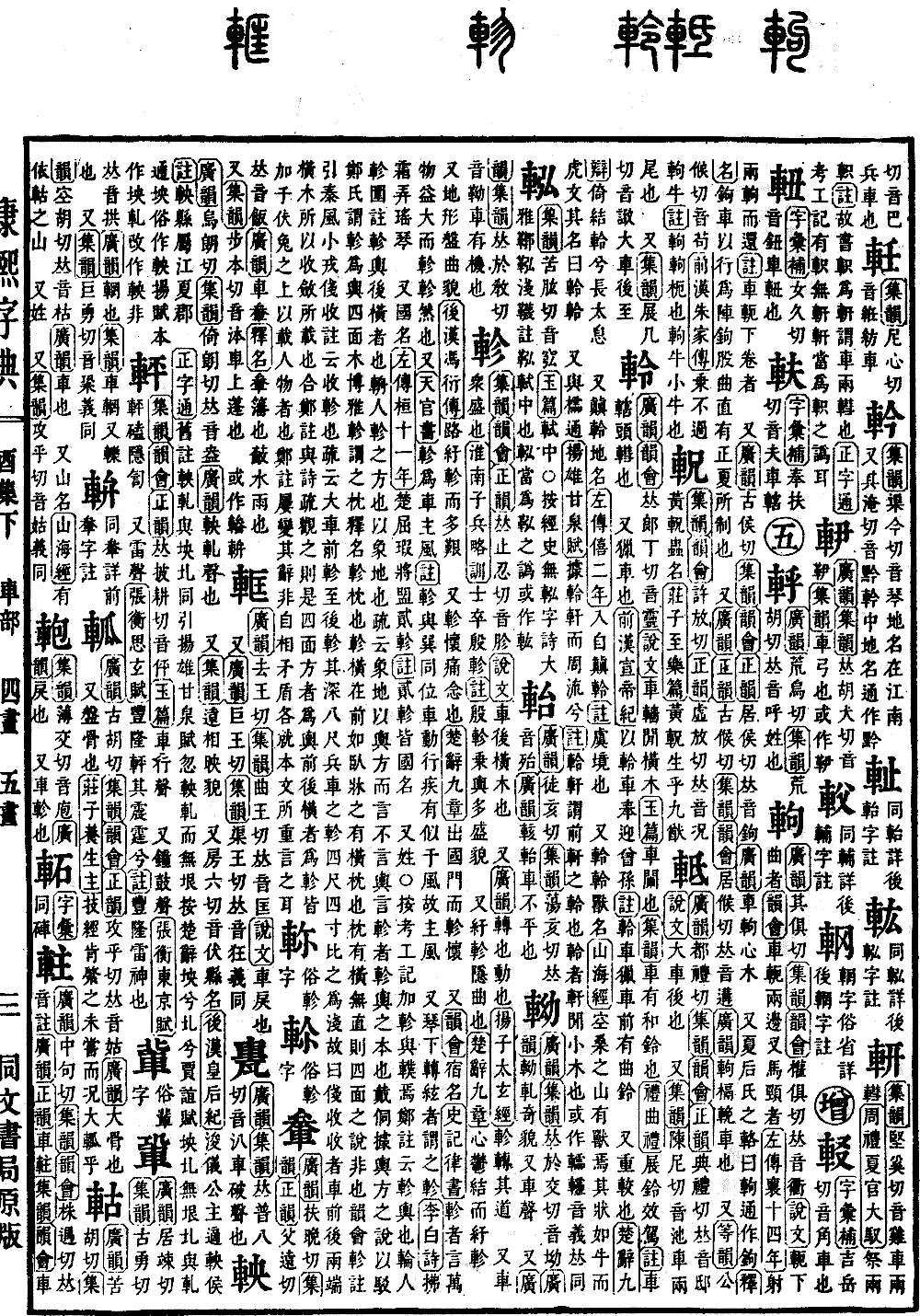
You Collection, Lower Volume
Radical: Carriage (chē)
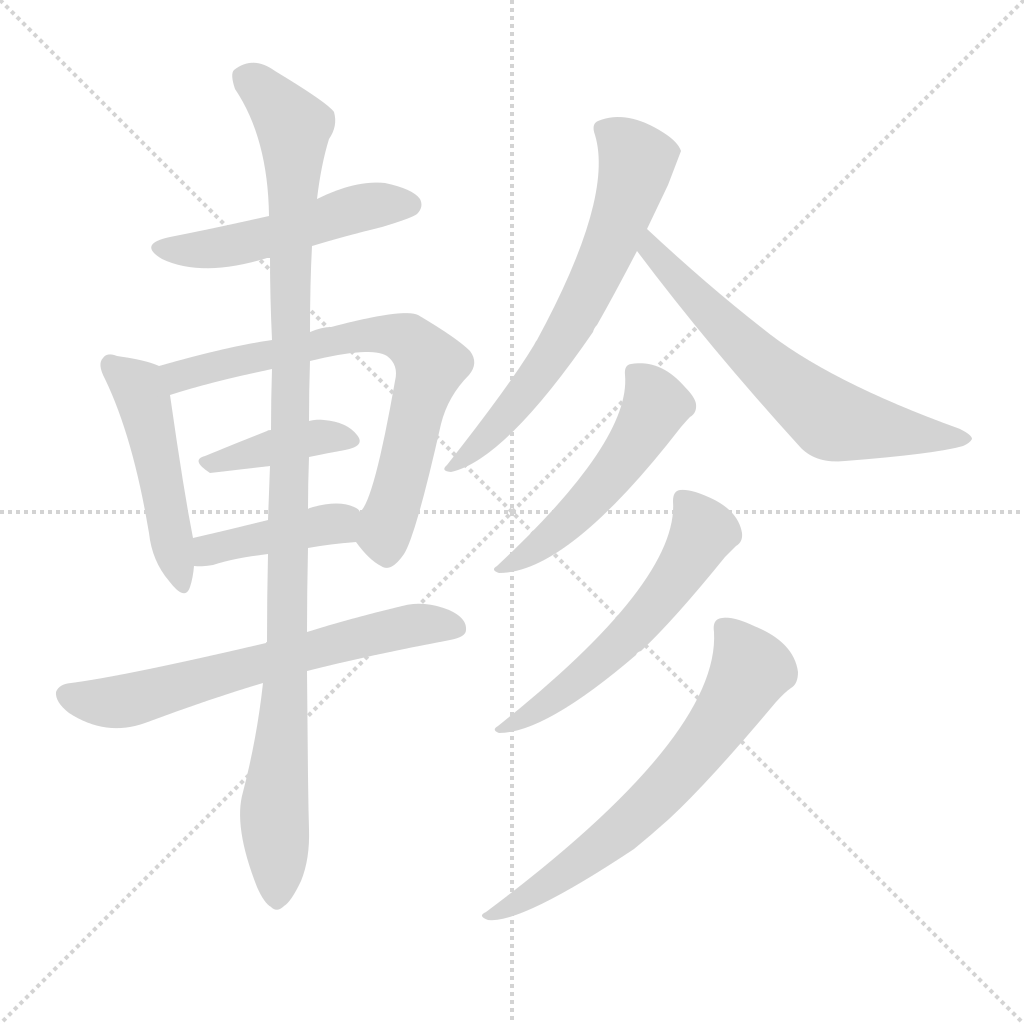
Zhen
Kangxi radical strokes: 12
Page 1241, Entry 20
Pronounced zhen (rising tone) according to Collection of Rhymes (Jiyun), Rhyme Compilation (Yunhui), and Orthodox Rhymes (Zhengyun). In the Explaining Graphs and Analyzing Characters (Shuowen), it refers to the horizontal wood at the rear of a carriage.
According to Broad Rhymes (Guangyun), it carries the meaning of rotating or moving.
In the Great Mystery (Taixuanjing) by Yangzi, it refers to roads winding and changing.
It also describes a large quantity and grandeur of vehicles. In the Military Strategy (Binglue Xun) of the Huainan Masters (Huainanzi), it describes soldiers and carriages as numerous and grand. The commentary notes that the term signifies the prosperous appearance of carriages and horses.
It also refers to that which is circuitous, winding, hidden, and profound. In the Nine Chapters (Jiuzhang) of the Songs of Chu (Chuci), it describes a heart filled with repressed, winding, and sorrowful emotions.
It also describes terrain that is winding and twisting. In the Biography of Feng Yan from the History of the Later Han (Houhan Shu), it describes roads that are winding and difficult.
It also refers to sorrowful yearning. In the Nine Chapters of the Songs of Chu, it describes exiting the city gates of the capital and feeling sorrowful yearning.
According to the Rhyme Compilation (Yunhui), it is the name of a lunar mansion. In the Records of the Grand Historian (Shiji), Law Treatise (Lüshu), it states that the Zhen Mansion represents the state where all things become more robust and prosperous. In the Treatise on the Celestial Offices (Tianguan Shu), it states that the Zhen Mansion symbolizes a carriage and governs the wind. The commentary notes that because the Zhen Mansion shares the same directional orientation as the Xun trigram, and since the movement of a carriage resembles the speed of the wind, it is considered to govern the wind.
It also refers to the tuning pegs located at the lower end of a zither body. In a poem by Li Bai, it describes brushing away cold frost to pluck a jade zither.
It is also the name of a feudal state. In the Zuo Tradition (Zuo Zhuan), 11th year of Duke Huan, it states that Qu Xia of the Chu state was about to form an alliance with the states of Er and Zhen. The commentary notes that Er and Zhen are both names of states.
It is also a surname.
According to the Record of Trades (Kaogong Ji), it records the installation of the zhen and the fu (fù). Zheng Xuan comments that zhen refers to the carriage box. The commentary on the Wheel-maker (Lunren) section regarding the circumference of the zhen notes that the zhen is the horizontal wood at the rear of the carriage box. The Shaft-maker (Zhourén) section states that the zhen is square, used to symbolize the earth. The sub-commentary explains that using the square shape of the carriage box to symbolize the earth, and referring to it as the zhen rather than the carriage box, is because the zhen serves as the foundation of the carriage box. Dai Tong refutes Zheng Xuan based on the theory of the square carriage box, arguing that the zhen is the wooden frame on the four sides of the carriage box. The Broad Categorization (Boya) states the zhen is called a pillow (zhen), and the Explanation of Names (Shiming) states the zhen is a pillow. The zhen lies horizontally at the front of the carriage like a horizontal pillow on a bed. Since a pillow only has width and no height, the theory of a four-sided wooden frame is incorrect.
The Rhyme Compilation, in its entry for zhen, cites the commentary on the Qin Wind (Qin Feng) poem Small Chariots (Xiao Rong), which says the shou (shōu) is the zhen. The sub-commentary explains that for a large carriage, the depth from the front zhen to the rear zhen is eight feet, while the zhen of a war chariot is four feet four inches, which is comparatively shallow, hence it is called shallow shou. The shou is the horizontal wood at the front and back of the carriage, used to gather and carry objects. Combining the commentaries of Zheng Xuan and the sub-commentary of the Book of Odes (Shijing), the square frame on four sides is the carriage box, and the horizontal wooden strips at the front and back are the zhen; both are installed upon the fu (fù) to carry people and goods. Zheng Xuan’s commentaries change focus several times; this is not self-contradiction, but rather reflects each commentary focusing on different aspects of the original text.