Mao Collection, Middle Volume
Radical: Hand (shǒu)
Kangxi Strokes: 15
Page 452, Entry 12
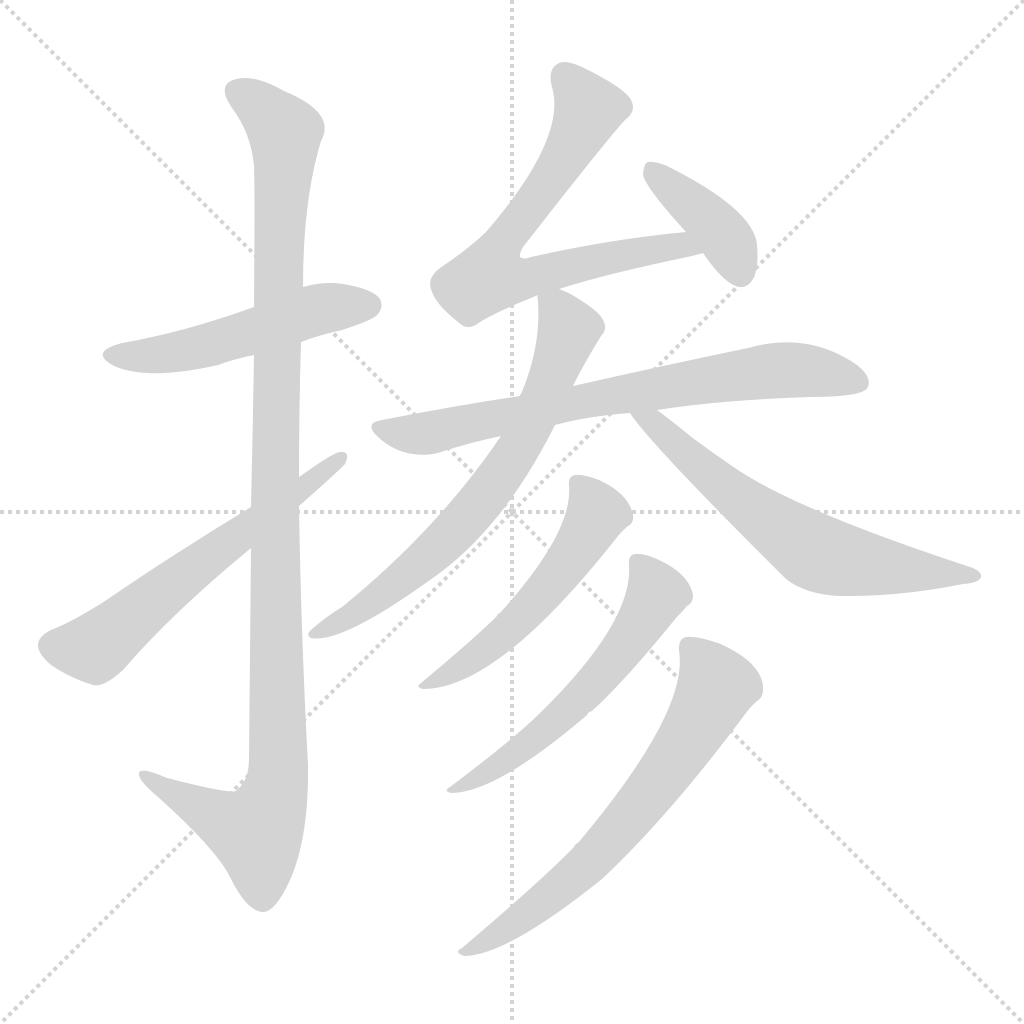
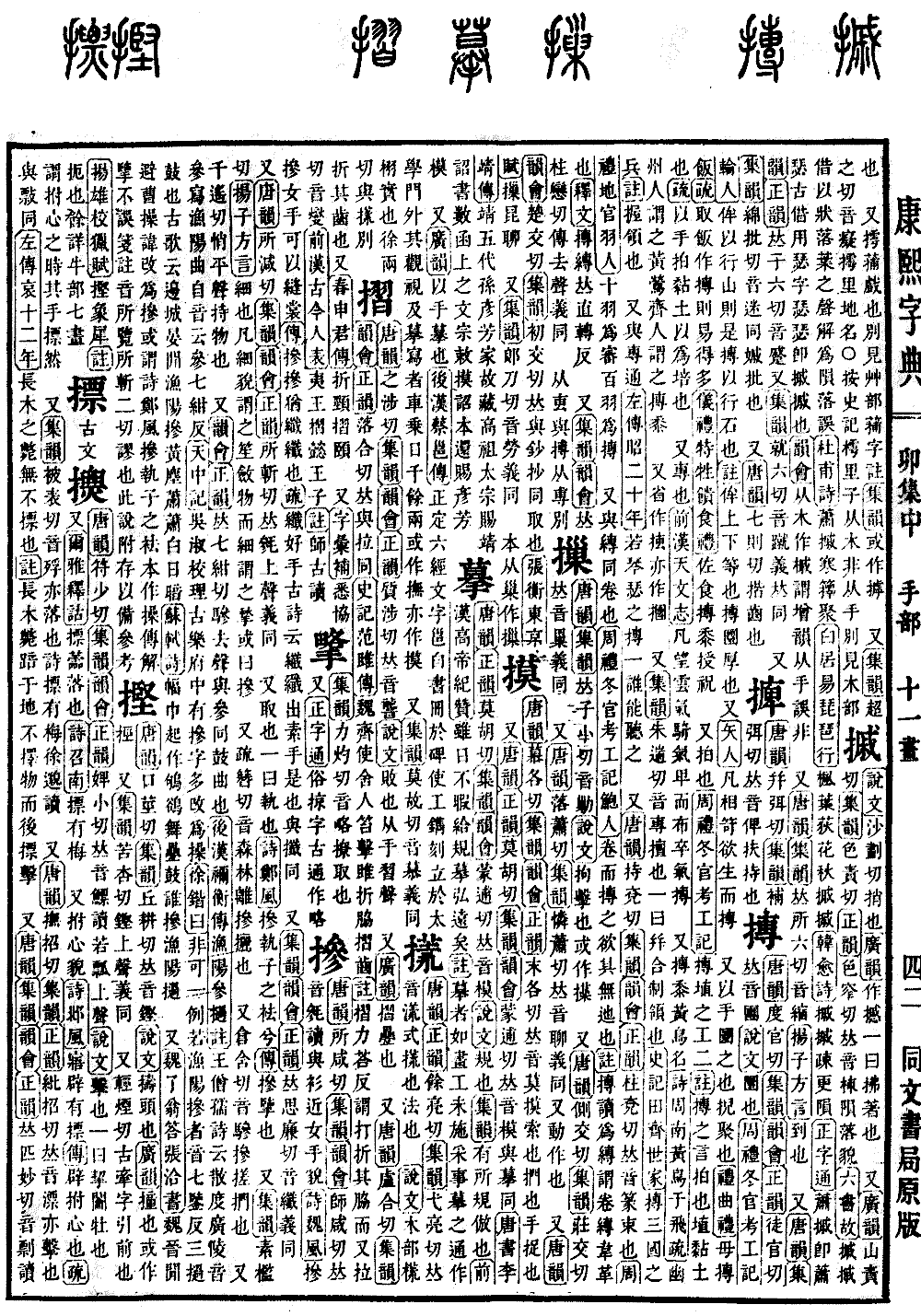
Pronounced san. The sound is close to shan. It describes the slender and beautiful hands of a woman. The Book of Odes (Shijing), Odes of Wei, states: "Slender, slender are the woman's hands, fit to sew garments." The Commentary explains: "Slender, slender" means thin and delicate. The Sub-commentary further explains that it refers to fingers that are thin and beautiful. Ancient poetry says: "Slender, slender emerge the white hands," which carries the same meaning. This character is identical to the variant form (xian).
Pronounced xian. The meaning is the same.
Pronounced san (rising tone). The meaning is the same. It also carries the meaning of "to take." Another interpretation is "to grasp." The Book of Odes (Shijing), Odes of Zheng, states: "Grasping your sleeve." The Commentary explains: "To grasp" means to hold or pull.
Pronounced sukan. Yang Xiong's Dialects (Fangyan) states: It means thin or fine. Anything that appears thin is called sheng, and gathering things so that they become thin is called jiu. Some say it is also called san.
Pronounced sen. Describes an appearance of being scattered or not concentrated.
Pronounced can. Sancuo means to stroke or caress.
Pronounced qiao (level tone). It means to hold or carry an object.
Pronounced can (departing tone). Identical to the character can. It refers to a type of drum performance. The commentary to the Biography of Mi Heng in the History of the Later Han (Hou Hanshu) mentions "Yuyang canzhua": Wang Sengru's poem says: "Spreading the sounds of Guangling, playing the Yuyang tune." His own annotation states: Can is pronounced qijian. The Record of the Center of the Heavens (Tianzhongji) records: When Wu Shu was collating ancient music bureaus, he frequently changed the character san to cao.
Xu Kai states: One cannot generalize. For terms like "Yuyang san," the pronunciation is qijian, referring to three drum beats. An ancient song says: "The border city peacefully opens to the Yuyang drum, yellow dust whistles as the white sun darkens." Su Shi's poem says: "With a headscarf I rise to dance like a myna, who is beating the Yuyang drum on the ramparts?"
Wei Liaoweng's Reply to Zhang Qia states: During the Wei and Jin periods, to avoid the naming taboo of Cao Cao, the character cao was changed to san. Some believe that in the Book of Odes (Shijing), Odes of Zheng, "Grasping your sleeve," the character san was originally written as cao, and the Commentary's interpretation as "to hold" is not incorrect. The pronunciations provided in the annotations as suolan and suozhan are erroneous. This opinion is appended here for reference.