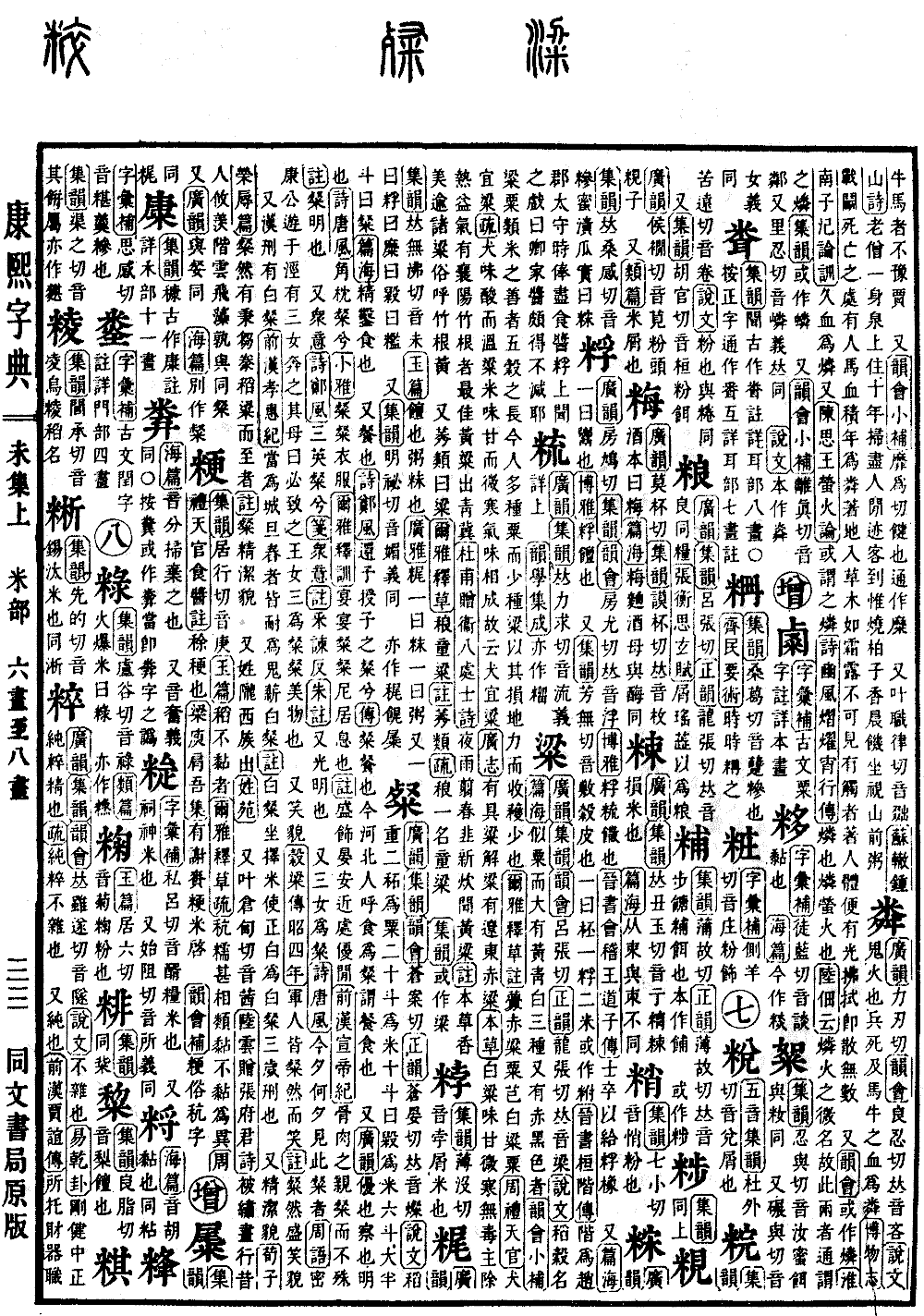
Wei Collection, Upper Volume
Radical: Rice (mǐ)
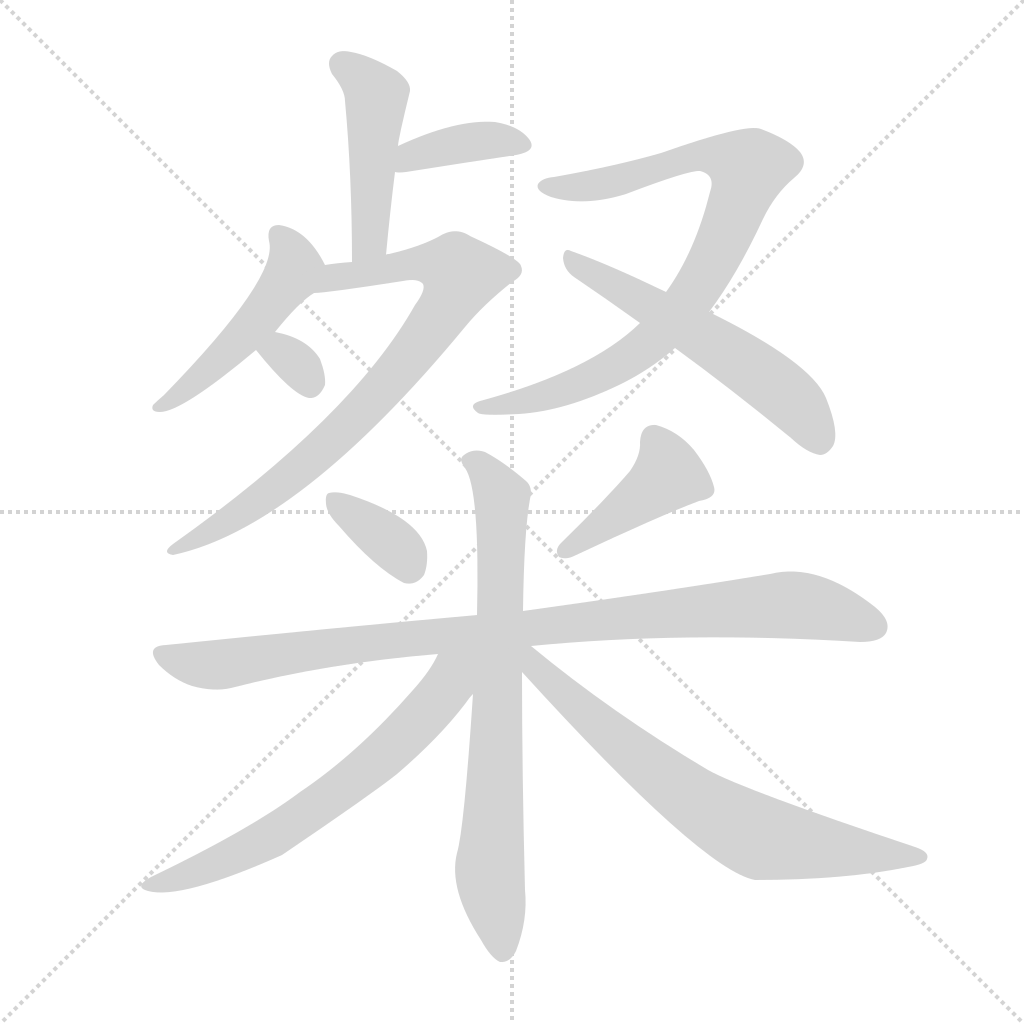
Entry: Can
Kangxi strokes: 13
Page 909, Entry 23
Pronounced can. According to the Shuowen Jiezi (Shuowen), when two zi of rice are husked, they produce twenty dou of millet, which in turn produces ten dou of rice; this is called hui. When six and two-thirds dou of rice are produced, it is called can. According to the Pianhai, it refers to polished, high-quality rice. It also refers to meals. Book of Odes (Shijing): Returning to you to give you this meal. Commentary: Can means meal. In the present day, people in Hebei call meals can, meaning food.
Also, according to the Guangyun, it has the meaning of beautiful, clear, and bright. Book of Odes (Shijing): The horn pillows are bright. Minor Odes (Xiaoya): Bright clothing. Erya: Shixun: Yan-yan can-can, to live in comfort and leisure. Commentary: Beautifully dressed, peaceful and relaxed, living in comfort nearby. Book of Han (Hanshu): Relations by blood, clear and not separated. Commentary: Can means bright.
It also denotes a large quantity. Book of Odes (Shijing): Three beauties are numerous. Note: Refers to quantity. Commentary: Pronounced cai (rising tone). Zhu Xi's commentary: It also has the meaning of bright.
Three women together are also called can. Book of Odes (Shijing): What night is this night, that I see these beauties? Discourses of the States (Guoyu): When Duke Kang of Mi was traveling on the Jing River, three women ran away to join him. His mother said: You must present them to the ruler; three women together are called can. Can refers to beautiful things.
It also refers to the appearance of laughing. Guliang Commentary (Guliang Zhuan): The soldiers all laughed heartily. Commentary: Can-ran, describing the appearance of laughing aloud.
In the Han dynasty, there was a punishment called bai-can. Book of Han (Hanshu): Those who should have been sentenced to the cheng-dan-chong penalty were all reduced to the gui-xin-bai-can penalty. Commentary: Bai-can is a punishment where the prisoner is made to select rice to make it pure white; the term of the sentence is three years.
It also refers to the appearance of being refined and clean. Xunzi: People came carrying livestock and rice. Commentary: Can means refined and clean.
It is also a surname. A family from Longxi, originating from the Xingyuan (Register of Surnames).
Also, the pronunciation is rhymed as cang-dian, sounding like qian. Lu Yun: Poem to Zhang Fujun: Wearing embroidery to walk in the day, the ancients envied this. If the clouds on the steps fly with patterns, who could compare to this brightness.
Also, according to the Guangyun, it is the same as the character [variant]. According to the Haipian, it is also written as [variant].