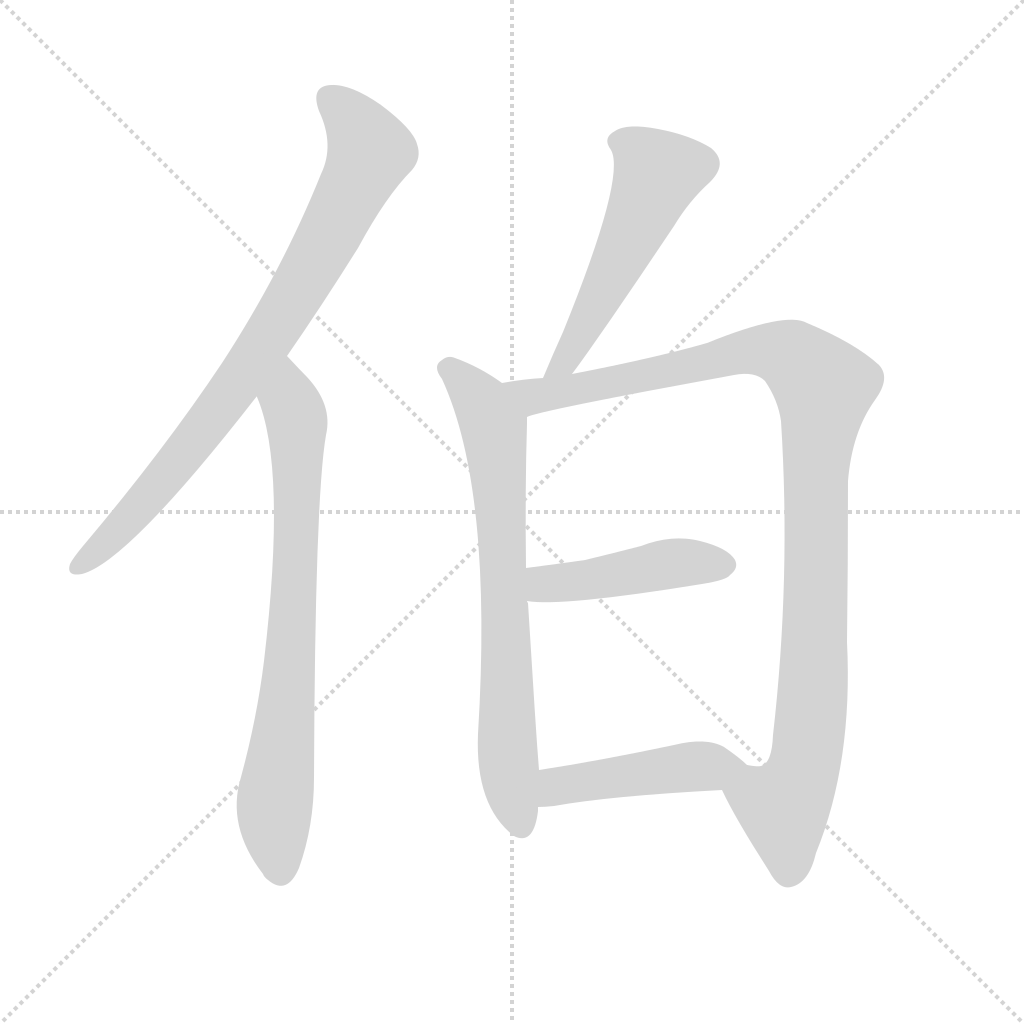
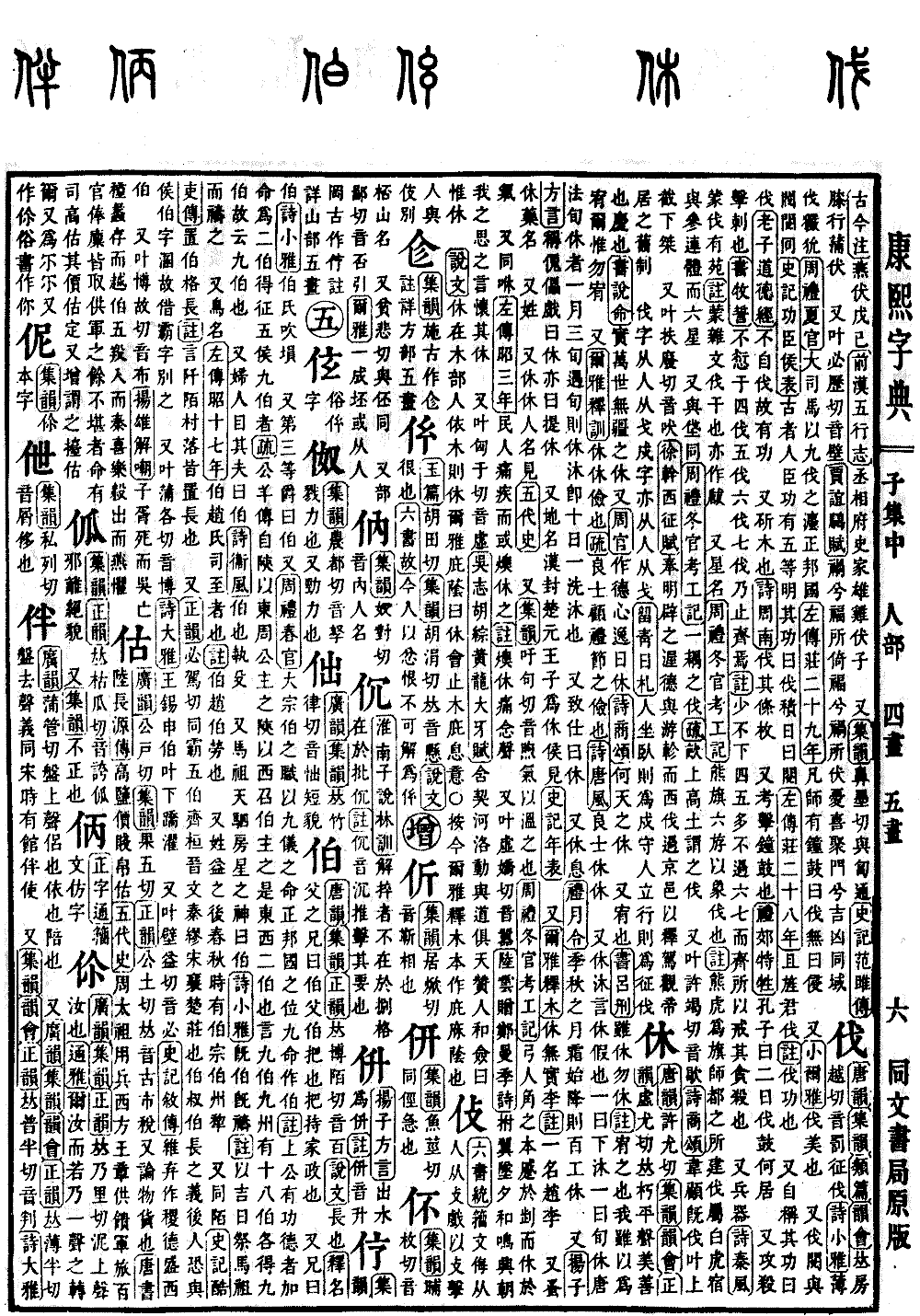
Zi Collection, Middle Volume. Radical: Person (rén). Kangxi strokes: 7. Page 96, entry 16.
Pronounced bǎi.
Shuowen Jiezi (Shuowen): Means elder or leader.
Shi Ming (Interpretation of Names): The elder brother of one’s father is called bofu (uncle). Bo signifies to take hold of, referring to managing the household affairs. Also, an elder brother is referred to as bo.
Book of Odes (Shijing): The elder brother plays the xun (a globular flute).
Also, the third rank of nobility is called bo.
Rites of Zhou (Zhouli): The duties of the Grand Minister of Instruction (Da Zongbo) involve defining the status of feudal states through the orders of the nine ranks; the ninth rank is called bo. Commentary: For those meritorious Dukes (Gong), an additional commission makes them the two bo, who have the authority to punish the five lords and nine bo. Sub-commentary: The Gongyang Commentary states that the area east of Shan was managed by the Duke of Zhou, and the area west of Shan was managed by the Duke of Shao. These were the two bo of the East and West. Regarding the nine bo, it is because the Nine Provinces each had eighteen bo; since each region possessed nine, they are called the nine bo.
Also, a woman’s way of addressing her husband is bo. Book of Odes (Shijing): My husband holds his spear.
Also, the ancestor of horses, the deity of the star room (Fang), is called bo. Book of Odes (Shijing): Having sacrificed to the horse ancestor and offered prayers. Commentary: On an auspicious day, one sacrifices to the horse ancestor and offers prayers.
Also, a type of bird. Zuo Commentary (Zuo Zhuan): The bo zhao is the official responsible for the summer solstice. Commentary: Bo zhao refers to the shrike bird.
Also, a surname. A descendant of Yi. During the Spring and Autumn period, there were Bo Zong and Bo Zhouli.
Also, identical to the character for road or path (mo). Records of the Grand Historian (Shiji): Established the bo ge chang (local road and village overseer). Commentary: This means that overseers were established in field paths and villages.
Also, pronounced bà. Same as the term for a hegemon (ba). The five hegemons (Wu Bo) refer to Duke Huan of Qi, Duke Wen of Jin, Duke Mu of Qin, Duke Xiang of Song, and King Zhuang of Chu. Because the term bo (as in uncle or leader) might be confused with the bo of feudal rank, the character ba was borrowed to distinguish it.
Also, pronounced bó. Book of Odes (Shijing): The King bestowed upon the Marquis of Shen.
Also, pronounced bì. Records of the Grand Historian (Shiji): Abandoning it to become the Lord of Millet, his virtue flourished as the Western Bo (Xibo).
Also, pronounced bù. Yang Xiong, Against Ridicule (Jiechao): Zi Xu died and the state of Wu perished; Zhong and Li survived and the state of Yue became a hegemon (bo). The five rams were introduced and Qin rejoiced; Yue Yi departed and Yan feared.
Textual Research: Rites of Zhou (Zhouli): The duties of the Grand Minister of Instruction, the ninth commission is called bo. Sub-commentary: The Gongyang Commentary states that the area east of Shan was managed by the Duke of Zhou, and the area west of Shan was managed by the Duke of Shao. These were the two bo of the East and West. Regarding the nine bo, it is because the Nine Provinces each had eighteen bo; since each region possessed nine, they are called the nine bo. According to the original text, the bo character in Shao Bo has been corrected to Duke (Gong). The character zhe has been added after the mention of the nine bo.