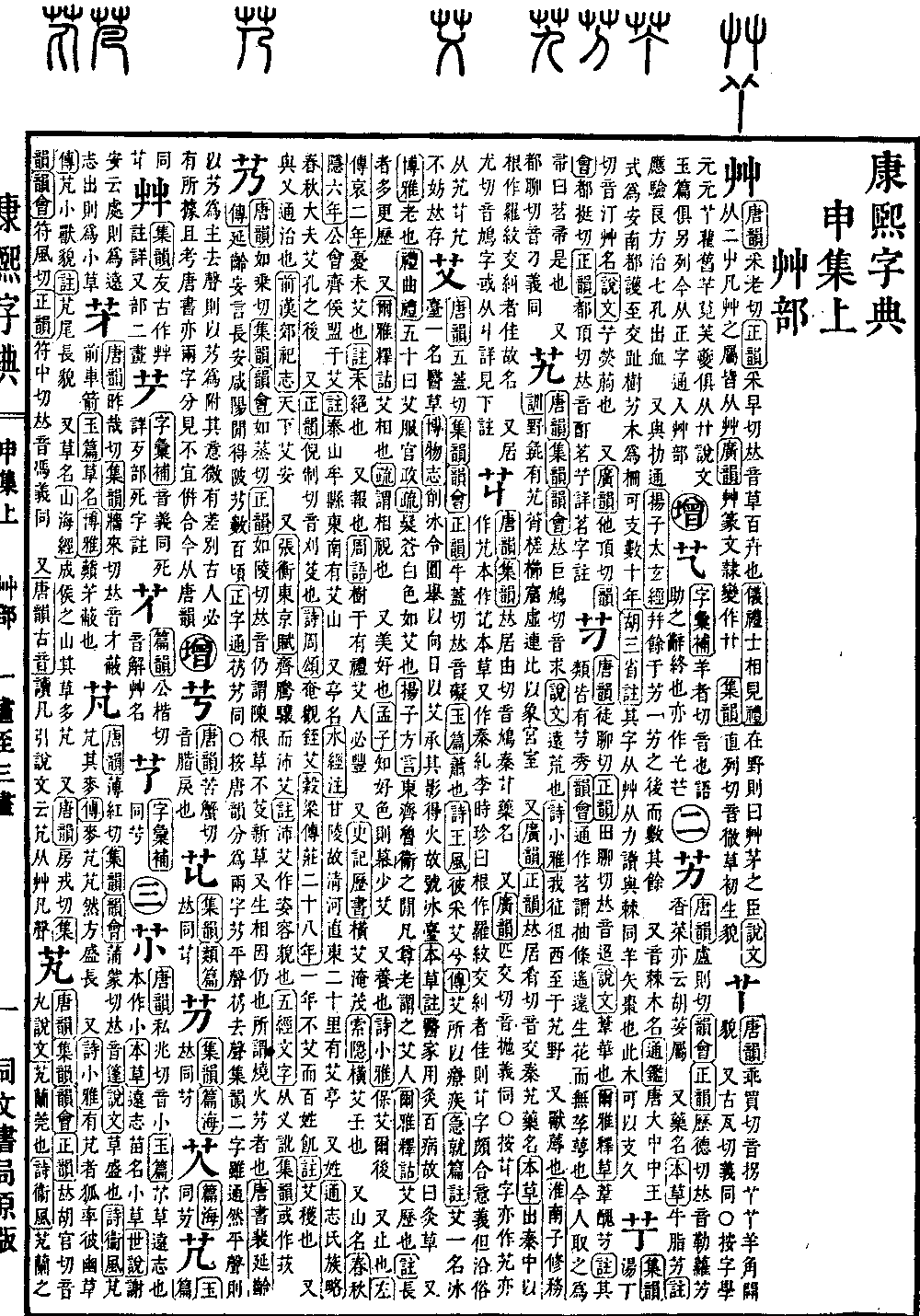
Shen Collection, Upper Volume
Radical: Grass (cǎo)
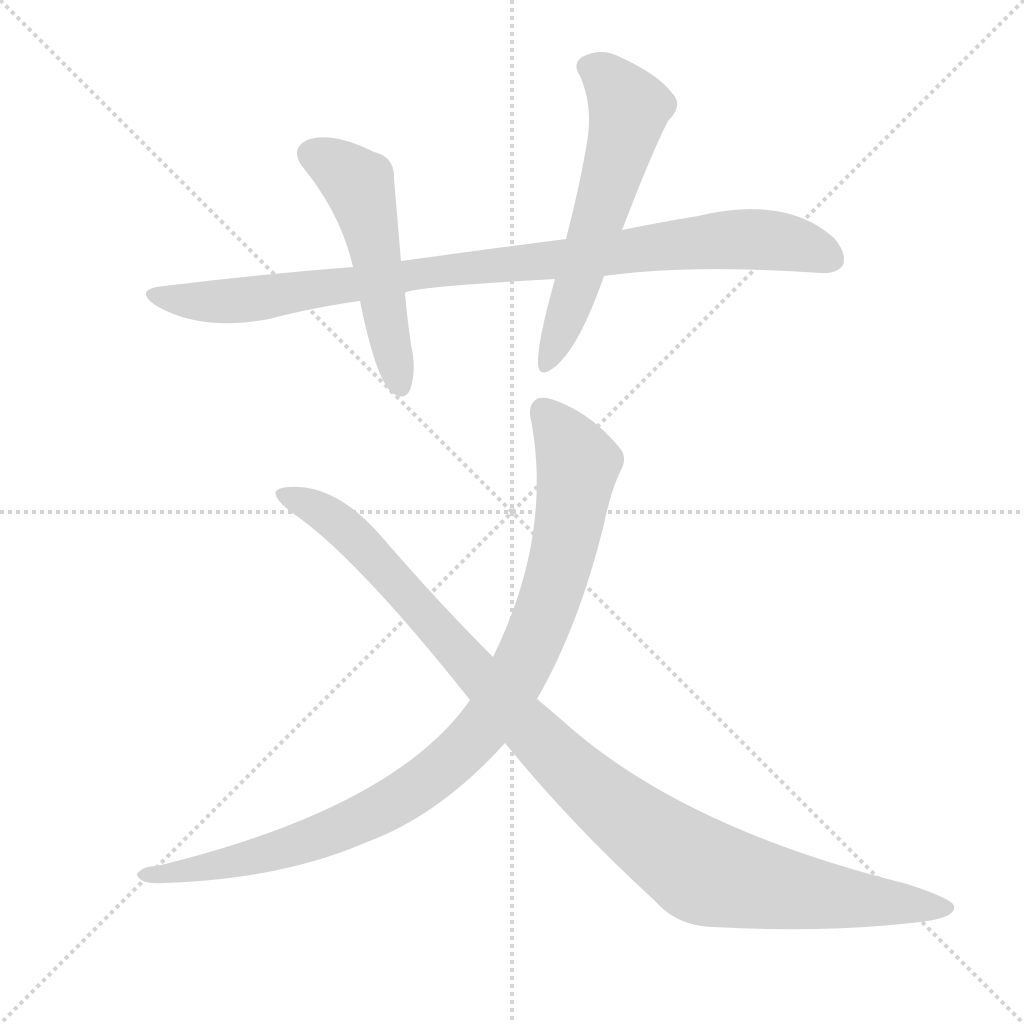
Ai; Kangxi strokes: 8; Page 1017, Entry 09
Pronounced ai (falling tone)
Jade Record (Yupian): Wormwood.
Book of Odes (Shijing), Kingdom of Wang: Collecting wormwood there.
Commentary: Wormwood is used to heal illnesses.
Annotation to the Quick Literacy Primer (Jijiu pian): Wormwood is also called ice terrace and medicinal herb.
Record of Investigations of Things (Bowuzhi): Shave ice until round, hold it toward the sun, and place wormwood to catch the shadow to obtain fire; hence the name ice terrace.
Materia Medica Annotation (Bencao zhu): Physicians use it to cauterize all illnesses, which is why it is called cautery herb.
Broad Aphorisms (Boya): To grow old.
Book of Rites (Liji), Songs of Refinement (Quli): At fifty one is called ai, serving in government office.
Subcommentary: The hair turns grey like the color of wormwood.
Yangzi’s Regional Dialects (Fangyan): In the regions of Eastern Qi, Lu, and Wei, all respected elders are called ai people.
Approaching Refinement (Erya), Explaining Ancient Words (Shigu): Ai means to experience.
Commentary: The elderly have experienced much.
Approaching Refinement (Erya), Explaining Ancient Words (Shigu): Ai means to assist.
Subcommentary: This refers to looking after one another.
Also, it means beautiful.
Mencius: When one knows how to appreciate beauty, one admires the young and beautiful.
Also, it means to nourish.
Book of Odes (Shijing), Lesser Odes (Xiaoya): Protect and nourish your descendants.
Also, it means to cease.
Zuo Tradition (Zuozhuan), Second Year of Duke Ai: The worry has not yet ceased.
Commentary: Not yet extinguished.
Also, it means to requite.
Discourses of the States (Guoyu): Establish those with ritual propriety, and the requited people will certainly be abundant.
Also, Historical Records (Shiji), Treatise on the Calendar: Heng-ai is exuberant.
Search for Hidden Meanings (Suoyin): Heng-ai refers to the heavenly stem ren.
Also, a mountain name.
Spring and Autumn Annals (Chunqiu), Sixth Year of Duke Yin: The Duke met the Marquis of Qi and formed an alliance at Ai.
Commentary: There is an Ai Mountain southeast of Mou County in Mount Tai.
Also, a pavilion name.
Commentary on the Classic of Waterways (Shuijing zhu): Twenty li directly east of the old Qinghe, formerly of Ganling, there is an Ai Pavilion.
Also, a surname.
Comprehensive Records (Tongzhi), Epitome of Clans: Descendants of Ai Kong, a grand officer of the Spring and Autumn period.
Also, pronounced yi (falling tone).
To harvest.
Book of Odes (Shijing), Zhou Hymns (Zhousong): Behold the harvesting with sickles.
Guliang Tradition (Guliang zhuan), Twenty-eighth Year of Duke Zhuang: If one does not harvest for a year, the hundred surnames go hungry.
Commentary: Ai means to harvest.
Also, interchangeable with yi, meaning to govern.
Former Han History (Qianhan shu), Treatise on Suburban Sacrifices: The world is governed and at peace.
Also, Zhang Heng, Eastern Capital Rhapsody (Dongjing fu): Rising and soaring, spirited and vigorous.
Commentary: Pei-ai describes a bearing or appearance.
Five Classics Script (Wujing wenzi): Derived from the character yi, which is a miswriting.
Collected Rhymes (Jiyun): Sometimes written as a variant form. The original character is derived from the character for grass placed below.
Textual Research:
Yangzi’s Regional Dialects (Fangyan): In the regions of Eastern Qi, Lu, and Wei, all respected elders are called ai people.
I respectfully note that in the original text, there is no character for person after ai. I have corrected the character for person to the character for also, serving as a transitional word for the following meaning.