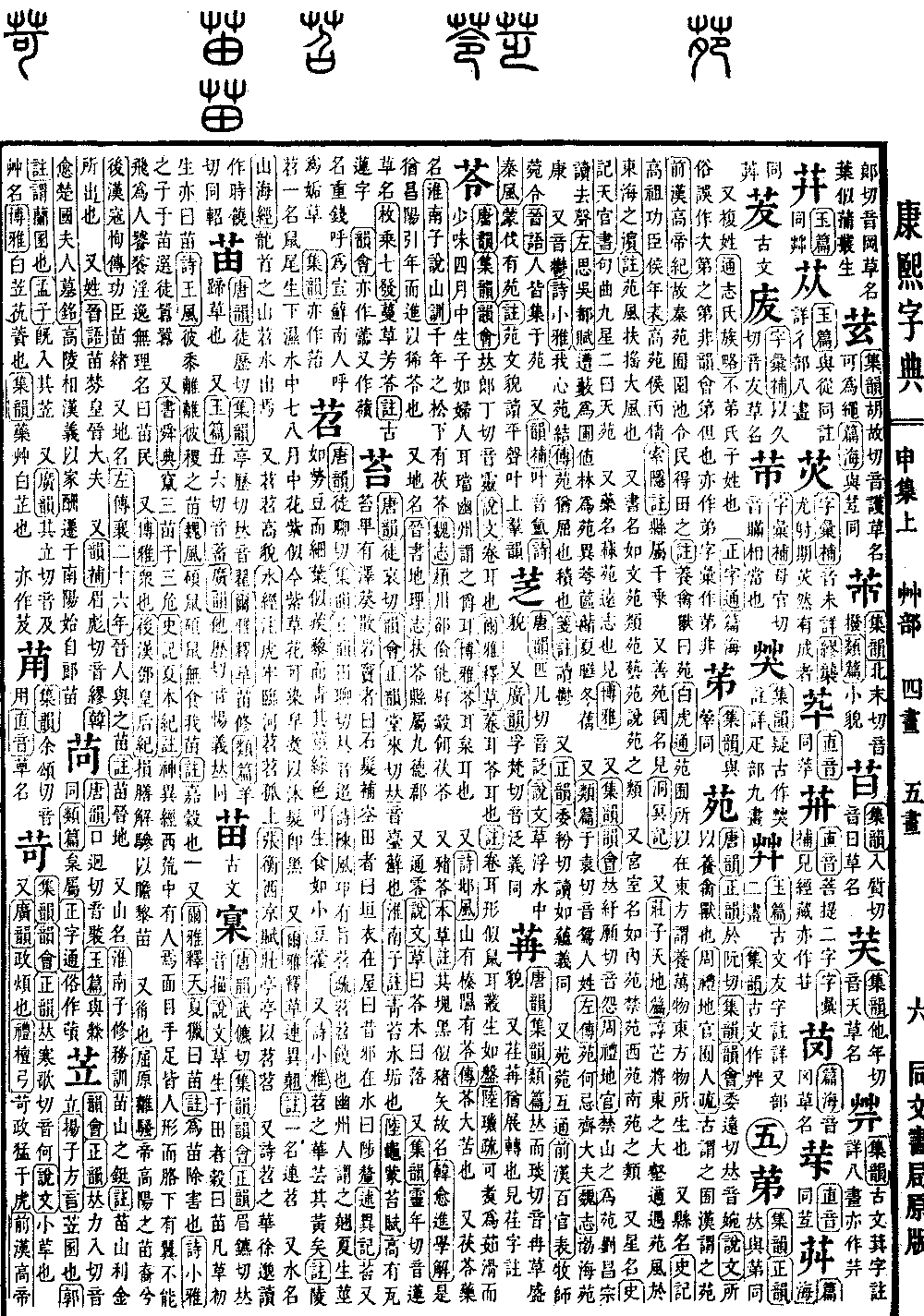
Shen Collection, Upper Volume
Radical: Grass (cǎo)
Ling; Kangxi stroke count: 11
Page 1022, Entry 24
Pronounced ling.
Shuowen Jiezi (Explanation of Simple and Compound Characters): It is the cocklebur.
Erya (Approaching Elegance), Interpretation of Grasses: The cocklebur is called ling-ear. Commentary: The cocklebur has a shape like an ear and grows in tufts resembling a plate.
Lu Ji’s Commentary: It can be boiled as a vegetable; the texture is smooth and the taste is bland. In mid-fourth month, it bears seeds that resemble earrings worn by women. In the You province region, it is called jue-ear.
Boya (Broad Refinement): Ling-ear is the same as the rough cocklebur.
Also, from Book of Odes (Shijing), Beifeng: The mountain has hazel trees, the marsh has ling. Commentary: Ling refers to the great bitter herb.
Also refers to poria, the name of a medicinal herb.
Huainanzi (The Masters of Huainan), Sayings of the Mountains: Under a thousand-year-old pine tree, poria grows.
Records of Wei (Weizhi): Xi Jian from Yingchuan was able to fast from grains and consume poria.
Also refers to polyporus (zhu ling). Compendium of Materia Medica (Bencao) Commentary: Its lump-like form is black and resembles pig excrement, which is how it acquired its name.
Han Yu, Discourse on Advancing Learning: This is like using sweet flag to prolong life, but offering polyporus instead.
Also refers to a place name. Book of Jin (Jinshu), Treatise on Geography: Fuling County, subordinate to Jiude Commandery.
Also used interchangeably with ling (to wither). Shuowen Jiezi: When grass withers it is called ling, when trees wither it is called luo.
Pronounced lian. Name of an herb.
Mei Cheng, Seven Stimuli: Creeping plants and fragrant ling. Commentary: This is the ancient form of the character for lotus.
Rhyme Compilation (Yunhui): Also written in a variant form (ling). Also written in a variant form (ling).