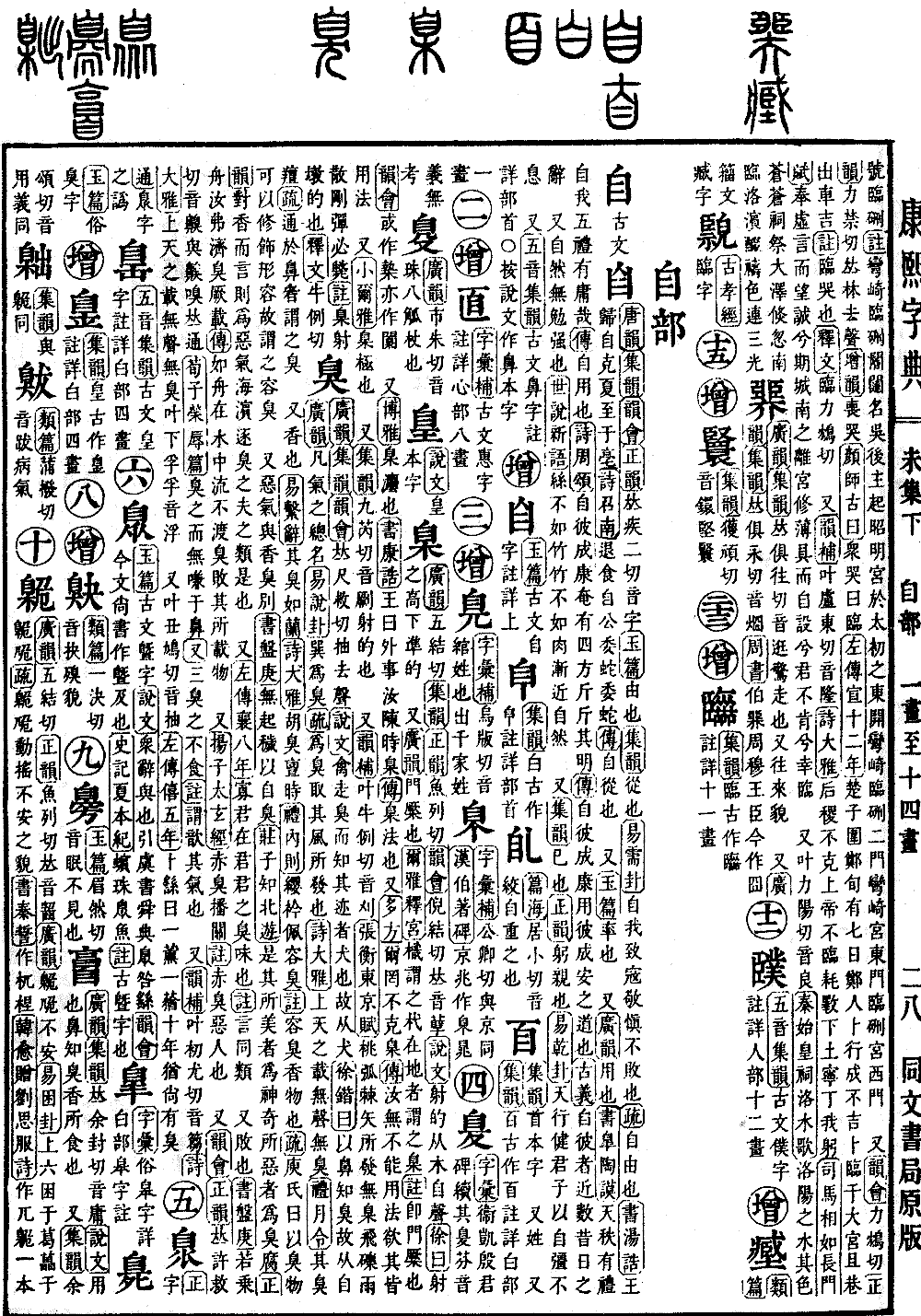
Wei Collection, Lower Volume
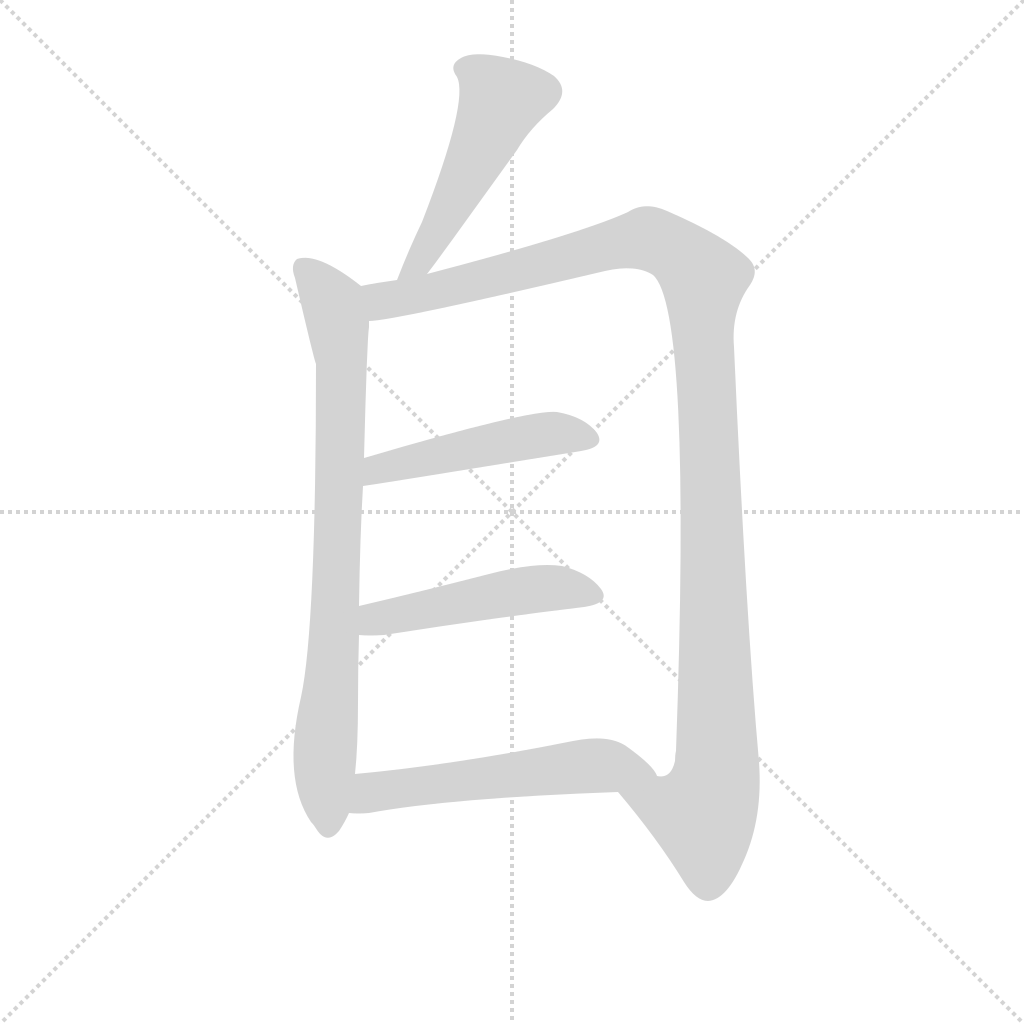
Radical: Self (zì)
Kangxi Strokes: 6
Page 1000, Entry 07
Ancient form. Pronounced zi (falling tone).
Jade Chapters (Yupian): Means from.
Collected Rhymes (Jiyun): Means to follow.
Book of Changes (Yijing), Hexagram of Waiting (Xu Gua): From myself the bandits arrive, if one is respectful and cautious, one will not suffer defeat. Commentary: Self means from.
Book of Documents (Shujing), Announcement of Tang (Tang Gao): The King returned from conquering the Xia, and arrived at Bo.
Book of Odes (Shijing), Odes of Shao (Shaonan): Retiring from the public office, leisurely and relaxed. Commentary: Self means from.
Also, Jade Chapters (Yupian): Means to lead.
Also, Broad Rhymes (Guangyun): Means to use.
Book of Documents (Shujing), Counsels of Gao Yao (Gao Yao Mo): Heaven has ordered the rituals, by using our five rituals, there is merit. Commentary: Self means to use.
Book of Odes (Shijing), Odes of Zhou (Zhou Song): From the time of Cheng and Kang, they possessed the four quarters, clear and bright. Commentary: From the time of Cheng and Kang, using the path of peace established by them. Ancient meaning: The expression from that time refers to the counting of past days.
Also, natural, without force or compulsion. A New Account of Tales of the World (Shishuo Xinyu): Silk instruments are not as good as bamboo, bamboo instruments are not as good as the human voice, gradually approaching nature.
Also, Collected Rhymes (Jiyun): Self.
Orthodox Rhymes (Zhengyun): Personally or oneself.
Book of Changes (Yijing), Hexagram of the Creative (Qian Gua): The movement of the heavens is powerful, the noble person uses this to strengthen oneself without ceasing.
Also, Five Sounds Collected Rhymes (Wuyin Jiyun): Ancient form of the character for nose. Note detailed in the radical section. According to the Explaining Characters (Shuowen), it is the original character for nose.