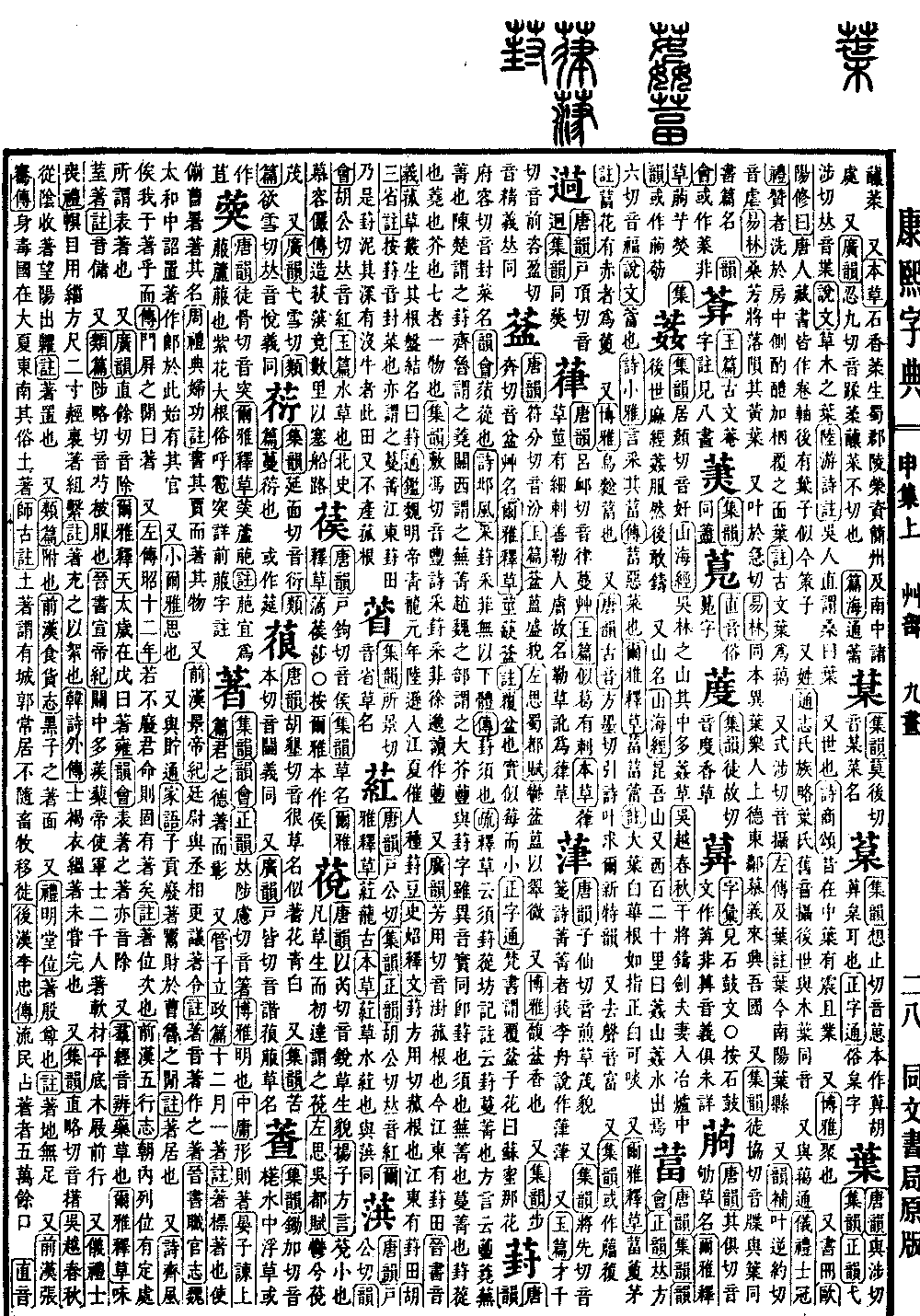
Shen Collection, Upper Volume
Radical: Grass (cǎo)
Kangxi Strokes: 15
Page 1044, Entry 26
Collection of Rhymes (Jiyun), Collected Rhymes (Yunhui), Correct Rhymes (Zhengyun): Pronounced zhu.
Broad Compendium of Matters (Boya): To be bright.
Doctrine of the Mean (Zhongyong): When form is present, it is revealed.
Master Yan's Discourses (Yanzi): The virtue of the ruler is revealed and manifest.
Also, Guanzi (Guanzi): Each month one mandate is set forth. Commentary: To set forth, meaning to indicate, requiring the officials to record and set down their names.
Rites of Zhou (Zhouli): Record the price and label the item.
Book of Han (Qianhan): The commandant of justice and the prime minister again discussed and established the decree. Commentary: Pronounced as in the word for literary compositions.
Book of Jin (Jinshu): During the Taihe reign of the Wei dynasty, an edict established the office of historiographer; this was the beginning of that office.
Also, Lesser Erya (Xiao Erya): To think.
Also, interchangeable with the character for store. School Sayings of Confucius (Jiayu): Zigong abandoned trading and accumulated wealth between the states of Cao and Lu. Commentary: Meaning to reside.
Also, Book of Odes (Shijing): Waiting for me at the gate screen. Commentary: The area between the gate and the screen is called the gate screen.
Also, Zuo Tradition (Zuozhuan): If the ruler's command is not repealed, then there is a fixed rank. Commentary: Meaning position or order.
Book of Han (Qianhan): Within the court, rankings have fixed places, which is what is meant by visible status.
Also, Extended Rhymes (Guangyun): Pronounced chu.
Erya (Erya): When the year is in the wu position, it is called zhu-yong.
Collected Rhymes (Yunhui): The character for visible status is also pronounced chu.
Discrimination of Sounds in the Classics (Qunjing Yinbian): A medicinal herb.
Erya (Erya): The flavor is bitter.
Categories of Characters (Leipian): Pronounced shao. To wear clothing.
Book of Jin (Jinshu): The pass was overgrown with thorny plants; the emperor ordered two thousand soldiers to wear soft-soled wooden clogs to proceed forward.
Book of Etiquette (Yili): A cloth to cover the eyes is made of black silk, one foot and two inches square, padded with cotton padding and tied with silk cords. Commentary: The cloth is filled with silk wadding.
Han Fu's Illustrations of Poetry (Hanshi Waizhuan): The scholar's coarse clothing was padded, and never whole.
Also, Categories of Characters (Leipian): Pronounced zhuo.
Annals of Wu and Yue (Wuyue Chunqiu): Collect and store during the yin period, wait for the yang period to sell the grain. Commentary: Meaning to place.
Also, Categories of Characters (Leipian): Meaning to attach.
Book of Han (Qianhan): A black mole appearing on the face.
Book of Rites (Liji): A type of wine vessel used in the Yin dynasty. Commentary: A vessel with no feet that sits on the ground.
Book of Han (Qianhan): The Shendu state is located southeast of Daxia; its customs are those of settled people. Commentary: Settled people refers to those who have walled cities and permanent dwellings, and who do not move about with herds.
Book of the Later Han (Houhan): Fifty thousand wandering people registered as permanent residents.
Direct Pronunciation (Zhiyin): Commonly written as the character for wear.
Textual Research: Book of Han (Qianhan), Record of Food and Money: Black mole appearing on the face. Note: This phrase does not appear in the Record of Food and Money; it has been corrected to the Biography of Jia Yi.