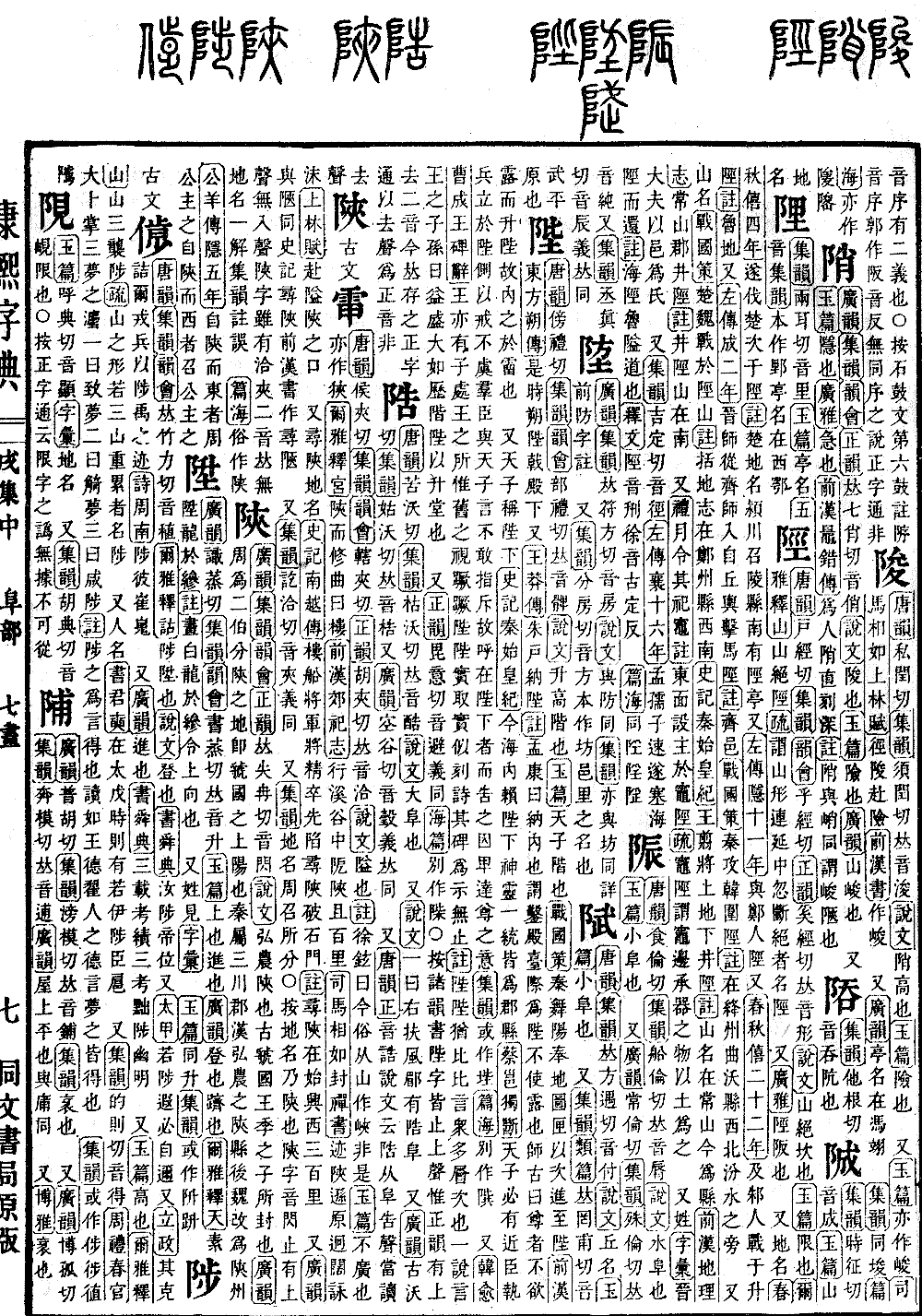
Xu Collection, Middle Volume
Radical: Mound (fù)
Zhi; Kangxi strokes: 15; Page 1351, Entry 16
Ancient character form
According to Guangyun (Guangyun), Jiyun (Jiyun), and Yunhui (Yunhui), the pronunciation is zhúlì qiè, sounding like zhí.
Zhi means to ascend. — Erya (Erya), Explanation of Ancient Words
To climb. — Shuowen Jiezi (Shuowen Jiezi)
"You ascend the imperial throne." — Book of Documents (Shujing), Canon of Shun
Also: "If you ascend afar, it must be from near." — Book of Documents (Shujing), Taijia
Also: "May they be able to discipline your military, and thus ascend to Yu's achievements." — Book of Documents (Shujing), Lizheng
"Ascend those lofty peaks." — Book of Odes (Shijing), Zhou Nan
Also, according to Guangyun (Guangyun), it means to advance.
"After three years, their merits were examined; after three examinations, the obscure and the brilliant were promoted or demoted." — Book of Documents (Shujing), Canon of Shun
Also, according to Yupian (Yupian), it means high.
"A mountain of three superimposed [layers] is called Zhi." — Erya (Erya), Explanation of Mountains
Annotation: The form of a mountain that resembles three superimposed mountains is named Zhi.
Also, a personal name.
"During the time of Tai Wu, there were such as Yi Zhi and Chen Hu." — Book of Documents (Shujing), Jun Shi
Also, according to Jiyun (Jiyun), another pronunciation is dìzé qiè, sounding like dé.
"The Grand Diviner manages three methods of dream interpretation: first, interpreting auspicious dreams; second, interpreting auspicious or inauspicious dreams; third, interpreting complete dreams as 'Zhi'." — Rites of Zhou (Zhouli), Spring Officials
Annotation: Here, Zhi means 'to obtain' or 'to achieve'. Read like the 'dé' in 'wáng dé dí rén zhī dé'. This signifies that all dreams are obtained or achieved.
According to Jiyun (Jiyun), sometimes also written as the variant forms jié, zhí, or zhì.