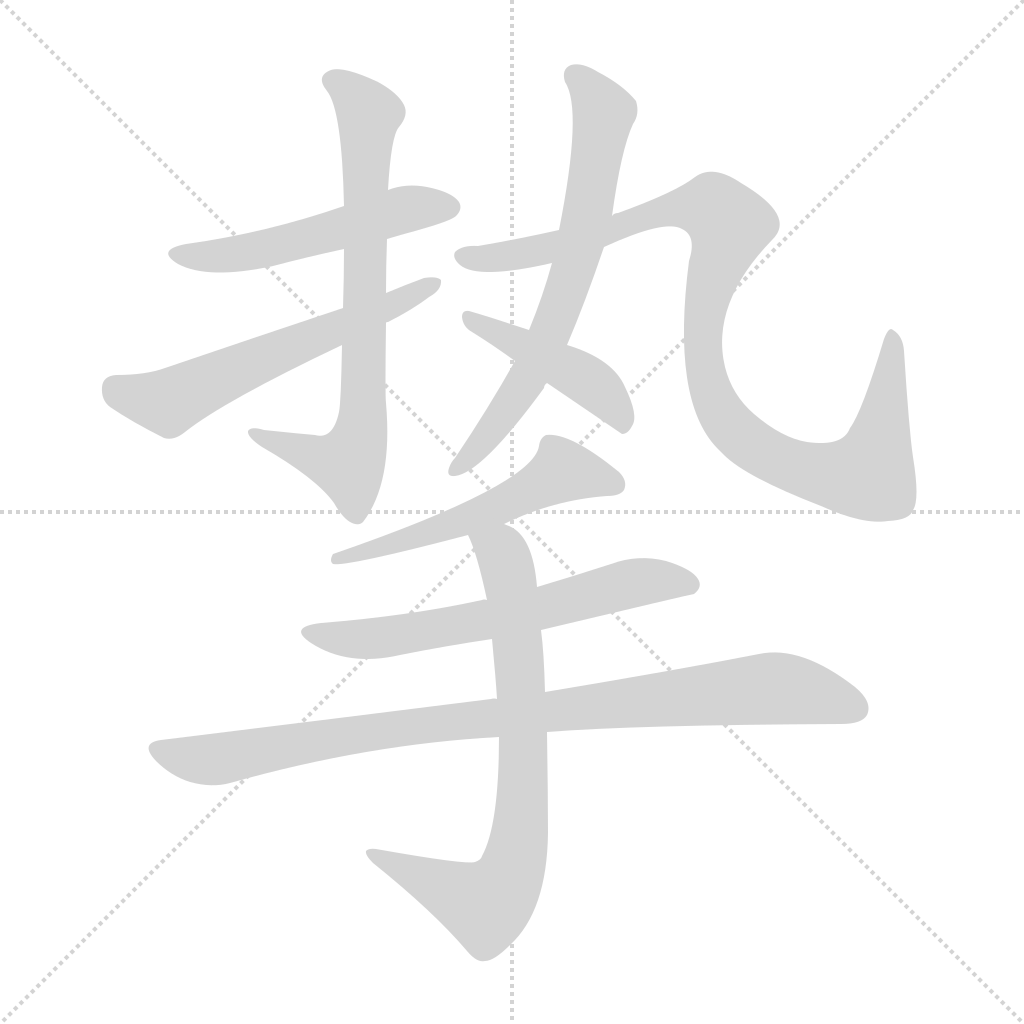
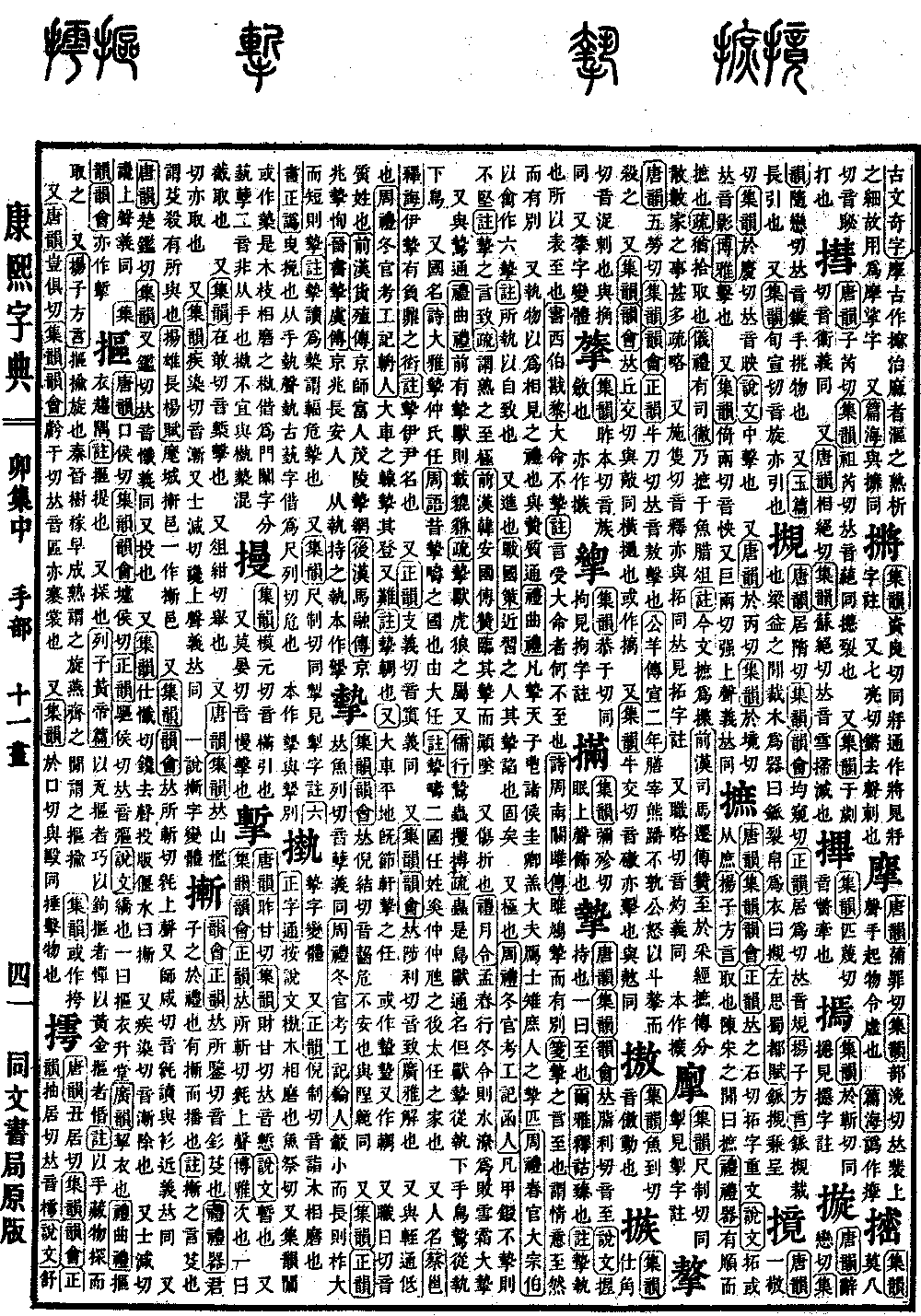
Mao Collection, Middle Volume
Radical: Hand (shǒu)
Kangxi stroke count: 15
Page 451, Entry 01
Pronounced zhi. Pronounced the same as zhi.
Shuowen Jiezi (Explaining Single-component Characters and Analyzing Compound Characters) defines it as to grasp or hold. Another interpretation is that it means to arrive.
Erya (Approaching Elegance), Shigu (Explanation of Ancient Terms) defines it as zhen (to arrive).
Commentary: Zhi implies holding, used to express the meaning of arriving.
Book of Documents (Shujing), Xibo Kan Li: The great mandate does not arrive.
Commentary: This means, why does the one who has received the mandate of Heaven not arrive?
Book of Odes (Shijing), Zhou Nan, Guanju Zhuan: The osprey is earnest and has distinctions.
Annotation: The meaning of zhi is to arrive, referring to deep affection that is accompanied by propriety. It also refers to holding an item as a gift for a first meeting. It is used interchangeably with zhi (gift) and zhi (substance).
Book of Rites (Liji), Quli (Summary of Propriety): For initial meeting gifts, the Son of Heaven uses fragrant wine, feudal lords use jade tablets, ministers use lambs, grand masters use wild geese, scholars use pheasants, and commoners use ducks.
Rites of Zhou (Zhouli), Spring Officials, Great Minister of Rites: Using game animals to serve as the six ritual gifts.
Commentary: This refers to gifts that are held to express one's sincerity. It also refers to making an offering.
Strategies of the Warring States (Zhan Guo Ce): The offerings of those who are close and familiar are inherently firm.
It also refers to the extreme or very.
Rites of Zhou (Zhouli), Winter Officials, Record of Trades (Kaogongji), Armor Maker: If the forging of the armor does not reach the extreme, it will not be sturdy.
Commentary: Zhi means zhi (to reach the utmost).
Sub-commentary: This refers to forging that is extremely refined.
History of the Former Han (Qian Hanshu), Biography of Han Anguo, Eulogy: Approaching its extreme, it falls and collapses.
It also refers to harming or crushing.
Book of Rites (Liji), Monthly Ordinances (Yueling): If the government policies of winter are enacted during the first month of spring, then floods will cause destruction, and frost and snow will severely crush all things.
It is also used interchangeably with zhi (fierce).
Book of Rites (Liji), Quli (Summary of Propriety): If there is a fierce beast in front, then carry the figure of a pixiu (mythical beast).
Sub-commentary: Fierce beasts refer to ravenous animals like tigers and wolves.
Also, Ruxing (Conduct of the Scholars): Fierce insects grab and fight.
Sub-commentary: Insect is a general term for birds and beasts, but the zhi for beasts is written with hand below the component for hold, while the zhi for birds is written with bird below the component for hold.
It also refers to the name of a state.
Book of Odes (Shijing), Daya: The Lady Ren of the Zhi clan.
Discourses of the States (Guoyu), Zhou Discourses: In the past, the states of Zhi and Chou were of the Ren surname, descendants of Xizhong and Zhonghui, and the maternal family of Tai Ren.
It also refers to a personal name.
Cai Yong, Shihui (Explanation of Admonitions): Yi Zhi had the display of carrying a cauldron.
Commentary: Zhi is the name of Yi Yin.
Also, according to Zhengyun (Correct Rhymes), pronounced zhi. Pronounced the same as zhi. The meaning is the same.
Also, according to Jiyun (Compilation of Rhymes) and Yunhui (Collection of Rhymes), pronounced zhi. Pronounced the same as zhi.
Guangya (Expanded Elegance) defines it as to loosen.
It is also used interchangeably with zhi (to lower). It refers to being low.
Rites of Zhou (Zhouli), Winter Officials, Record of Trades (Kaogongji), Carriage Pole Maker: If the pole of a large carriage is too low, then ascending is difficult.
Commentary: Zhi means zhou (low).
Also: When the large carriage is on flat ground, it regulates the weight of being elevated or lowered.
Sometimes written as a variant form. Also written as zhou (a variant form).
Also pronounced zhi. It is a surname.
History of the Former Han (Qian Hanshu), Biographies of Merchants: Among the rich in the capital, there was Zhi Gang of Maoling.
History of the Later Han (Hou Hanshu), Biography of Ma Rong: Zhi Xun of Jingzhao.
History of the Jin (Jinshu), Biography of Zhi Yu: Jingzhao, a person from Chang'an. The character is formed with the component for hold, originally written in a variant form.