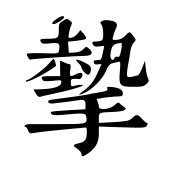
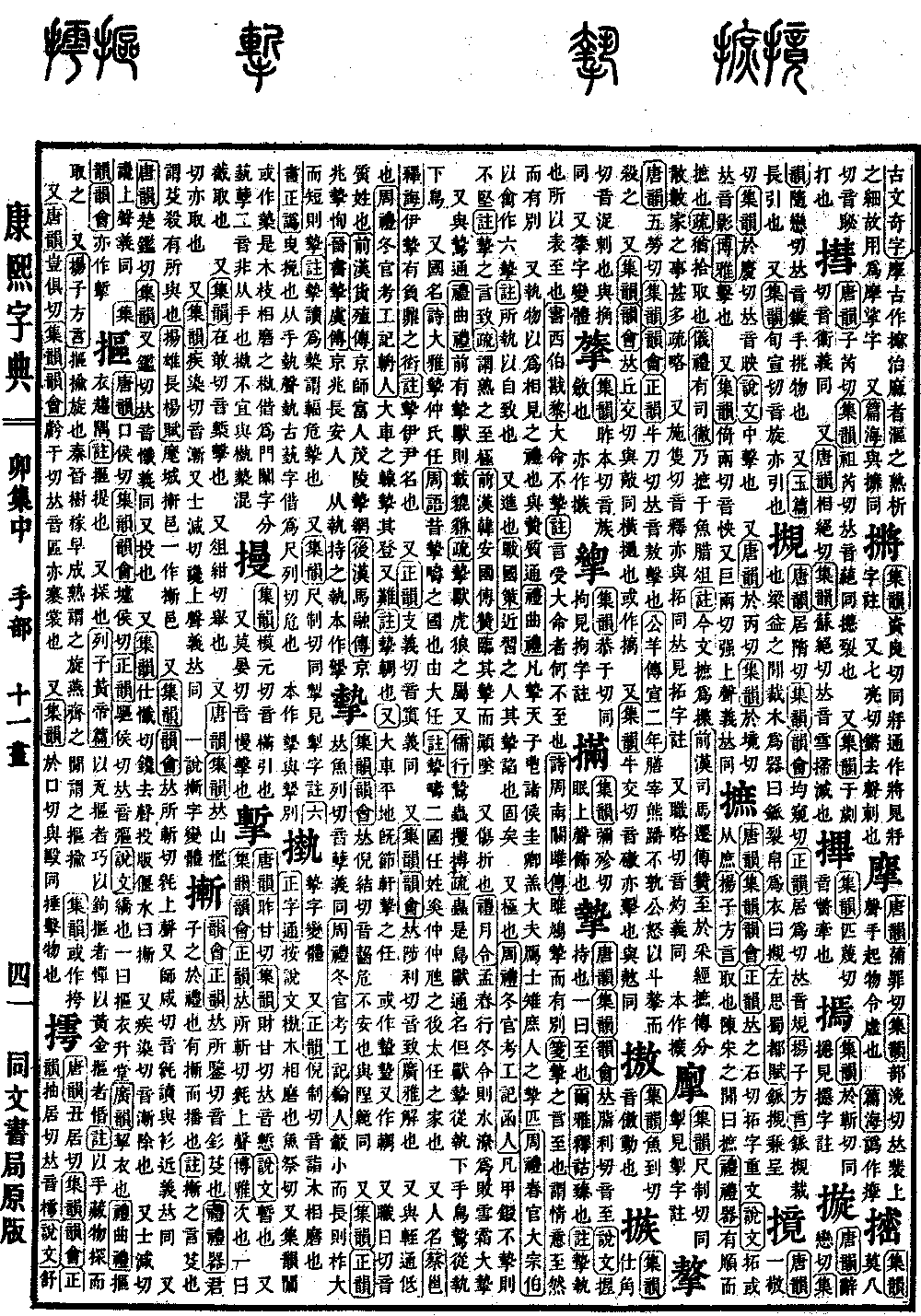
Mao Collection, Middle Volume. Radical: Hand (shǒu). 15 strokes. Page 451, Entry 19.
According to Collected Rimes (Jiyun) and Rime Compilation (Yunhui), the pronunciation is nie (falling-rising tone). It refers to being in a state of danger and instability. It has the same meaning as the characters nie (falling-rising tone) and nie (falling-rising tone).
Also, according to Collected Rimes (Jiyun) and Correct Rimes (Zhengyun), the pronunciation is nie (falling-rising tone). The meaning is the same.
In the Rites of Zhou (Zhouli), section Winter Officials, Artisans' Record (Dongguan Kaogongji), concerning wheel-makers: If the wheel hub is small and long, it is considered柞, if it is large and short, it is considered zhi (falling-rising tone). The commentary notes: zhi (falling-rising tone) should be read as nie (falling-rising tone). It describes the spokes of a carriage being in a dangerous and unstable state.
Also, according to Collected Rimes (Jiyun), the pronunciation is che (falling tone), which is the same as the character che (falling tone). Refer to the note for the character che (falling tone).
According to Six Scripts Corrected (Liushu Zheng'e), it means to drag, pull, or haul. It is composed of the Hand radical and the phonetic element yi (falling tone). Yi (falling tone) is the ancient form of the character for agricultural arts. Borrowed to be pronounced as lie (falling-rising tone), it signifies danger. This was originally written as a variant form. It is distinct from the character zhi (falling-rising tone).