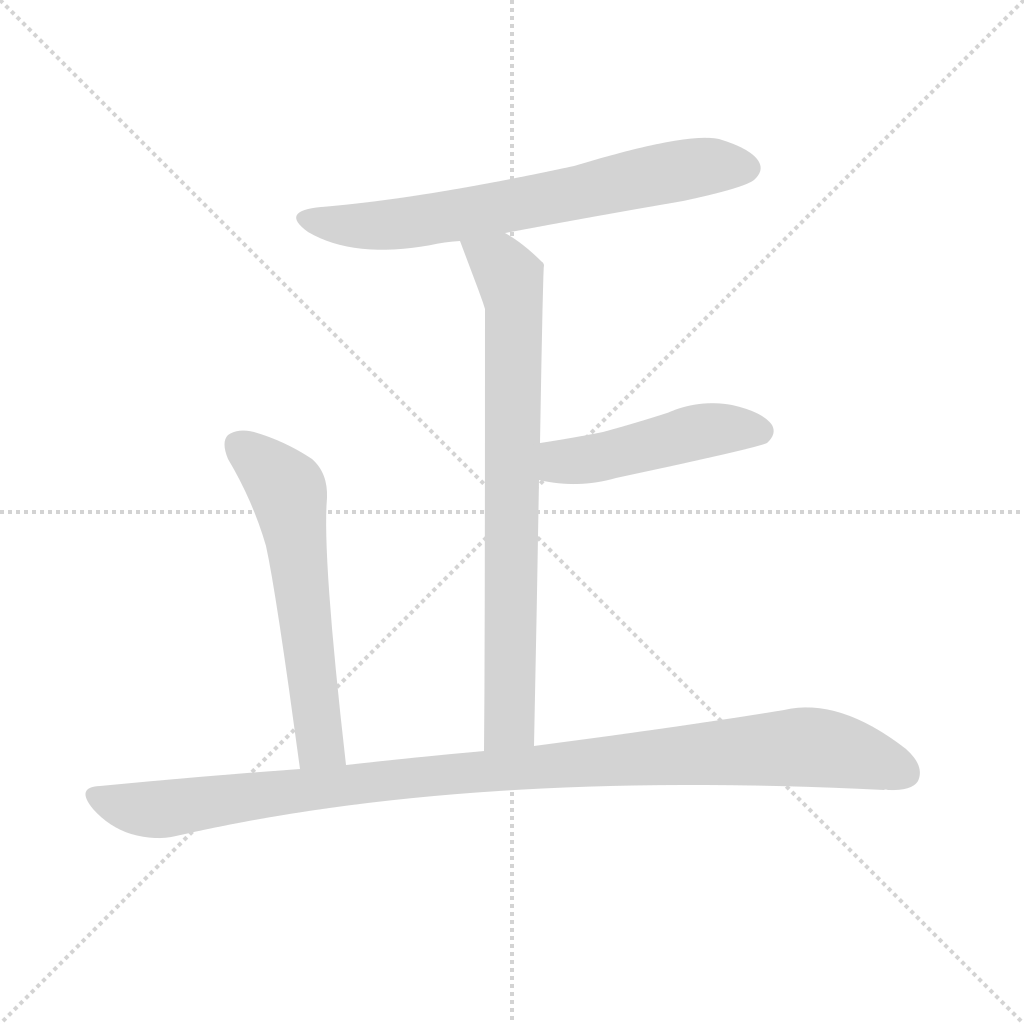
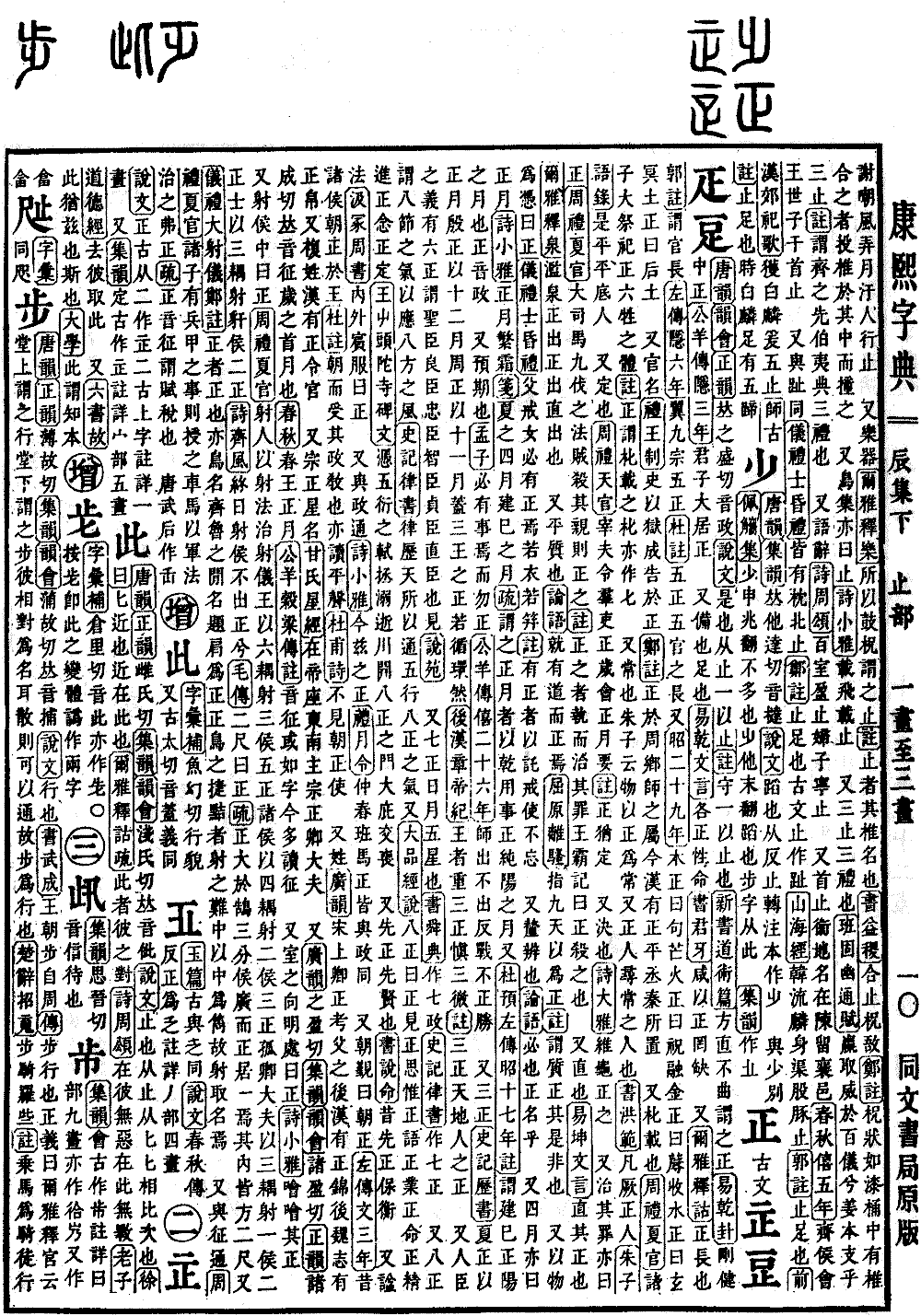
Chen Collection, Lower Volume, Radical: Stop (zhǐ); Kangxi stroke count: 5; Page 574, Entry 02
According to Tang Rhyme (Tangyun), Rhyme Collection (Yunhui), and Correct Rhymes (Zhengyun), it is pronounced zheng (fourth tone). The Explanation of Writing and Analysis of Characters (Shuowen Jiezi) interprets it as meaning right or correct. The character structure consists of stop and one, representing holding fast to one and ceasing. New Book (Xinshu), Chapter on Taoist Methods, states: That which is square, upright, and unyielding is called zheng. Book of Changes (Yijing), Qian Hexagram, states: Firm, vigorous, and centered and upright. Commentary of Zuo (Gongyang Zhuan), third year of Duke Yin, states: The gentleman honors the firm upholding of the righteous path.
It also denotes completeness and sufficiency. Book of Changes (Yijing), Qian Hexagram, Words of the Text, states: Enabling each to have their nature and destiny corrected and completed. Book of Documents (Shangshu), Jun Ya, states: All able to use the righteous path without deficiency.
According to Er Ya, Explanations of Words (Shi Gu), zheng means a high-ranking official. Guo Pu’s commentary refers to the head of officials. Commentary of Zuo (Zuo Zhuan), sixth year of Duke Yin, records: The nine lineages and five zheng of the Yi territory. Du Yu’s commentary states: Five zheng are the heads of the five offices. Also, the 29th year of Duke Zhao records: The head of the wood office is called Goumang, the head of the fire office is Zhu Rong, the head of the metal office is Rushou, the head of the water office is Xuanming, and the head of the earth office is Houtu.
It also serves as an official title. Book of Rites (Liji), Royal Regulations, states: The judicial official reports the judgment to the zheng. Zheng Xuan’s commentary notes: Zheng, during the Zhou dynasty, was equivalent to an official such as a township master; in the Han dynasty, there is a zheng ping cheng, established during the Qin dynasty.
It also refers to the cutting and carving of sacrificial animal bodies. Rites of Zhou (Zhouli), Summer Offices, states: During major sacrifices, the junior sons are responsible for dividing the bodies and bones of the six livestock. Commentary notes: Zheng refers to dividing and carving. Bi is also written as a variant form (bi).
It also means constant. Zhu Xi stated: Things take zheng as their normal state.
Zheng ren refers to ordinary or common people. Book of Documents (Shangshu), Hong Fan, states: All those officials. Zhu Zi Quotations (Zhuzi Yulei) says: It means plain and common people.
It also means to verify or determine. Rites of Zhou (Zhouli), Heavenly Offices, states: The chief steward commands the various officials to verify the annual accounting and verify the monthly statistics. Commentary notes: Zheng is like the word for determine.
It also means to decide. Book of Odes (Shijing), Greater Odes, states: Use the tortoise shell to decide it.
Punishing a crime is also called zheng. Rites of Zhou (Zhouli), Summer Offices, states: The Grand Marshal has nine principles of military conquest; those who kill their own relatives are subject to zheng. Commentary notes: To zheng them is to capture and punish their crimes. Record of Kings and Hegemons (Wangba Ji) states: Zheng means to execute them.
It also means straight. Book of Changes (Yijing), Kun Hexagram, Words of the Text, states: Straightness is its zheng. Er Ya, Explanations of Water (Shi Shui), states: A gushing spring flows out zheng. Flowing out zheng means gushing straight out.
It also means to consult or rectify. The Analects (Lunyu) states: Go to those who possess the Way to consult and rectify. Qu Yuan’s Li Sao states: Pointing to the vast heaven to serve as proof. Commentary notes: Refers to asking for a judgment on right and wrong.
It also means using items as tokens or evidence, called zheng. Book of Etiquette and Ceremonial (Yili), Marriage Rites for Scholars, states: The father admonishes his daughter, there must be a token, such as a garment or a hairpin. Commentary notes: Having zheng is to use an item to pin the admonition upon, so that she does not forget.
It also means to clarify or distinguish. The Analects (Lunyu) states: One must distinguish names and ranks.
The fourth month is also called zheng yue. Book of Odes (Shijing), Lesser Odes, states: Heavy frost fell in the fourth month. Zheng Xuan’s annotations note: The fourth month of summer is the month of the Si branch. Kong Yingda’s sub-commentary states: It is called zheng yue because at this time the Qian hexagram governs affairs, and it is a month of pure yang. Also, Du Yu’s commentary on the Commentary of Zuo (Zuo Zhuan), 17th year of Duke Zhao, states: It refers to the month of the Si branch, the month of pure yang. Zheng is pronounced zheng (fourth tone).
It also means to anticipate. Mencius states: One must cultivate it, but do not anticipate its results. Commentary of Zuo (Gongyang Zhuan), 26th year of Duke Xi, states: The army does not anticipate a certain return; in battle, one does not anticipate a certain victory.
It also refers to the Three Zheng. Records of the Grand Historian (Shiji), Book of the Calendar, states: The Xia dynasty used the first month as the beginning of the year, the Yin dynasty used the twelfth month, and the Zhou dynasty used the eleventh month; the beginnings of the year for the three kings are like a cycle. History of the Later Han (Hou Hanshu), Annals of Emperor Zhang, states: The king values the three zheng and treats the three subtle points with caution. Commentary notes: Three zheng are the righteous ways of heaven, earth, and man.
It also refers to the six zheng of a minister’s morality, meaning: holy minister, excellent minister, loyal minister, wise minister, pure minister, and direct minister. Seen in Garden of Stories (Shuoyuan).
It also refers to the Seven Zheng, meaning the sun, moon, and the five planets: metal, wood, water, fire, and earth. Book of Documents (Shangshu), Canon of Shun, writes it as seven zheng (zheng here meaning government). Records of the Grand Historian (Shiji), Book of Musical Pitch, writes it as seven zheng.
It also refers to the Eight Zheng, meaning the phenology of the eight solar terms, corresponding to the winds of the eight directions. Records of the Grand Historian (Shiji), Book of Musical Pitch, states: Musical pitch and the calendar are what heaven uses to connect the five elements and the energy of the eight zheng. Also, the Mahaprajnaparamita Sutra says the eight zheng are: right view, right thought, right speech, right action, right livelihood, right effort, right mindfulness, and right concentration. Wang Che’s Tou Tuo Temple Inscription says: Relying on the carriage of the five vehicles to save those drowning in the flowing river. Opening the gate of the eight zheng to broadly protect those meeting with distress.
It also refers to xian zheng, meaning the virtuous ministers of former generations. Book of Documents (Shangshu), Instructions of Yue, states: Formerly the virtuous minister of the past, Bao Heng.
It is also a character used in posthumous titles. Zhou Shu (Zhou Shu) states: Being submissive both inside and outside is called zheng.
Also interchangeable with zheng (politics). Book of Odes (Shijing), Lesser Odes, states: The government affairs of this year. Book of Rites (Liji), Monthly Ordinances, states: In the middle of spring, promulgate the ordinances for raising horses. Both are pronounced zheng.
It also refers to the feudal lords paying court to the Son of Heaven, called chao zheng. Commentary of Zuo (Zuo Zhuan), third year of Duke Wen, states: Formerly, the feudal lords paid court to the King of Zhou in the first month. Du Yu’s commentary: Paying court and receiving the government and teachings of the Son of Heaven. Also pronounced in the level tone. Du Fu’s poetry states: Do not see the messenger paying court.
It is also a surname. Guangyun states: It is a descendant of Zheng Kaofu, the high minister of the Song state. In the Han dynasty there was Zheng Jin, and the History of the Later Wei records Zheng Bo.
It is also a compound surname; in the Han dynasty there was Zheng Lingguan.
It is also Zong Zheng, the name of a star. Gan’s Star Classic states: It is located to the southeast of the Emperor’s Seat star and oversees the officials and grand masters of the Zong Zheng.
According to Guangyun, pronounced zheng (first tone). According to Jiyun, Yunhui, and Zheng Yun, pronounced zheng (first tone). Refers to the first month of the year. Spring and Autumn (Chunqiu) states: The king of spring in the first month. Annotations of Gongyang and Guliang commentaries read it as zheng (first tone). Or read according to the original character. Now mostly read as zheng (first tone).
It also refers to the bright, south-facing part of a room, called zheng. Book of Odes (Shijing), Lesser Odes, states: The room is bright and spacious.
It also means the center of a target, called zheng. Rites of Zhou (Zhouli), Summer Offices, states: The shooting master uses shooting methods to regulate the etiquette of archery; the Son of Heaven uses six pairs of archers to shoot at three targets (Tiger Target, Bear Target, Leopard Target) and sets up five zheng (target centers). The feudal lords use four pairs of archers to shoot at two targets (Bear Target, Leopard Target) and set up three zheng. The solitary, ministers, and grand masters use three pairs of archers to shoot at one target (Elk Target) and set up two zheng. The scholars use three pairs of archers to shoot at the canine target and set up two zheng. Book of Odes (Shijing), Odes of Qi, states: Shooting at that target all day, not leaving that center. Mao’s commentary: Two chi square is called zheng. Kong Yingda’s sub-commentary: Zheng is larger than the hu, one-third of the width of the target is the zheng area, and the zheng itself is two chi square. Also, Zheng Xuan’s commentary on Book of Etiquette and Ceremonial (Yili), Great Archery Rites, states: The meaning of zheng is correct. It is also a type of bird. In the Qi and Lu regions, the sparrowhawk is called zheng. This bird is agile and cunning, very difficult to hit, and hitting it is considered excellent, so archery competitions use its name for the center of the target.
It is also interchangeable with zheng (tax). Rites of Zhou (Zhouli), Summer Offices, states: If the junior sons have matters of war, allocate them carriages and horses and govern them with military law, and do not collect taxes. Sub-commentary: Zheng is pronounced zheng (first tone). It refers to taxes.
The character created by Empress Wu Zetian of the Tang dynasty.
Textual research: The original text in Commentary of Zuo (Gongyang Zhuan), 26th year of Duke Xi, "the army leaves, does not leave, returns" is incorrect and has been corrected based on reliable versions to "the army does not return correctly."