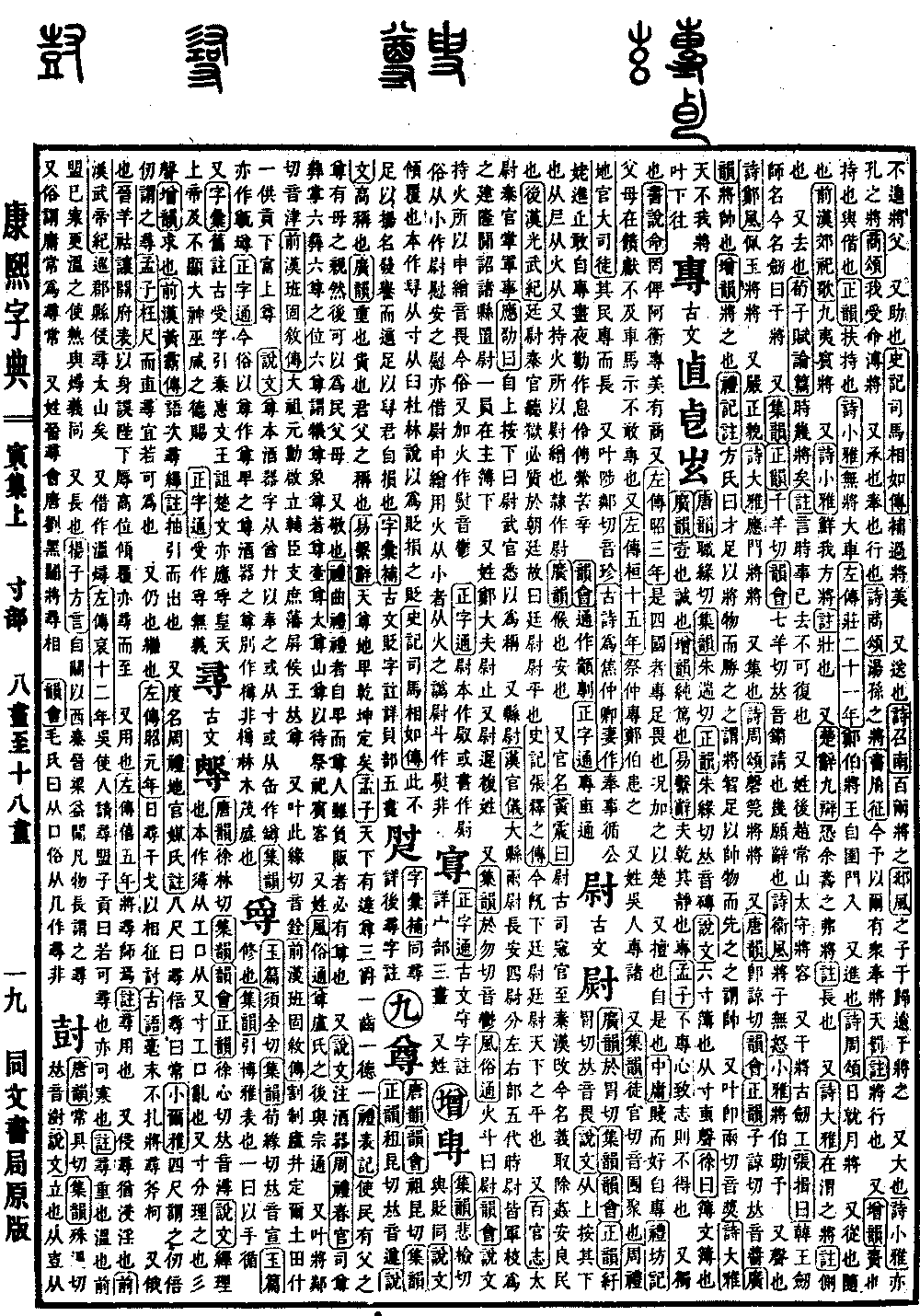
Yin Collection, Upper Volume. Radical: Inch (cùn). Zhuan. Kangxi Stroke Count: 11. Page 295. Ancient script. According to the Tang Rhymes (Tangyun), the pronunciation is zhuan. According to the Collected Rhymes (Jiyun), the pronunciation is zhuan. According to the Correct Rhymes (Zhengyun), the pronunciation is zhuan. The sound is zhuan. According to the Analytical Dictionary of Characters (Shuowen Jiezi), it refers to a six-inch ledger. It is composed of the inch radical and the phonetic component zhuan. Xu says: A ledger refers to a written record. According to the Expanded Rhymes (Guangyun), it means single-minded or sincere. According to the Augmented Rhymes (Zengyun), it means pure and earnest. In the Book of Changes (Yijing), Great Treatise (Xici): As for the Creative, in its stillness it is focused. In the Mencius (Mengzi): If one does not focus the mind and devote the will, one will not succeed. It also means solitary or exclusive. In the Book of Documents (Shujing), Charge to Yue (Shuoming): Do not let the Grand Coordinator alone possess the glory of the Shang dynasty. In the Zuo Commentary (Zuozhuan), 12th Year of Duke Zhao: Zige replied, These four states alone are enough to be feared. It also means to act on one's own authority or to be self-opinionated. In the Doctrine of the Mean (Zhongyong): To be of low status yet fond of acting on one's own authority. In the Record of Rites (Liji), Record of the Dikes (Fangji): While parents are alive, gifts do not include carriages or horses, to show that one does not dare to act on one's own authority. In the Zuo Commentary, 15th Year of Duke Huan: Zhai Zhong acted on his own authority, and the Earl of Zheng was troubled by it. Also a surname, such as Zhuan Zhu of the state of Wu. According to the Collected Rhymes, it is also pronounced tuan, meaning to gather. In the Rites of Zhou (Zhouli), Offices of Earth (Diguan), Grand Minister of Education (Dasitu): Its people are concentrated and long-lived. Also used as a rhyming word pronounced zhen. In the Old Poem Written for the Wife of Jiao Zhongqing: In serving I followed my parents-in-law; in coming and going, how could I dare act on my own authority? Day and night I worked diligently, lonely and entangled in hardship. According to the Rhyme Assembly (Yunhui), it is interchangeable with the characters pronounced zhuan or tuan. According to the Correct Character Mastery (Zhengzitong), the character zhuan and its phonetic component are interchangeable. Textual Research: Regarding the citation from the Zuo Commentary, 3rd Year of Duke Zhao, which states these four states alone are enough to be feared, and moreover they are joined by Chu, it is noted that the meaning is unclear and the year is incorrect. It is corrected to the 12th Year of Duke Zhao, where Zige replied, These four states alone are enough to be feared.