Shen Collection, Upper Volume
Radical: Grass (cǎo)
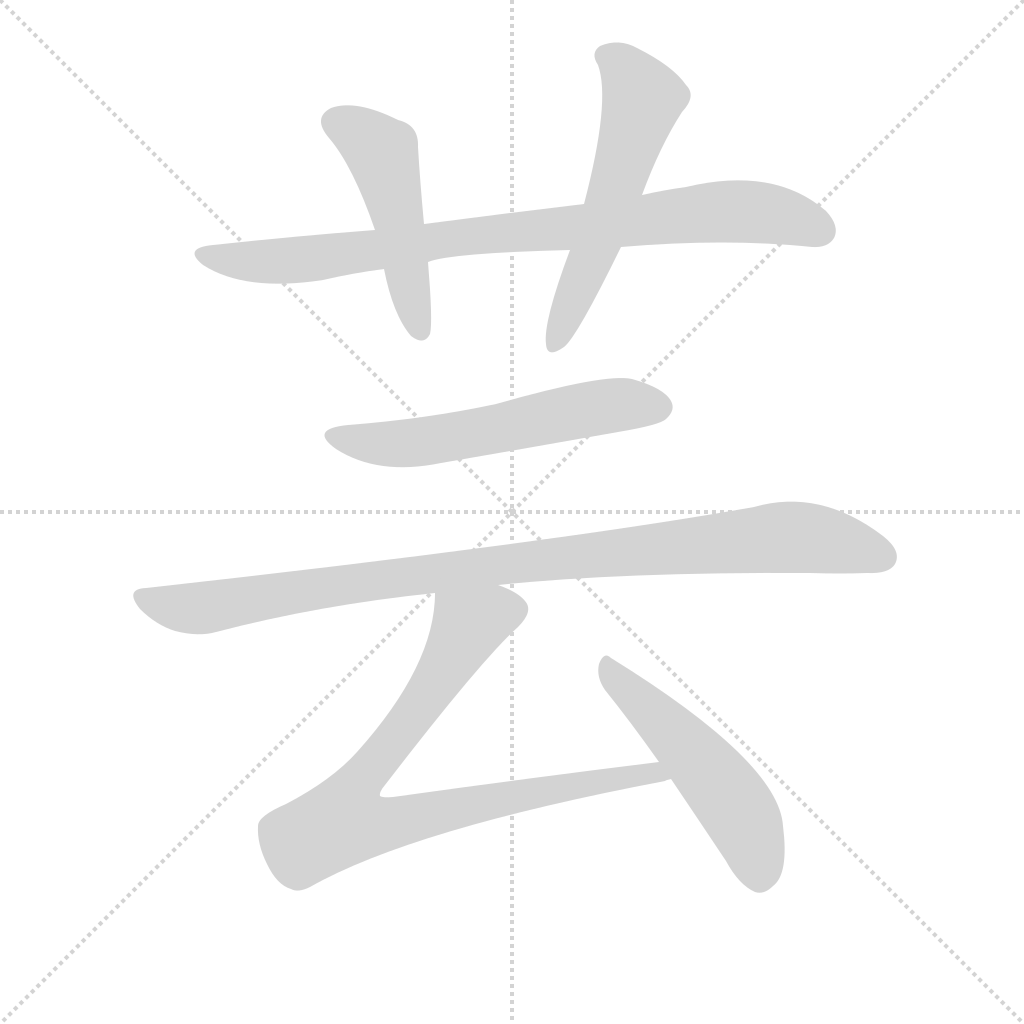
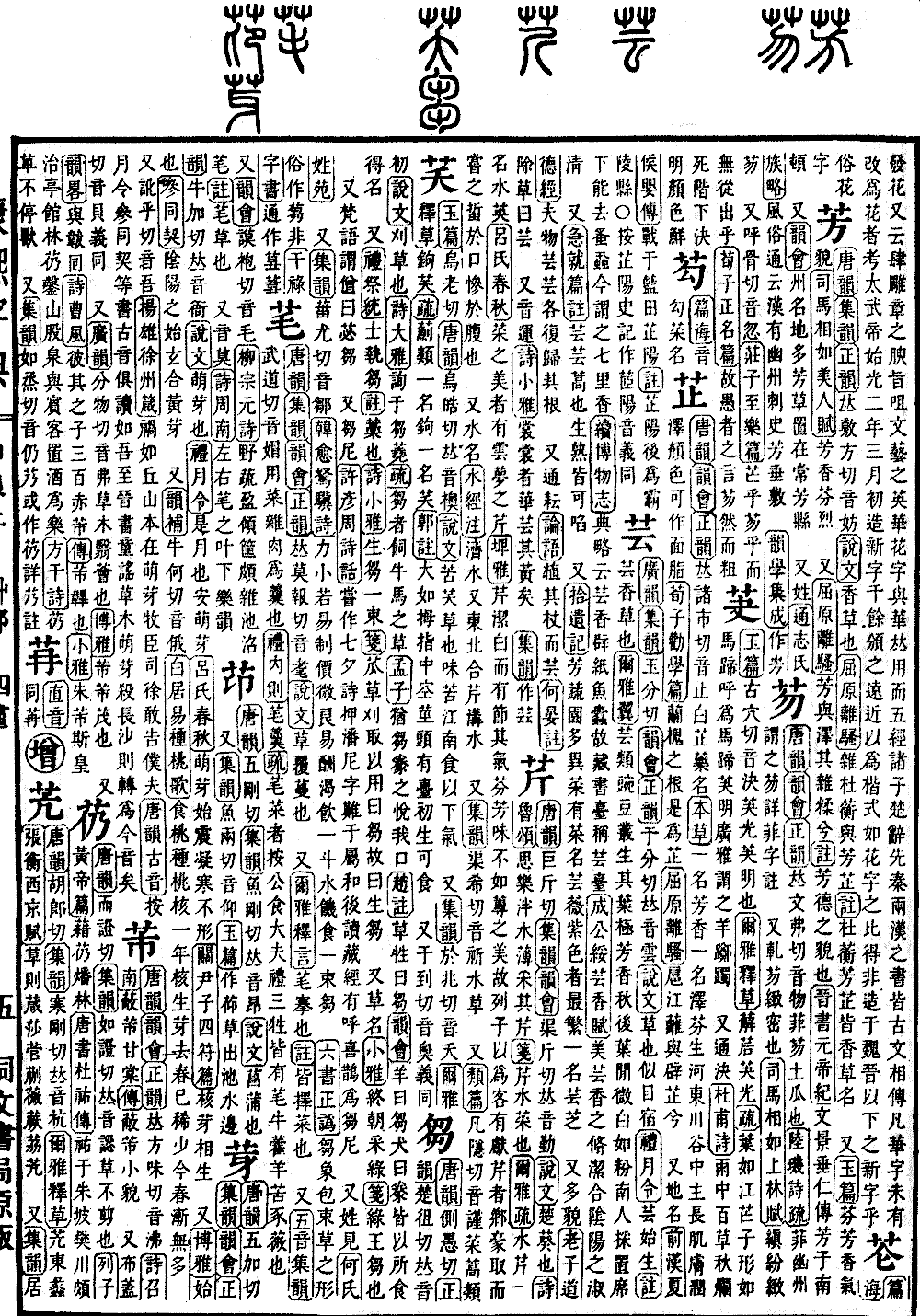
Yun. Kangxi stroke count: 10. Page 1021, Entry 07.
According to Broad Rhymes (Guangyun) and Collected Rhymes (Jiyun), it is pronounced yun. According to Rhyme Compilation (Yunhui) and Correct Rhymes (Zhengyun), it is pronounced yun. According to Explanation of Script (Shuowen), it is a type of herb, resembling alfalfa. According to Book of Rites (Liji), Monthly Ordinances (Yueling), it is when the yun herb begins to sprout. The commentary states that yun is a fragrant herb. According to Wings of the Erya (Erya Yi), yun resembles the pea plant and grows in clusters. Its leaves are extremely fragrant; after autumn, they appear slightly white as if dusted with powder. People in the south collect it and place it under mats, as it can repel fleas and lice. It is now known as seven-mile fragrance. According to Continued Records of Broad Matters (Xu Bowuzhi), the Strategy Records (Dianlüe) state that the fragrant yun herb can prevent paper from being eaten by bookworms, which is why library terraces are called yun terraces. In Cheng Gongsuis Ode to Fragrant Herbs, the author praises the yun herb for its slender cleanliness, noting it integrates the pure harmony of yin and yang.
Additionally, according to the commentary on the Quick Reference Chapters (Jijiu Pian), yun is synonymous with yun-artemisia, which can be eaten either raw or cooked. According to Records of Gleanings (Shiyi Ji), there are many exotic vegetables in the fragrant vegetable garden; there is a vegetable called yun-wei, the purple variety of which is the most lush, also known as yun-mushroom.
It is also used to describe a multitude. In Laozi, Dao De Jing, it is said: all things flourish in a multitude, each returning to its root.
It is also used interchangeably with the word for weeding. In the Analects (Lunyu), it is written: he planted his staff and weeded. He Yan's commentary states that removing weeds is called yun.
Also pronounced yun. In the Book of Odes (Shijing), Lesser Odes of the Kingdom (Xiaoya), it is written: how glorious the flowers, yellow and luxuriant. Collected Rhymes (Jiyun) lists this as a variant form.
Yun. According to Tang Rhymes (Tangyun) and Collected Rhymes (Jiyun), it is pronounced yun. According to Jade Chapters (Yupian), it is the rape turnip vegetable. According to the commentary on the Materia Medica (Bencao), this vegetable easily sprouts stalks, and one must pick the stalks so that more branches will grow, which is why it is called yun-tai (rape turnip). People in the Huai region call it tai-mustard.
It also refers to the fragrant herb yun-xiang. According to Du Yang Miscellaneous Records (Duyang Zadian), Yuan Zai built the Yunhui Hall at his private residence; that fragrance originated from the Kingdom of Khotan, white as jade, and was crushed into powder to paint the walls.
Collected Rhymes (Jiyun) notes it is sometimes written as a variant form.
Textual research: In Du Yang Miscellaneous Records (Duyang Zadian), it is written that Yuan Zai built the Yunhui Hall at his private residence, and its fragrance originated from the Kingdom of Khotan. Following the original text, Yu-tian has been corrected to Khotan (Yutian).