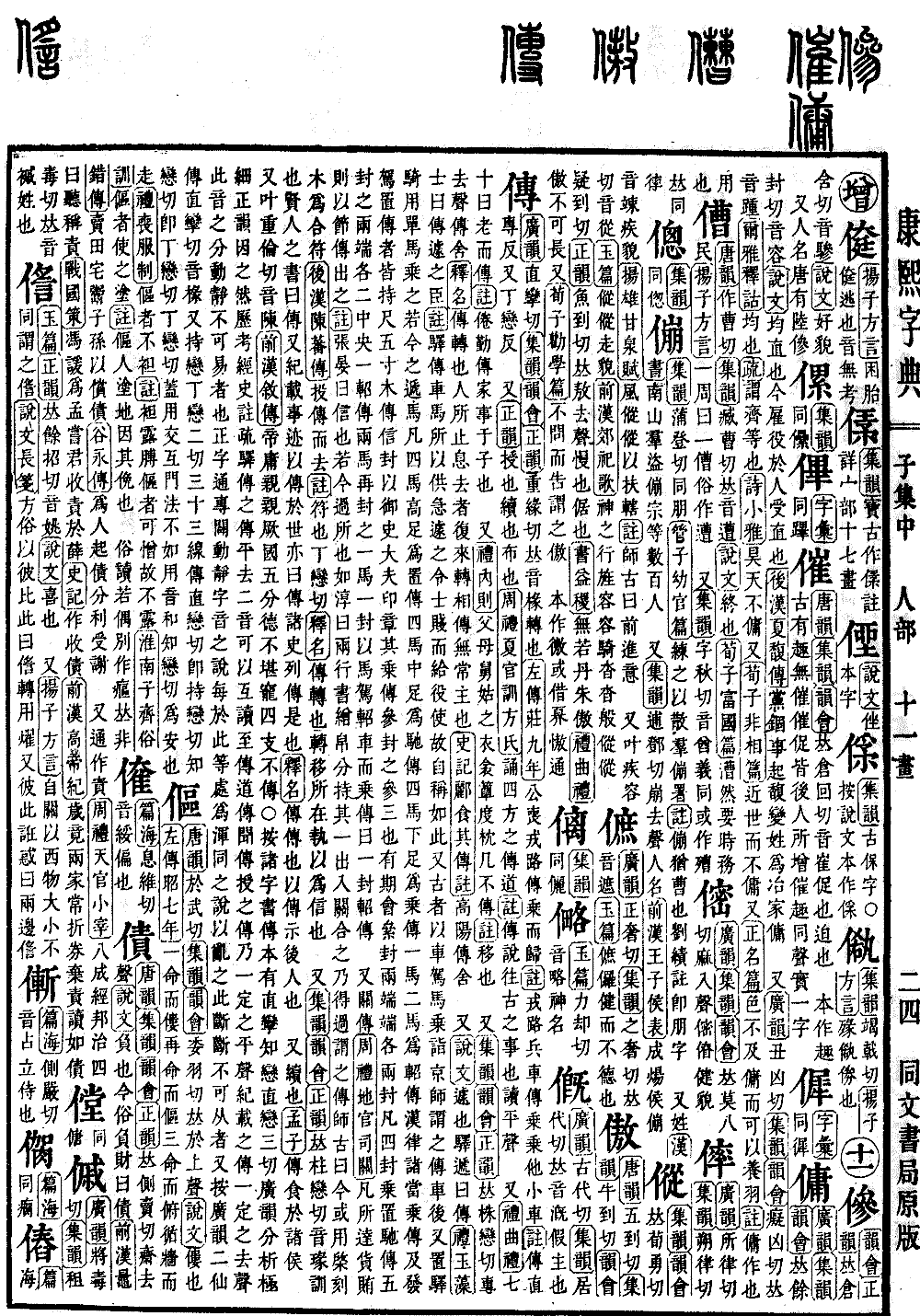
Zi Collection, Middle Volume
Radical: Person (rén)
Page 114, Entry 01
Kangxi Stroke Count: 13
According to the Guangyun (Broad Rhymes), pronounced chuan (level tone). According to the Jiyun (Collected Rhymes), the Yinhui (Compendium of Rhymes), and the Zhengyun (Correct Rhymes), pronounced chuan (falling tone).
To rotate.
Zuo Zhuan (Chronicle of Zuo), 9th Year of Duke Zhuang: The Duke lost his military chariot, rotated to another carriage and returned. Commentary: Military road refers to a military chariot. Rotating to another carriage means boarding a different vehicle.
Shuowen (Explication of Script): According to the exegesis, pronounced chuan (level tone); also pronounced zhuan (falling tone).
To bestow, to continue, to distribute.
Rites of Zhou (Zhouli), Summer Officials, Xunfang Shi: To recite the teachings handed down from the four quarters. Commentary: This refers to stories about ancient events. Read in the level tone.
Book of Rites (Liji), Qu Li: At seventy, one is called old and hands down responsibilities. Commentary: Tired of diligence, one transfers family affairs to their son.
Book of Rites (Liji), Nei Ze: The clothing, bed mats, pillows, and small tables of parents or parents-in-law should not be transferred. Commentary: To move or shift.
According to the Jiyun, Yinhui, and Zhengyun, pronounced zhuan (falling tone).
A relay station or post house.
Shiming (Explanation of Names): Chuan means to rotate. It is a place where people stop to rest; those who leave are replaced by others. It rotates, meaning there is no permanent master.
Records of the Grand Historian (Shiji), Biography of Li Yiji, Commentary: The relay house of Gaoyang.
According to the Shuowen: Rapid, relay transport is called chuan.
Book of Rites (Liji), Yu Zao: Officials are called ministers of post and relay. Commentary: Post and relay carriages and horses are used to fulfill urgent orders; because the official is of low rank and serves in this capacity, he refers to himself as such.
In ancient times, carriages and horses were used to travel to the capital, referred to as post carriages. Later, relay riders were established using single horses, similar to modern postal horses. Generally, those with four high-stature horses were called designated relay stations; four medium-stature horses were called swift relay stations; four low-stature horses were called carriage relay stations; one or two horses were called light carriage relay stations.
According to Han statutes, those permitted to ride relay carriages or dispatch them carried a wooden pass measuring one foot five inches, sealed with the seal of the Censor-in-Chief. This was sealed thrice. Three represents the count. If there were scheduled meetings, the seals were doubled at both ends, with two seals at each end, totaling four seals. Swift relay carriages were sealed five times, with two seals at each end and one in the center. Light carriages were pulled by two horses and sealed twice; one horse pulled the light carriage and was sealed once.
Passes for barriers.
Rites of Zhou (Zhouli), Earth Officials, Si Guan: Whenever goods or bribes are transported, they are passed through with a tally.
Book of Han (Hanshu), Annals of Emperor Wen, Commentary: Zhang Yan stated: It acts as a letter of credence, similar to modern travel permits. Ru Chun stated: Two rows of characters were written on silk; each party held one part. When passing through a barrier, they were joined to allow passage, which is called a pass. Shigu stated: Nowadays, some use carved wood as matching tallies.
Book of the Later Han (Houhanshu), Biography of Fan: Threw away the pass and departed. Commentary: A tally.
Shiming (Explanation of Names): Chuan means to rotate. To transfer from one location to another, holding this as a sign of authenticity.
According to the Jiyun, Yinhui, and Zhengyun, pronounced zhuan (falling tone).
Teachings. Books written by sages are called chuan.
Recording deeds to pass them down to the world is also called chuan; the biographies in the various histories are examples of this.
Shiming (Explanation of Names): Chuan means to transmit. To pass on knowledge to later generations.
To continue.
Mencius: To relay food among the feudal lords.
Also pronounced zhuan (falling tone) in rhyme.
Book of Han (Hanshu), Narrative Biography: The Emperor sought to show affection to his kin, dividing the country into five parts; the virtue could not bear the favor, and the four limbs were not transmitted.
Note: In the various character dictionaries, chuan originally had the three pronunciations of chuan (level tone), zhuan (falling tone), and zhuan (falling tone). The Guangyun analyzes these in extreme detail, and the Zhengyun follows this. However, after examining the classics and commentaries, the pronunciation of post-relay chuan can be read in both level and falling tones. As for the chuan in teaching, hearsay, and instruction, it is strictly in the level tone. For historical records, it is strictly in the falling tone. This distinction between the moving and the still is immutable. The Zhengzitong (Correction of Characters) attempts to refute the theory of moving and still pronunciations, often conflating them to create confusion; this must absolutely not be followed.
Note also: In the Guangyun, under the rhyme xian, chuan is pronounced chuan (level tone), and also zhuan (falling tone). Under the rhyme xian, chuan is pronounced zhuan (falling tone). The pronunciation zhuan (falling tone) appears to use the interactive method, which is not as clear as the harmonious reading of zhuan (falling tone).