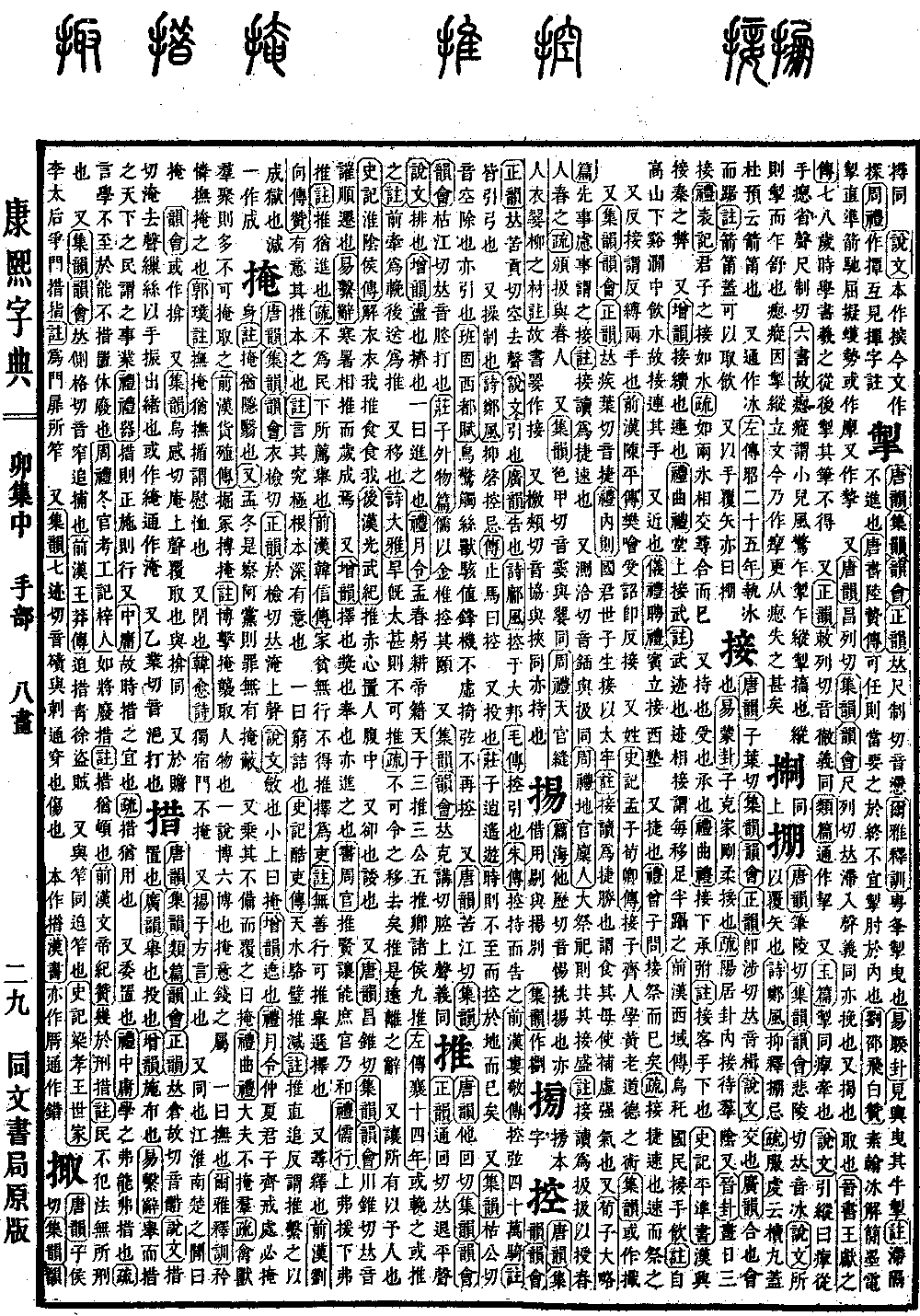
Mao Collection, Middle Volume
Radical: Hand (shǒu)
Kangxi Strokes: 12
Page 439, Entry 11
Pronounced zou.
According to the Shuo Wen Jie Zi (Explaining Graphs and Analyzing Characters), it refers to the act of beating or striking to maintain vigilance while keeping watch at night.
In the Zuo Zhuan (Commentary of Zuo), it is written: A subordinate official kept watch against those who acted dissolutely. The explanation of the text notes that the word gan is pronounced han.
In another passage from the Year 20 of the Duke Zhao of Lu, it says: The guest was about to keep watch, and the host declined. The commentary states that the term refers to the patrol who beats a wooden clapper at night, similar to modern night watchmen beating a gong.
It is also a place name. In the History of the Later Han (Hou Hanshu), in the Biography of Gengshi, it notes: The Red Eyebrows set up Liu Penzi; Gengshi ordered Li Song to station troops at Zou to resist them. The commentary states that the Continuation of the History of the Later Han (Xu Hanshu Zhi) records that there was a Zou City in Xinfeng.
Also, it is pronounced chou (rising tone). The meaning is the same as the above. It refers to holding something and making contact with another object.
Also pronounced ju. It means to strike or beat.
Also, according to the Jiyun, it is pronounced chou. It refers to using one's hand to take something.
Also pronounced zou. It means to hold something.
Also pronounced zou (rising tone). It also means to strike or beat.
In the History of the Former Han (Qian Hanshu), in the Record of the Five Elements, it is written: The people ran in alarm holding stalks, some holding a zou. The commentary notes that this refers to a hemp stalk. Note that wood is called zou, while hemp stalks are called cou. It is sometimes written as the character pronounced mao. The Rhyme Compilation (Yunhui) suggests that the character pronounced mao is interchangeably written as this character, which is a continuation of an error found in common editions.
According to the Jiyun, it is sometimes written as the character pronounced qu.
Textual Research: In the Zuo Zhuan, Year 25 of Duke Xiang, the phrase: A subordinate official kept watch against those who acted dissolutely. The note says: The word gan is pronounced han. I have corrected the explanation of the text in accordance with the original book note.