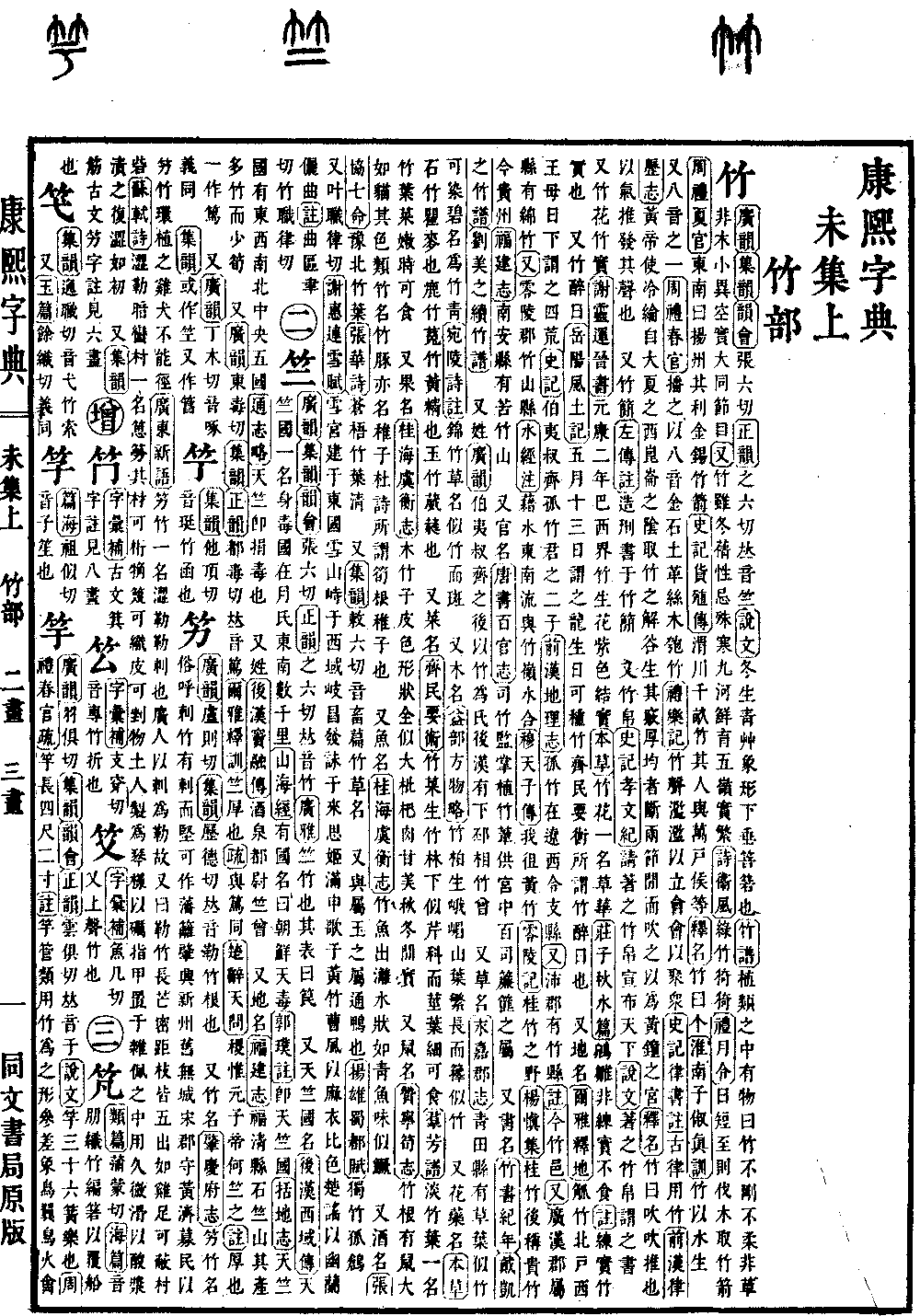
Wei Collection, Upper Volume
Radical: Bamboo (zhú)
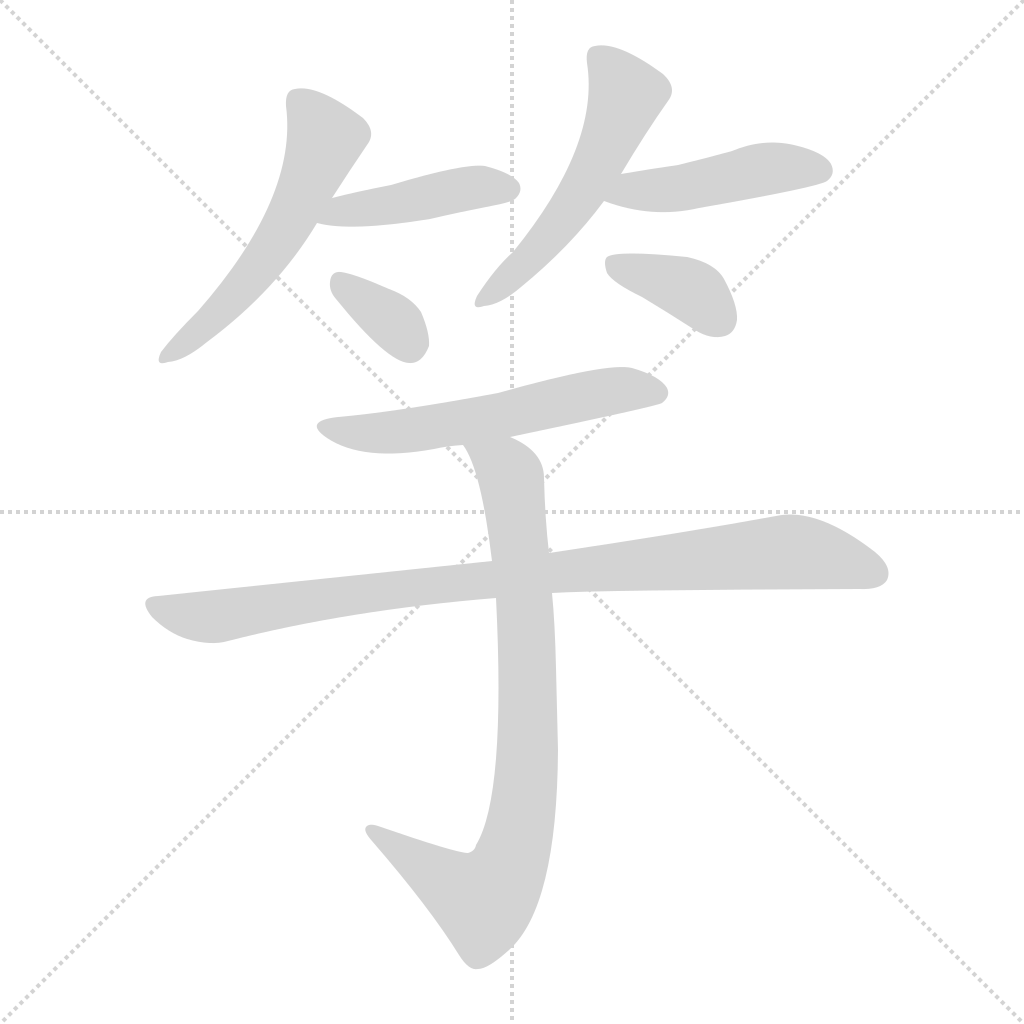
Yu
Kangxi stroke count: 9
Page 877, Entry 11
Pronounced yu.
According to the Explaining Graphs and Analyzing Characters (Shuowen), the yu is a musical instrument with thirty-six reeds.
According to the Commentary on the Office of Spring in the Rites of Zhou (Zhouli), the yu is four feet and two inches long. The commentary notes that the yu is a type of pipe instrument. It is made of bamboo, and its shape is irregular, resembling bird wings. The bird is a fire creature. The number for fire is seven. It is played at the winter solstice when water governs; the number for water is six, and six times seven is forty-two. The length of the yu is likely derived from this.
According to the Genealogies (Shiben), Sui invented the yu.
According to the Explanation of Names (Shiming), the term yu refers to its hollow center.
According to the Broad Study (Boya), the yu resembles the sheng, featuring thirty-six pipes with the principal pipe located in the center.
According to the Book of Music (Yueshu), modern sheng and yu possess nineteen reeds. The yu and sheng are different instruments but produce the same harmony; therefore, in the Rites of Zhou, the Shensheng (Master of the Sheng) is responsible for both.
The Rites of Zhou, Office of Spring, states that the Master of the Sheng is responsible for teaching the playing of the yu.
The Book of Rites (Liji), Record of Music, states that when a gentleman listens to the yu and sheng, he thinks of ministers who accumulate wealth and store goods.
According to the Yi Tong Gua Yan (Comprehensive Verification of the Changes and Trigrams), at the winter solstice, one plays the yellow bell pitch, and the intermediate music is provided by the yu.
The Laozi Dao De Jing states: Wearing patterned robes, carrying sharp swords, gorging on food and drink, and hoarding surplus wealth—this is called a robber's yu. The commentary notes that the yu is the leader of the five musical notes. When the yu leads, all other music harmonizes; when a great villain leads, petty thieves follow, hence it is called a robber's yu.
In the Collected Rhymes (Jiyun), it is sometimes written in a variant form.
Textual research: In the Explanation of Names, it says the yu refers to its hollow center. According to the original text, the character for sweat has been corrected to the character for hollow. In the Book of Rites, Record of Music, it says when a gentleman listens to the yu and sheng. According to the original text, the order has been corrected to yu and sheng.