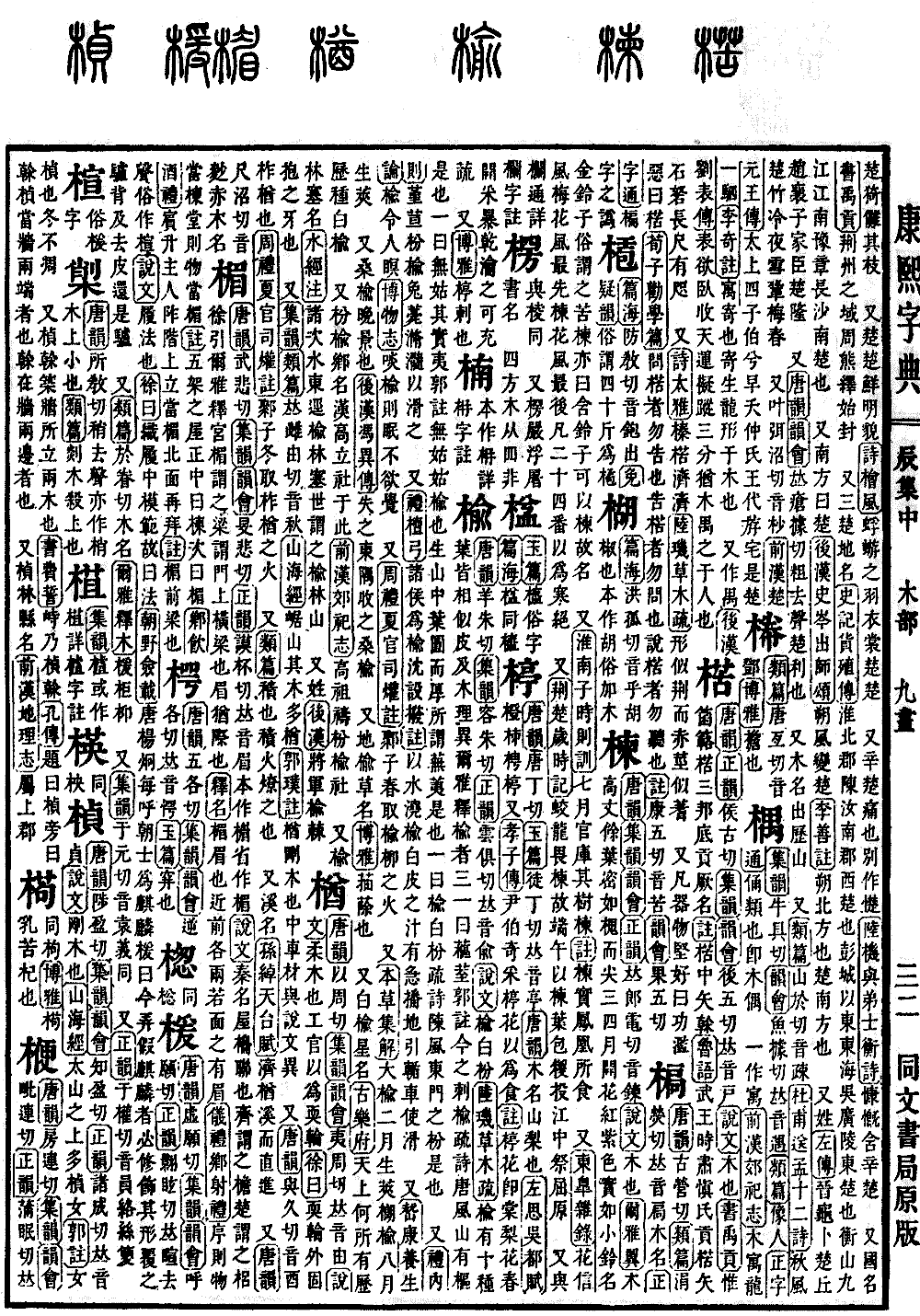
Chen Collection, Middle Volume
Radical: Tree (mù)
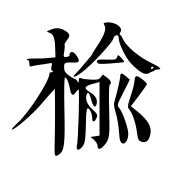
榆
Kangxi strokes: 13
Page 540, Entry 12
Pronounced yu.
Shuowen Jiezi (Dictionary of Explaining Graphs and Analyzing Characters) states that elm is a white elm. Lu Ji in Commentary on the Grasses and Trees (Caomu Shu) notes that there are ten types of elms with similar leaves, but different bark and wood grain.
The Erya (Approaching Elegance) explains three types of elms:
One is called haochi. Guo Pu notes: This is the modern thorny elm. The commentary says: The Book of Odes (Shijing) mention of the tree in the Tang的风 section refers to this.
One is called wugu, the fruit of which is called yi. Guo Pu notes: Wugu is the maiden elm, growing in mountains with round, thick leaves; it is what is known as wuyi.
One is white elm. The commentary says: The Book of Odes (Shijing) mention of the elm in the Chen的风 section refers to this.
Additionally, the Book of Rites (Liji) states that one should use violet greens, viola, elm leaves, and white elm leaves, whether fresh or dried, to thicken rice water for soup.
The Book of Rites (Liji) also notes that feudal lords used a substance made from elm sap during burials to assist in sliding the funeral carriage. The commentary explains: One pours the sap of white elm bark on the ground to create a slick surface for the hearse.
In Xi Kang's Essay on Nourishing Life (Yangsheng Lun), it is written that consuming elm makes one sleepy. The Treatise on Diverse Things (Bowuzhi) notes that eating elm causes one to fall asleep and not want to wake.
In the commentary to the Rites of Zhou (Zhouli), it is mentioned that the master of fire drills elm and willow wood in spring to create fire.
The Collection of Materia Medica (Bencao Jijie) notes that the large elm produces seed pods in the second month, while the lacebark elm produces them in the eighth month.
Sangyu is a metaphor for one's later years. The Book of the Later Han (Hou Hanshu) records: What is lost in the morning is compensated for in the evening (often understood as losing in the east and gaining in the west).
Diyu is the name of a type of grass. The Guangya (Broadening Elegance) identifies this as chouchu.
White Elm (Baiyu) is the name of a star. The Ancient Music Bureau (Gu Yuefu) poems ask: What is in the heavens? Clearly aligned are the stars of the White Elm.
Fenyu is the name of a village. Emperor Gaozu of Han established a shrine there. The Book of the Former Han (Qian Hanshu) records that Gaozu prayed at the Fenyu Shrine.
Yulin is the name of a frontier pass. The Commentary on the Water Classic (Shuijing Zhu) states that the Zhucishui River flows east through the Yulin Pass, known to the world as Yulin Mountain.
Also a surname. The Book of the Later Han (Hou Hanshu) records a General Yuji.