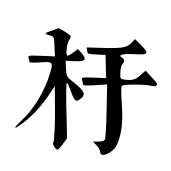
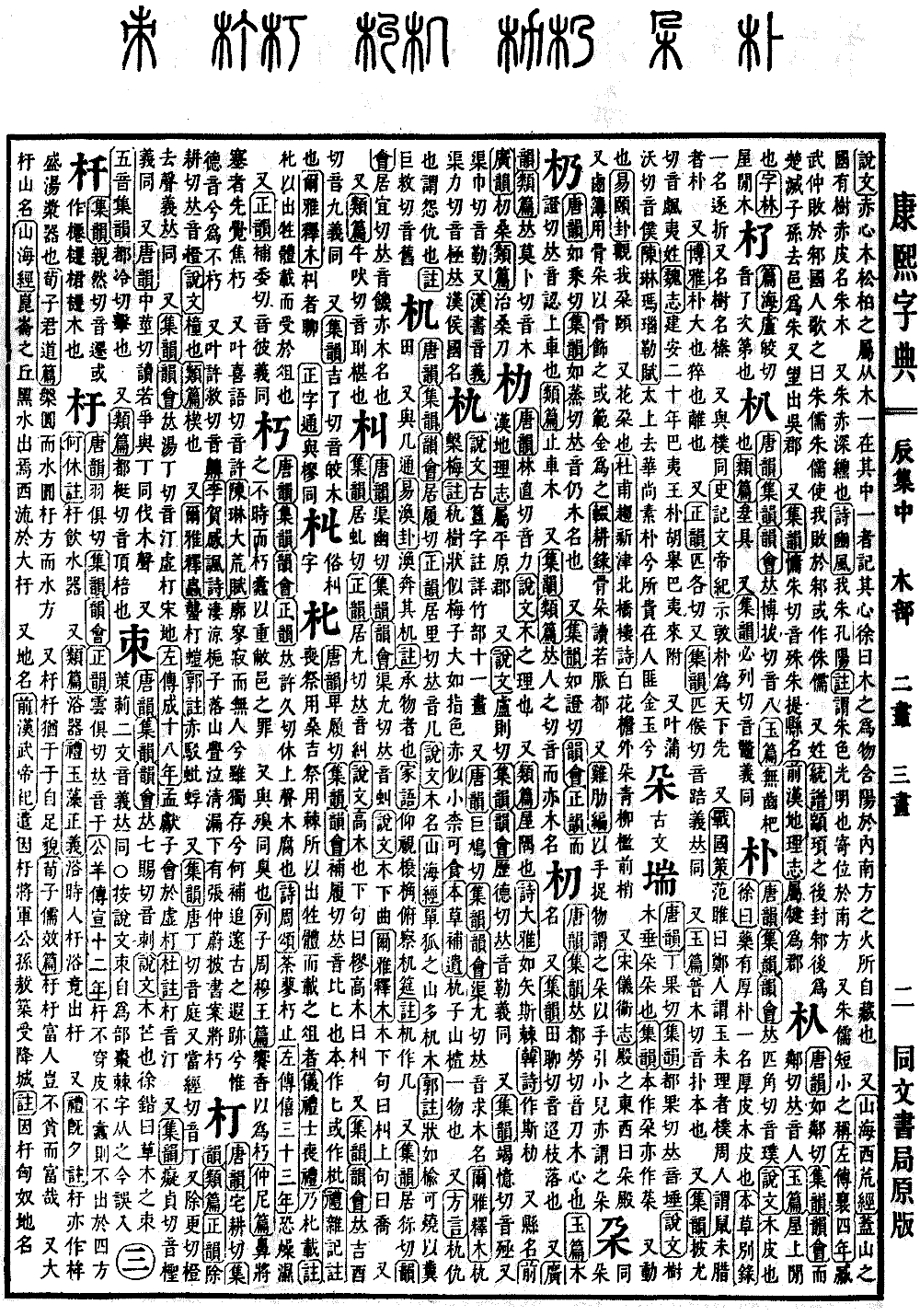
Chen Collection, Middle Volume
Radical: Tree (mù)
Kangxi stroke count: 7
Page 510, Entry 20
Pronounced yu.
Commentary in the Gongyang Commentary on the Spring and Autumn Annals (Gongyang Zhuan): If the drinking vessel is not worn through and the hide is not moth-eaten, then they do not go out to the four quarters. He Xiu’s annotation: A drinking vessel.
Also, according to the Classified Chapters (Leipian): A bathing vessel.
Book of Rites (Liji), Jade Pattern section: When bathing, enter the vessel; when bathing is finished, exit the vessel.
Ceremonial and Rituals (Yili), Supplementary notes on the funeral rites: Also written as a variant form (mú), a basin for holding hot water or broth.
Xunzi, The Way of the Ruler: If the basin is round, the water is round; if the vessel is square, the water is square.
Also, the term used to describe a self-satisfied appearance. Xunzi, Effectiveness of the Confucians: Self-satisfied and wealthy, how can one be impoverished and yet be considered wealthy?
Also, Dayu is the name of a mountain. Classic of Mountains and Seas (Shanhaijing): The Kunlun heights, where the Black River originates, flow west into Dayu.
Also, a place name. History of the Former Han (Qianhanji), Annals of Emperor Wu: Sent the Yinyu General Gongsun Ao to build the Surrender-Receiving City. Annotation: Yinyu is a place name in the territory of the Xiongnu.
Pronounced yu. The meaning is the same.
Records of the Grand Historian (Shiji), Annals of Qin: Qin was able to burn the dwellings and destroy the vessels of the lord’s state. Annotation: Pronounced wu. Note: In ancient texts, this character was the same as another (wū), but now they are separated.
Textual research: In the annotation to the Ceremonial and Rituals, it is noted that the character is also written in a variant form and is a vessel for holding hot water or broth. Following the original text, the word Ceremonial has been added to the Book of Rites reference, and the word vessel has been changed to basin.