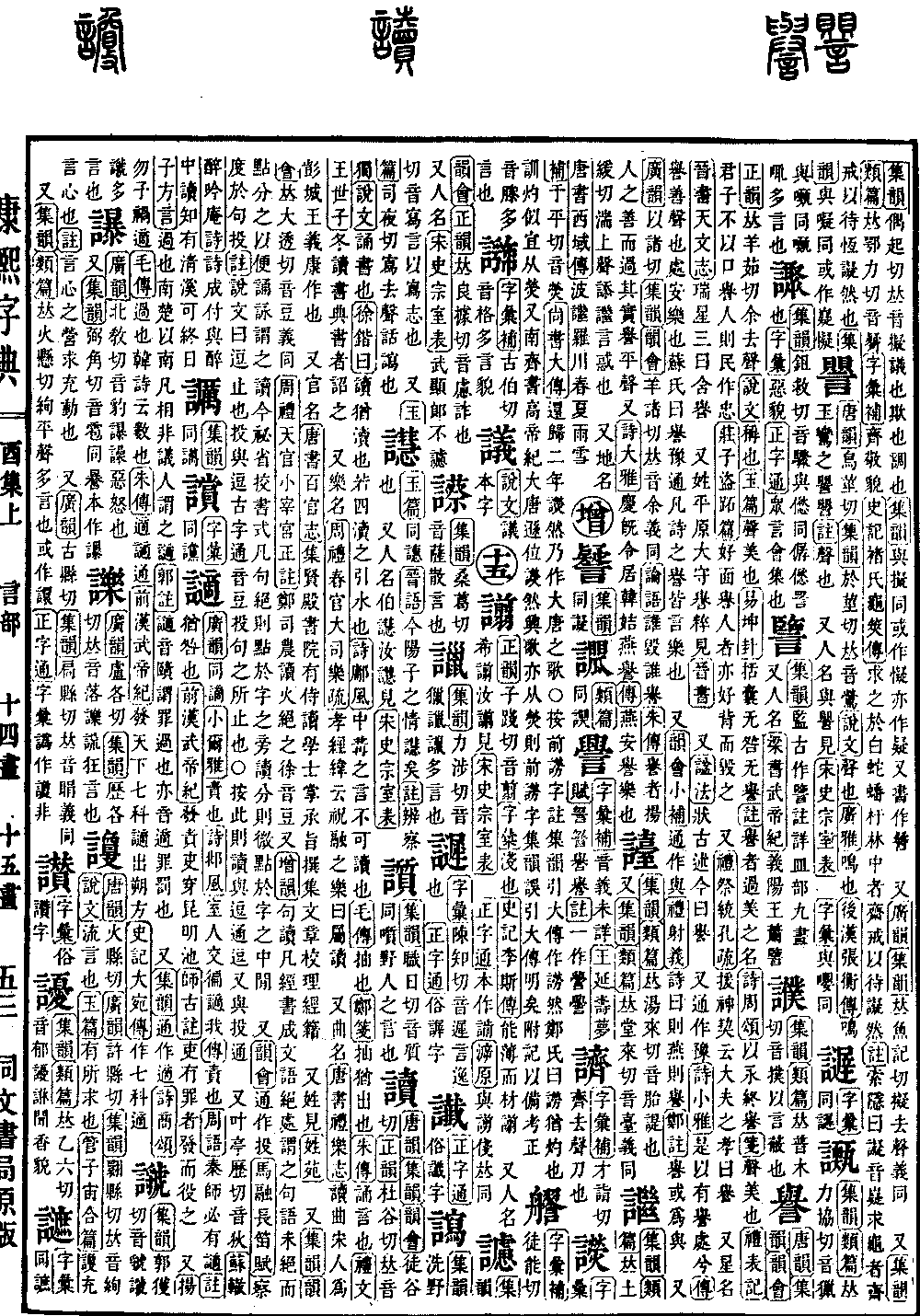
You Collection, Upper Volume
Radical: Speech (yán)
Yu
Kangxi Strokes: 21
Page 1185, Entry 01
Pronounced yu (falling tone).
Shuowen Jiezi (Explanation of Characters): To praise.
Yupian (Comprehensive Glossary): Beautiful sound.
Book of Changes (Yijing), Kun Hexagram: Tie tight the sack, there shall be no calamity nor praise. Commentary: Praise is a reputation that exceeds one's true qualities.
Book of Odes (Shijing), Zhou Song: In order to long maintain a beautiful reputation. Note: Beautiful sound.
Book of Rites (Liji), Biao Ji: If a superior person does not praise others with empty words, the common people will flourish in loyalty.
Zhuangzi, Robber Zhi: Those who enjoy flattering others to their faces also enjoy slandering them behind their backs.
Book of Rites (Liji), Ji Tong, Kong Yingda Sub-commentary: Citing the Shen Qi: The filial piety of a grand master is called praise.
Also the name of a celestial body. Book of Jin (Jinshu), Treatise on Astronomy: Among the auspicious stars, the third is called Han Yu.
Also a surname. The Governor of Pingyuan, Yu Cui. See Book of Jin (Jinshu).
Also, in the Law of Posthumous Titles: Describing ancient deeds and commenting on current affairs is called praise.
Also used interchangeably with the character yu (pleasure). Book of Odes (Shijing), Xiao Ya: Thus enjoying a good reputation and peace. Commentary: Praise means beautiful reputation. Peace means comfort. Su's commentary states: Praise and pleasure are interchangeable. Every instance of praise in the Book of Odes refers to happiness.
Also, according to Yunhui Xiaobu, used interchangeably with the character yu (give). Book of Rites (Liji), She Yi: The Book of Odes says: To approach the feast and approach the joy. Zheng's Commentary: For praise, some versions write give.
Also, pronounced yu (level tone). Same meaning.
Analects (Lunyu): Who slanders and who praises? Zhu's Commentary: Praise means to proclaim the virtues of others, exceeding the actual facts. Here, praise is pronounced in the level tone.
Also, Book of Odes (Shijing), Da Ya: Rejoicing in a good dwelling, Han Ji is happy and joyful. Commentary: Yan means peace. Praise means joy.