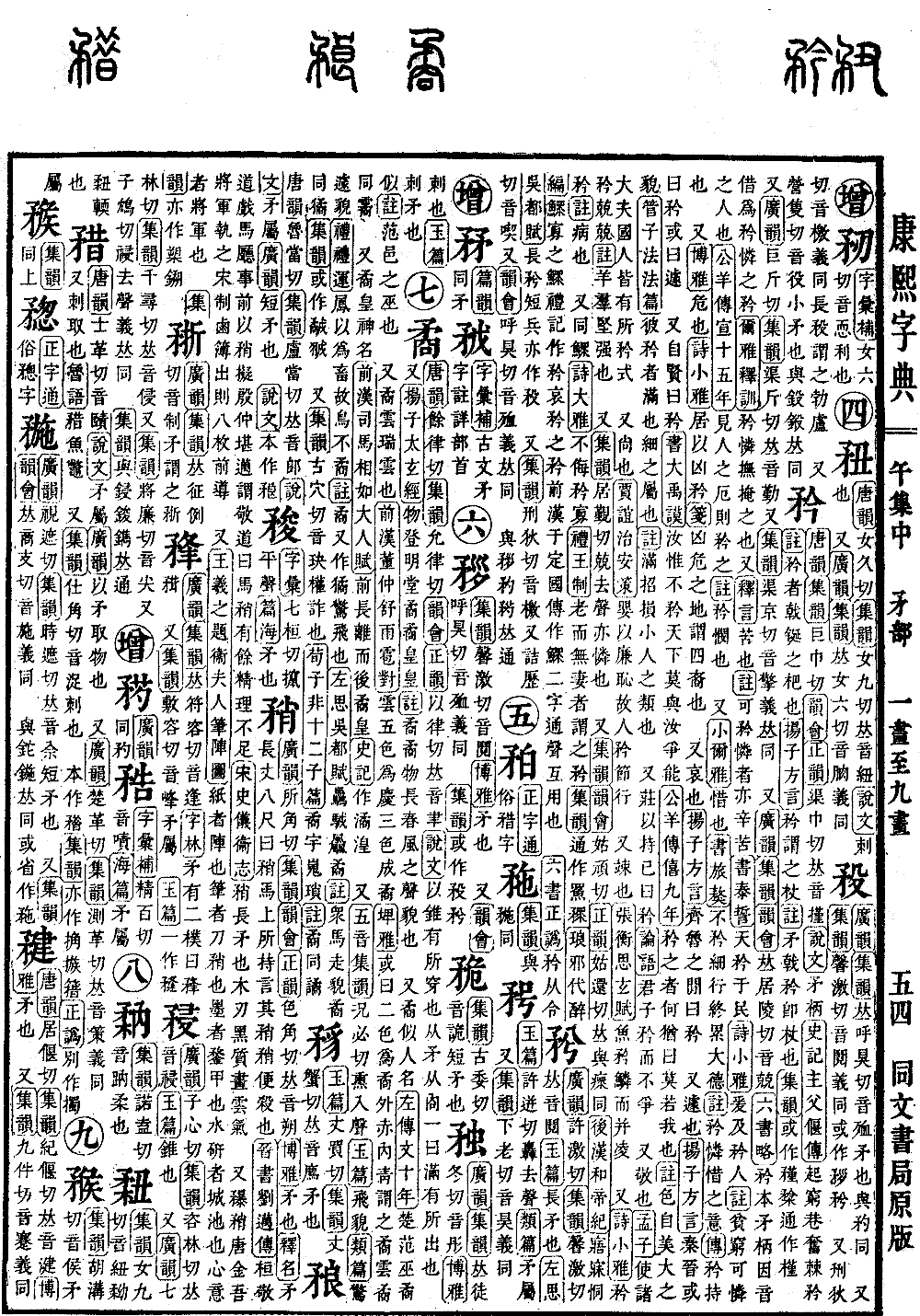
Wu Collection, Middle Volume
Radical: Spear (máo)
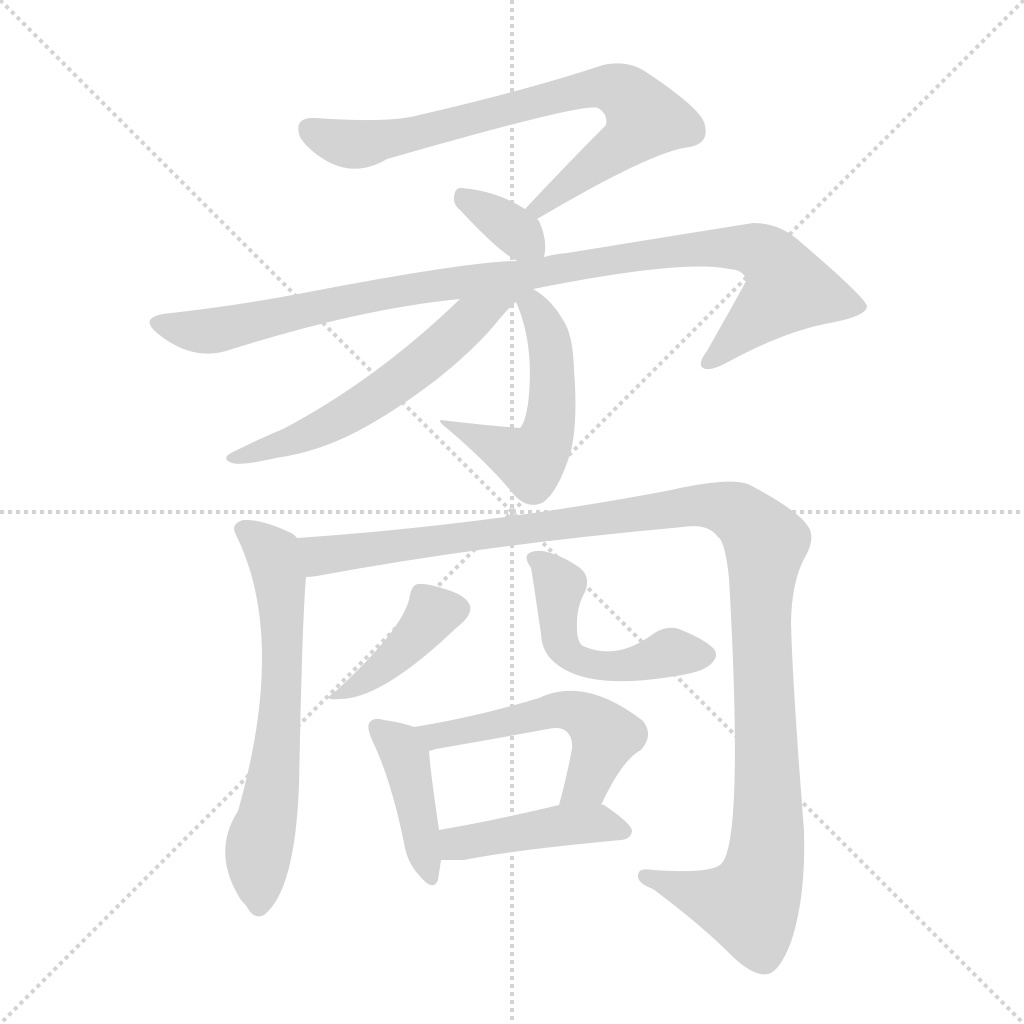
矞
Kangxi Strokes: 12
Page 822, Entry 14
Pronounced yù. According to the Tang Rhyme (Tangyun), Jiyun, Yunhui, and Zhengyun, the pronunciation is equivalent to the character pronounced yù. According to the Explaining Graphs and Analyzing Characters (Shuowen Jiezi), it refers to the act of piercing something with an awl. The character is composed of the radical for spear and an additional element. Another definition suggests it describes something full that is overflowing.
It is also used in the Taixuanjing by Yangzi: All things ascend to the Bright Hall, appearing glorious and abundant (yùyù huánghuáng). The commentary explains that yùyù refers to the sound and appearance of all things growing in the spring breeze.
It appears in the name Yùsì. In the Zuo Tradition (Zuozhuan), Year 10 of Duke Wen, it refers to the shaman Yùsì of the Fan territory of the state of Chu. The commentary notes that he was a shaman of the Fan territory.
It also refers to yùyún, which describes auspicious clouds. In the Book of Han (Hanshu), specifically the Response of Dong Zhongshu regarding rain and hail, it is noted that five-colored clouds are a sign of good fortune, while three-colored clouds are called yùyún. The Piya states that some believe two colors constitute yù, and a cloud that is red on the outside and blue on the inside is called yùyún. The character yù is equivalent to the character pronounced yù.
There is also a deity named Yùhuáng. In the Book of Han, specifically the Daren Fu by Sima Xiangru, it is written that the Changli is in front and the Yùhuáng is behind. The Records of the Grand Historian (Shiji) writes this as yuéhuáng.
Also, according to the Wuyin Jiyun, pronounced xūn (entering tone). The Yupian describes it as the appearance of flying. The Leipian describes it as the appearance of being startled and hurried. In the Book of Rites (Liji), specifically the Liyun chapter, it says when the phoenix is tamed, the flocks of birds will not be startled into flight. The commentary notes that yù is also written as chù, referring to being startled and flying away. In the Wu Capital Rhapsody (Wu Du Fu) by Zuo Si, it refers to the appearance of a multitude of horses galloping. Here, yù is equivalent to the character chù. Jiyun notes it is sometimes written with a variant form.
Also, according to Jiyun, pronounced jué. It refers to craftiness or deceit. In the Xunzi, specifically the Against the Twelve Masters chapter, it appears in a phrase describing devious and petty behavior. The commentary notes that here, yù is equivalent to the character jué.