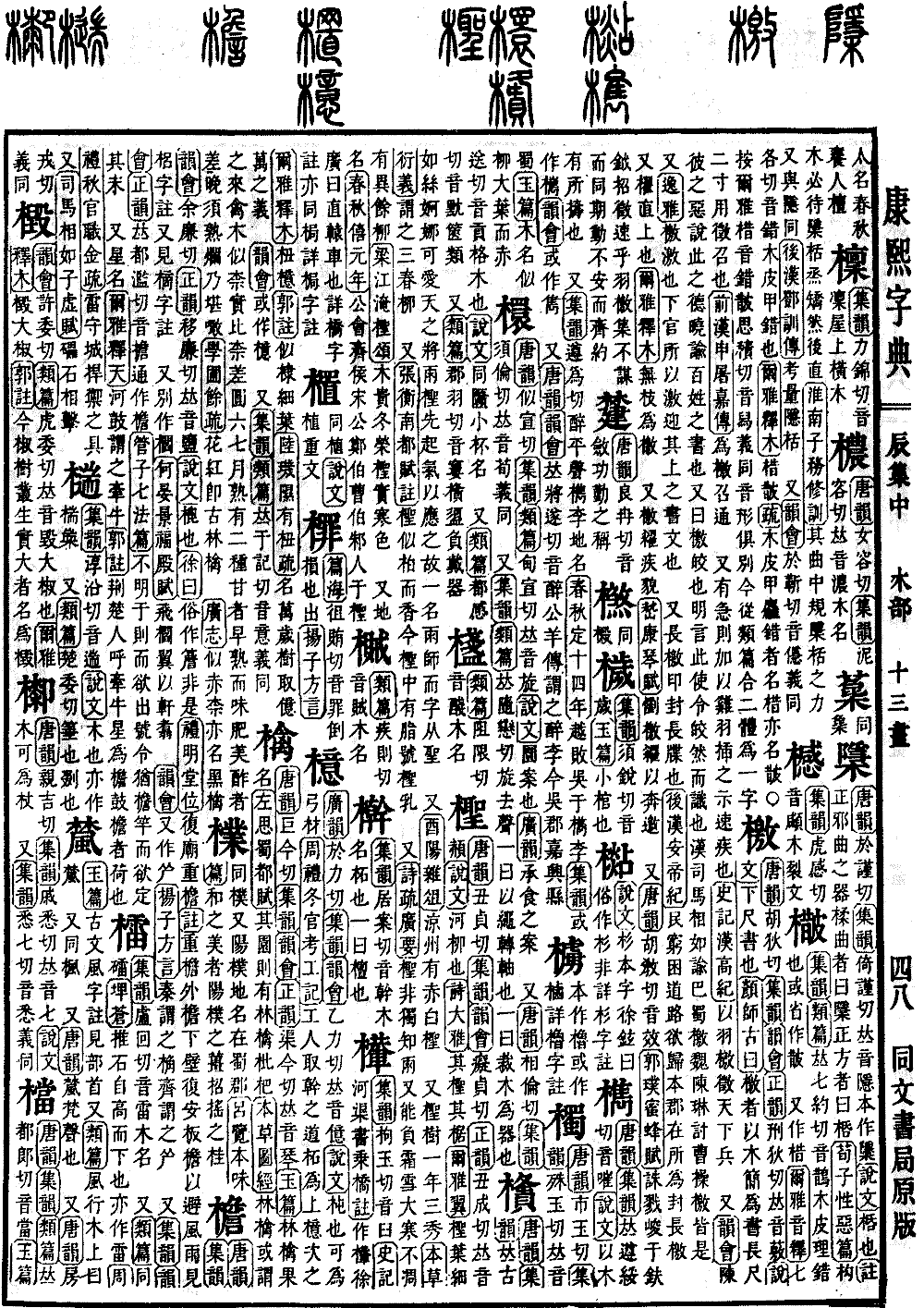
Chen Collection, Middle Volume
Radical: Tree (mù)
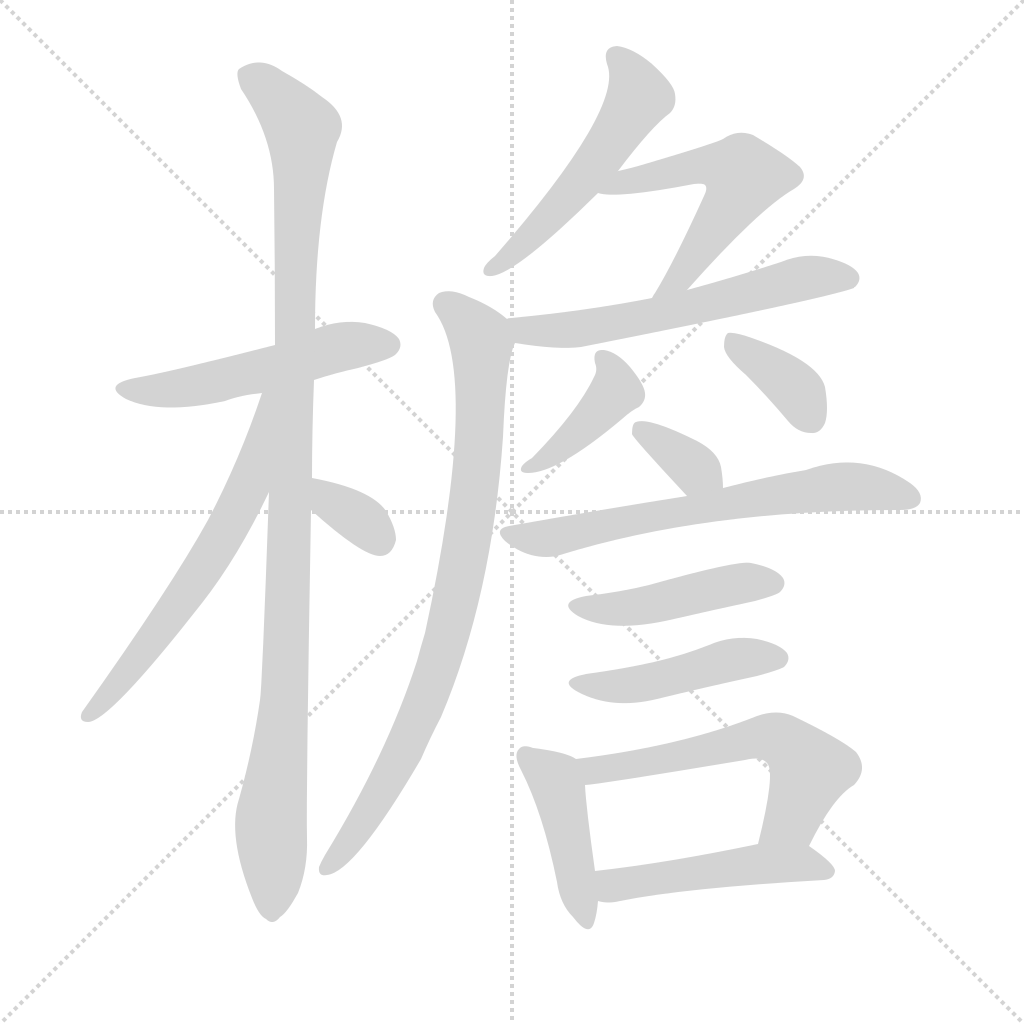
檐
Kangxi strokes: 19
Page 556, Entry 27
Tangyun, Jiyun, Yunhui: Pronounced yán. Zhengyun: Pronounced yán.
Shuowen: Refers to the eaves of a roof.
Xu says: The common form is written as 簷, which is incorrect.
Book of Rites (Liji), Mingtang Wei section: A temple with multiple layers of eaves.
Commentary: Layers of eaves refer to a secondary board installed beneath the outer eaves to protect against wind and rain. See the notes for the character lǚ. Also see the notes for the character dī.
Another form is written as 櫩.
He Yan, Jingfu Dian Fu: The flying eaves spread their wings as if ready to soar.
Yunhui: Also written as wēi.
Yangzi, Fangyan: In the Qin state it is called jué, in the Qi state it is called wēi.
Also Jiyun, Yunhui, Zhengyun: Pronounced dàn.
Commonly written as yán.
Guanzi, Qifa chapter: To wish to issue commands without understanding the rules is like carrying a pole on the shoulder (yán) while trying to steady its tip.
Also the name of a star.
Erya, Shitien: The River Drum star is called Qianniu.
Guo note: People in the Jingchu region call the Qianniu star Yangu. Yán here means to carry on the shoulder.
The character wēi was originally written with the cliff radical.