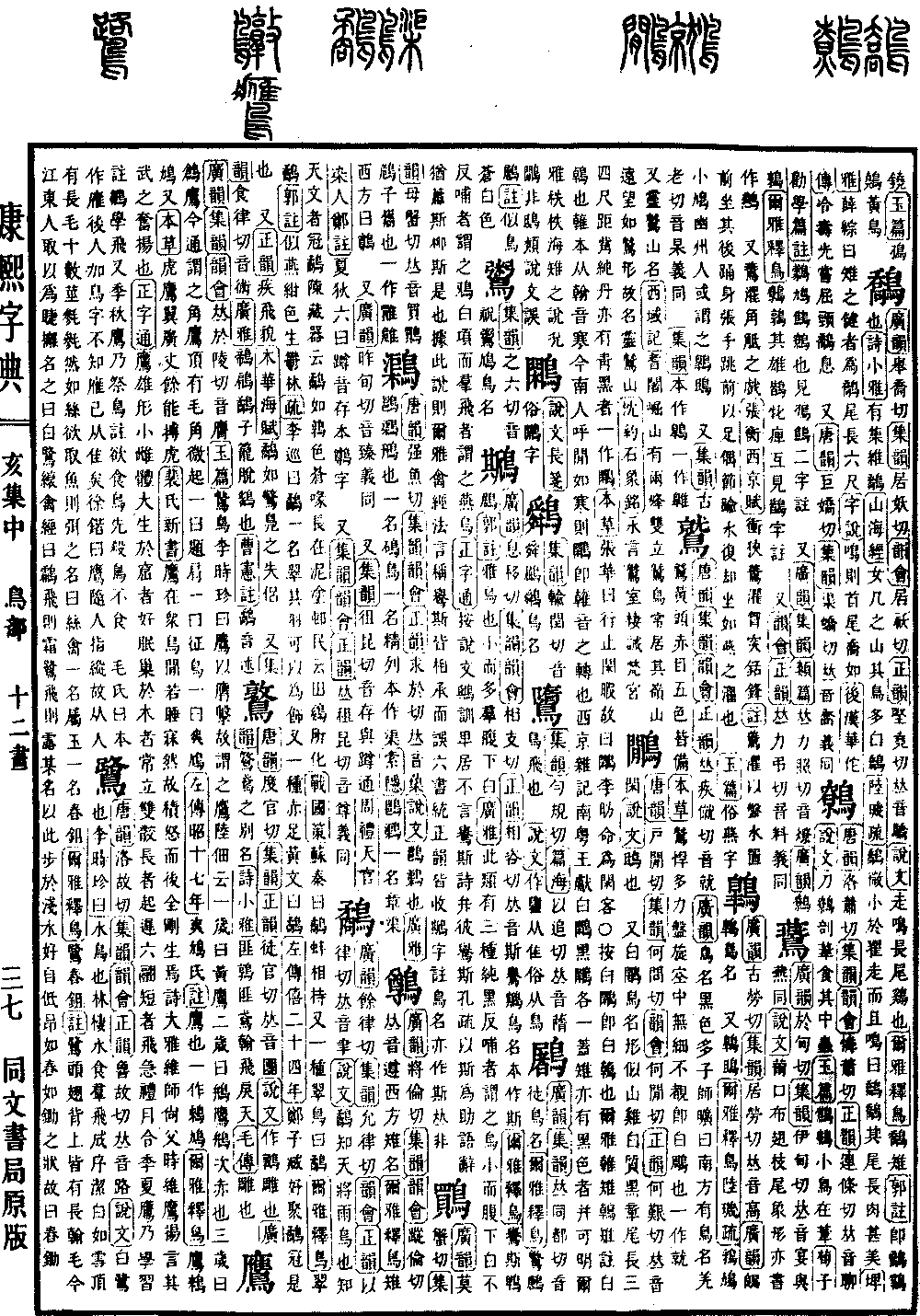
Hai Collection, Middle Volume
Radical: Bird (niǎo)
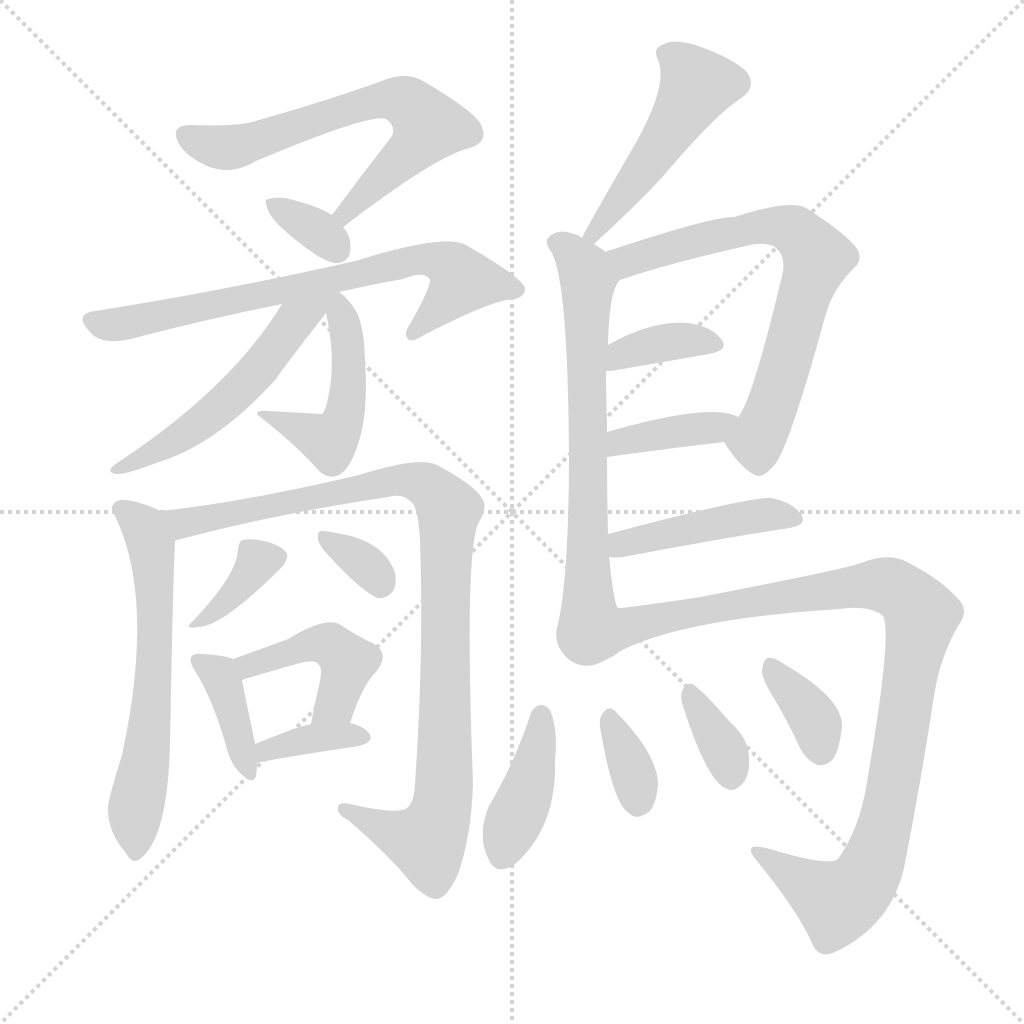
鹬
Kangxi strokes: 23
Page 1501, Entry 16
Pronounced yu.
According to the Explaining Graphs and Analyzing Characters (Shuowen Jiezi), the yu is a bird that knows when it is about to rain. Those who understand astronomy wear hats decorated with the feathers of this bird. Chen Cangqi states: The yu resembles a quail, has a greenish-black color and a long beak, and lives in marshes. Villagers say it is a bird transformed from a frog.
In Strategies of the Warring States (Zhanguo Ce), Su Qin says: A snipe and a clam fight with each other.
There is another type of kingfisher called yu.
In the Erya (Erya), section on birds: Cui-yu. Guo Pu comments: It resembles a swallow, is dark green with a reddish hue, and lives in Yulin. The commentary by Li Xun states: The yu, also called a kingfisher, has feathers that can be used for ornamentation. There is another type with red legs and yellow markings, also called a yu. In the Zuo Tradition (Zuozhuan), twenty-fourth year of Duke Xi: Zizang of Zheng liked to collect yu feathers to decorate his hats, which refers to this bird.
Also, according to the Zheng Yun (Zhengyun), it describes the appearance of rapid flight. In Mu Hua’s Rhapsody on the Sea (Haifu): The yu is like a startled wild duck that has lost its companion.
Also, pronounced shu.
According to the Guangya (Guangya), it is a type of hawk. Cao Xian notes: The character yu is pronounced shu. The character startled (jing) was originally carved with the component for respect (jing) combined with the bird radical.
Textual Research: The correction has been made. The text in Mu Hua’s Rhapsody on the Sea originally read as having the character respect (jing) below the character bird (niao) and then wild duck (fu) losing its companion. According to the original text, this has been corrected to startled (jing) and wild duck (fu).