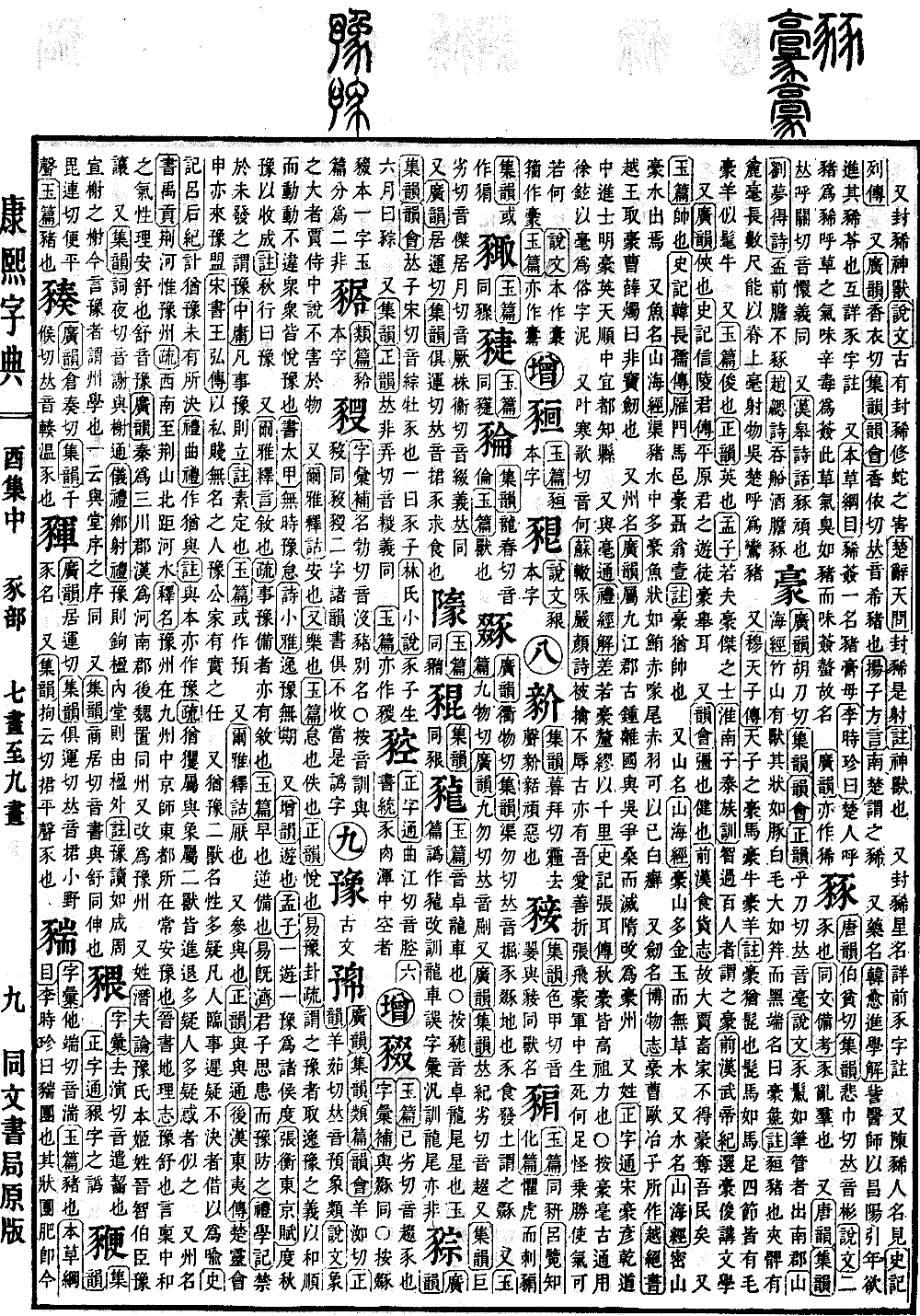
You Collection, Middle Volume
Radical: Pig (shǐ)
Page 1197, Entry 20
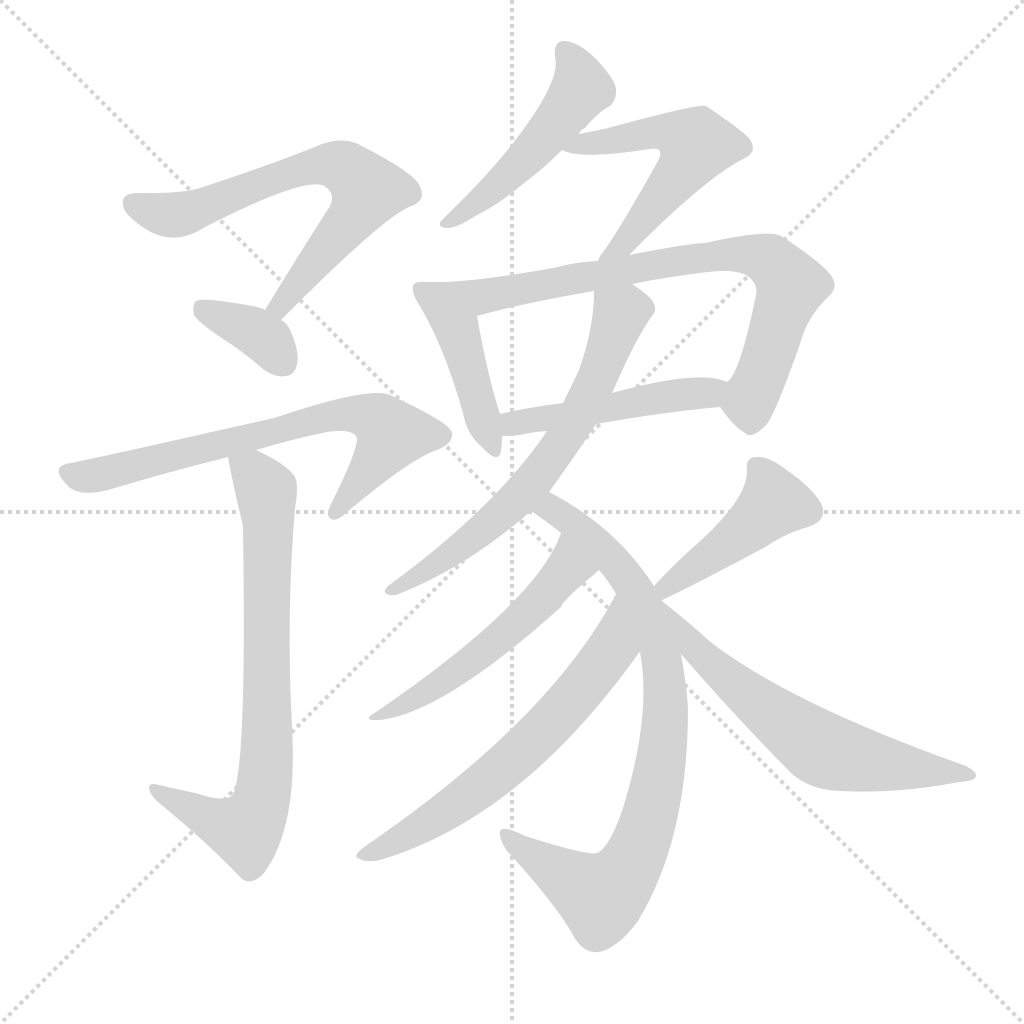
Pronounced yu (falling tone). A type of large elephant. In the Analytical Dictionary of Characters (Shuowen), it refers to a particularly large elephant; Jia Shizhong explained that this elephant does not harm other creatures. Also, in the Erya (Erya: Explaining Words), it means peace and stability. It also means happiness. In the Jade Chapters (Yupian), it means laziness or comfort. In the Correct Rhymes (Zhengyun), it means joy. In the Book of Changes (Yijing: Yu Hexagram Commentary), it is called "Yu" to convey the meaning of comfort and happiness; because one acts in a gentle and harmonious way, not going against the masses, everyone is happy and at peace. In the Book of Documents (Shujing: Taijia), it says do not be constantly comfortable and lazy. In the Book of Odes (Shijing: Xiaoya), it mentions comfort and pleasure without end. Also, in the Expanded Rhymes (Zengyun), it means to tour. In the Mencius (Mengzi), a tour in the spring is called "You," and a tour in the autumn is called "Yu"; these are the laws of the feudal lords. In Zhang Heng's Eastern Capital Rhapsody (Dongjing Fu), it mentions touring in the autumn to inspect the harvest. The commentary notes that traveling in the autumn is called "Yu." Also, in the Erya (Erya: Explaining Words), it means sequence or order. The commentary notes that when matters are prepared in advance, there is order. In the Jade Chapters (Yupian), it means early or to prepare in advance. In the Book of Changes (Yijing: Jiji Hexagram), the superior person considers potential disasters and prepares for them in advance. In the Book of Rites (Liji: Xueji), preventing matters before they occur is called "Yu." In the Doctrine of the Mean (Zhongyong), everything prepared in advance will succeed. The commentary notes that this refers to being determined and prepared as a matter of course. In the Jade Chapters (Yupian), it is sometimes written in a variant form (yu). Also, in the Erya (Erya: Explaining Words), it means satisfied or weary. It also refers to participating. In the Correct Rhymes (Zhengyun), it is interchangeable with the character meaning to participate or give (yu). In the History of the Later Han (Hou Hanshu: Eastern Barbarians Biography), King Ling of Chu held a meeting at Shen and also participated in the oath. In the Book of Song (Songshu: Wang Hong Biography), it refers to letting those of low status and no reputation participate in actual government duties. Also, "hesitation" (youyu) refers to the names of two wild beasts that are naturally suspicious. Whenever people are indecisive, they borrow these names to make an analogy. In the Records of the Grand Historian (Shiji: Empress Lu Annals), plans were hesitating and not decided. In the Book of Rites (Liji: Quli), it is written as "youyu." The commentary notes that "yu" was originally also written as "yu." The sub-commentary explains that "you" is a type of monkey and "yu" is a type of elephant; both beasts are suspicious when moving forward or backward, and people who are confused and indecisive are like them. It is also the name of a province. In the Book of Documents (Shujing: Yugong), the area between the Jing Mountains and the Yellow River is Yu Province. The sub-commentary notes that it extends southwest to the Jing Mountains and north to the Yellow River. In the Explaining Names (Shiming), Yu Province is in the center of the Nine Provinces and is the location of the eastern capital, where it is often peaceful and happy. In the Book of Jin (Jinshu: Treatise on Geography), "Yu" means to extend, referring to receiving the middle and harmonious energy, making the temperament peaceful and relaxed. The pronunciation of "extend" (shu) is the same as "Yu." In the Guangyun (Guangyun), it was the San-chuan Commandery during the Qin dynasty. During the Han dynasty, it was Henan Commandery. In the Later Wei, Tong Province was established, later renamed Yu Province. It is also a surname. In the Qianfu Lun (Qianfu Lun), the Yu clan was originally of the Ji surname. It includes Yu Rang, a retainer of Zhi Bo of the State of Jin. Also, in the Collected Rhymes (Jiyun), it is pronounced xie (falling tone), interchangeable with the character for a pavilion (xie). In the Book of Rites (Yili: Xiangshe Li), if it is a "Yu" (referring to a state school), the arrow is hooked inside the pillar; if it is a "Tang" (referring to a village school), the arrow is shot outward from the pillar. The commentary notes that "Yu" is pronounced like the "xie" in "Xuanxie" of Cheng-Zhou; today when people say "Yu," they refer to the state school. Another opinion is that it has the same meaning as the "xu" in "tangxu." Also, in the Collected Rhymes (Jiyun), it is pronounced shu (level tone), the same as the character for extend (shu). It means to stretch out.