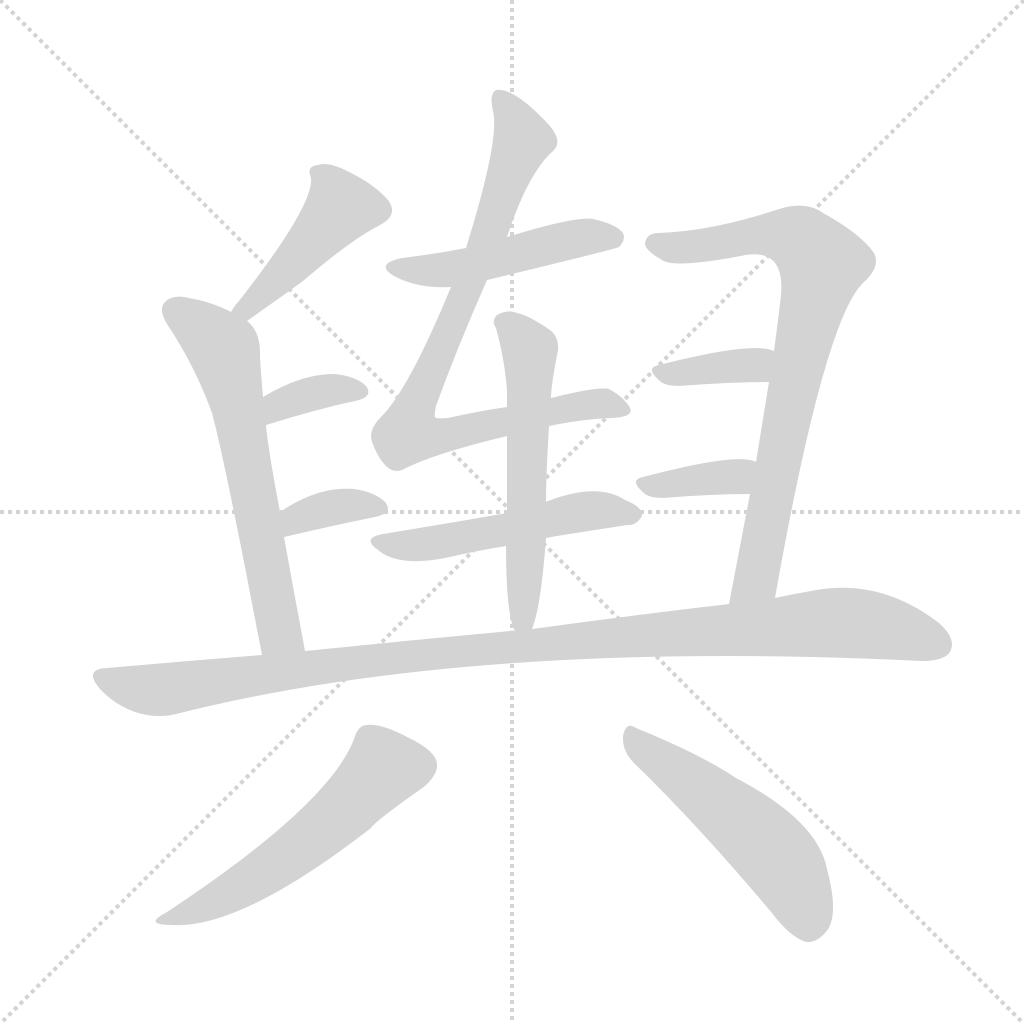
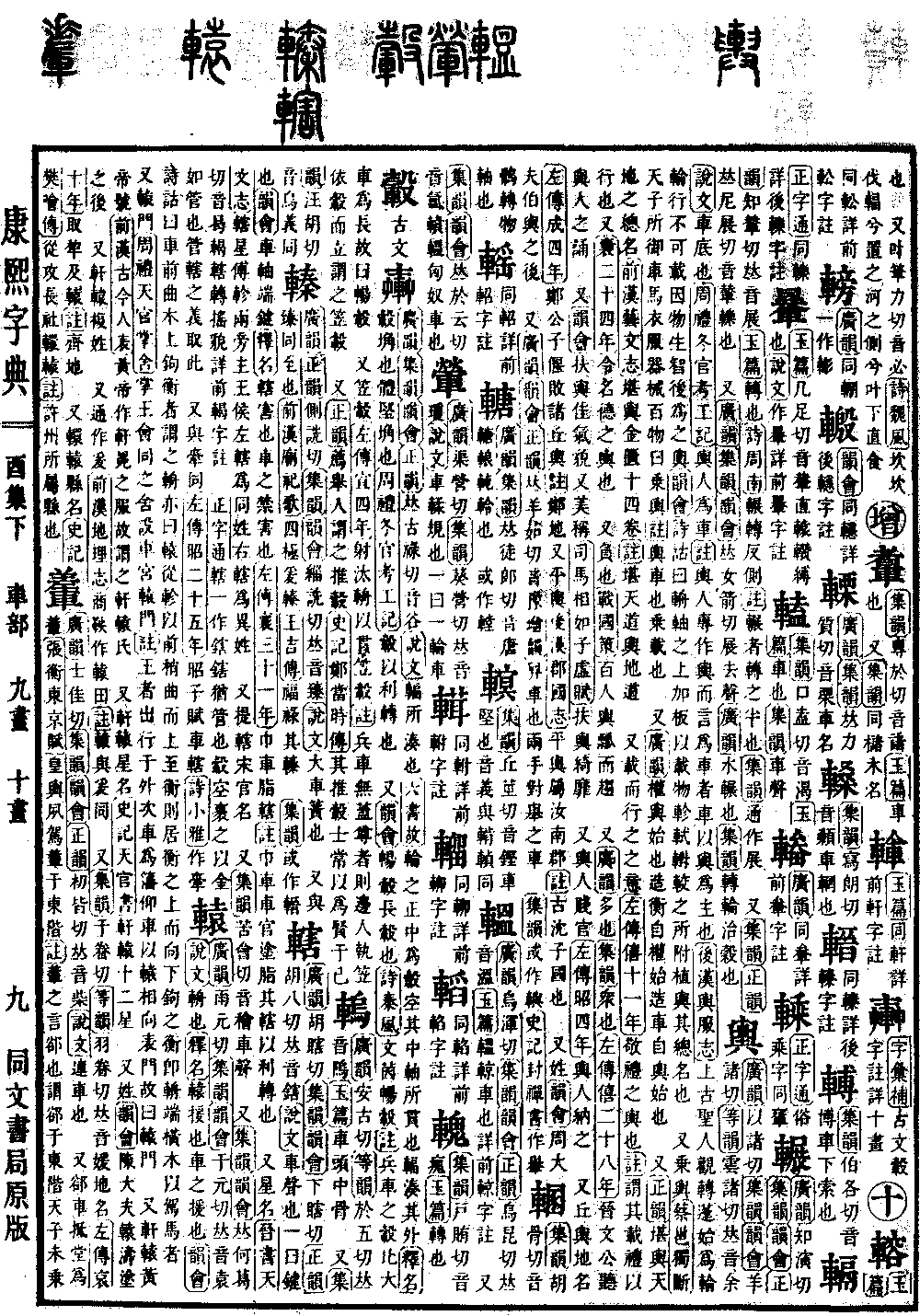
You Collection, Lower Volume
Radical: Carriage (chē)
Yú; Kangxi strokes: 17; Page 1247, Entry 01
Pronounced yú.
According to the Shuo Wen Jiezi (Shuo Wen), the bottom of a carriage.
According to the Rites of Zhou (Zhouli), Winter Officers, Record of Artificers (Kaogongji), carriage-makers create carriages. The commentary states that carriage-makers specialize in constructing the carriage body, which is referred to as the carriage because the body is the main component.
According to the Book of the Later Han (Houhan Shu), Treatises on Carriages and Attire (Yufu Zhi), sages of antiquity observed rolling tumbleweeds and began to construct wheels; however, wheels could not carry loads, so they derived wisdom from objects and subsequently created the carriage body.
According to the Rhyme Compendium (Yunhui), the Commentary on the Book of Odes (Shigu) states that wooden boards are added above the carriage shafts and axles to carry items; the horizontal crossbeams at the bottom and front, and the side boards of the carriage body are collectively referred to as the carriage.
Also refers to an imperial carriage. According to Cai Yong’s Rules of the Sovereign (Duduan), the carriages, horses, clothing, and implements used by the Emperor are called imperial carriages. The commentary states that the carriage is the vehicle and the imperial prefix means to bear.
Also, according to the Rhyme Compendium (Yunhui), quányú refers to the beginning. The creation of scales begins with the weight, and the creation of a carriage begins with the carriage body.
Also, according to the Correct Rhymes (Zhengyun), kānyú is a collective term for heaven and earth. According to the Book of the Former Han (Hanshu), Treatise on Literature and Arts (Yiwenzhi), the Kanyu Jingui (Gold Cabinet of Heaven and Earth) consists of fourteen volumes. The commentary states that kan refers to the way of heaven, and yu refers to the way of earth.
Also, it means to carry and move. According to the Zuo Commentary (Zuo Zhuan), Year 11 of Duke Xi, this is the vessel for respectful ritual. The commentary states this means carrying out ritual.
Also, Year 24 of Duke Xiang, a good reputation is the vessel for virtue.
Also, it means to carry or shoulder. According to the Stratagems of the Warring States (Zhan Guo Ce), one hundred men carry a gourd and walk quickly.
Also, according to the Expanded Rhymes (Guangyun), it means many. According to the Collection of Rhymes (Jiyun), it refers to a multitude. According to the Zuo Commentary (Zuo Zhuan), Year 28 of Duke Xi, Duke Wen of Jin listened to the songs of the multitude.
Also, according to the Rhyme Compendium (Yunhui), fúyú describes a state of flourishing and auspicious energy. It is also an aesthetic term. According to Sima Xiangru’s Rhapsody on Sir Vacuous (Zixu Fu), flourishing and elegant.
Also, carriage-men are low-ranking officials. According to the Zuo Commentary (Zuo Zhuan), Year 4 of Duke Zhao, the carriage-men escorted him in.
Also, Qiuyu is a place name. According to the Zuo Commentary (Zuo Zhuan), Year 4 of Duke Cheng, Gongzi Yan of Zheng defeated them at Qiuyu. The commentary states this is a place name in the State of Zheng.
Also, Pingyu. According to the Book of the Later Han (Houhan Shu), Treatise on Geography (Junguo Zhi), Pingyu belongs to Runan Commandery. The commentary states this was the ancient State of Shenzi.
Also, a surname. According to the Rhyme Compendium (Yunhui), it is the descendant of Bo Yu, a high official of the Zhou Dynasty.
Pronounced yù.
According to the Expanded Rhymes (Guangyun), the Rhyme Compendium (Yunhui), and the Correct Rhymes (Zhengyun), it refers to carrying a sedan chair, a vehicle held up by two people with their hands.
According to the Collection of Rhymes (Jiyun), it is also written in the variant form (yú). According to the Records of the Grand Historian (Shiji), Treatise on the Feng and Shan Sacrifices (Fengshan Shu), it is written as a compound character consisting of the radical for carriage and the character for and.