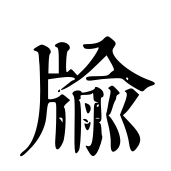
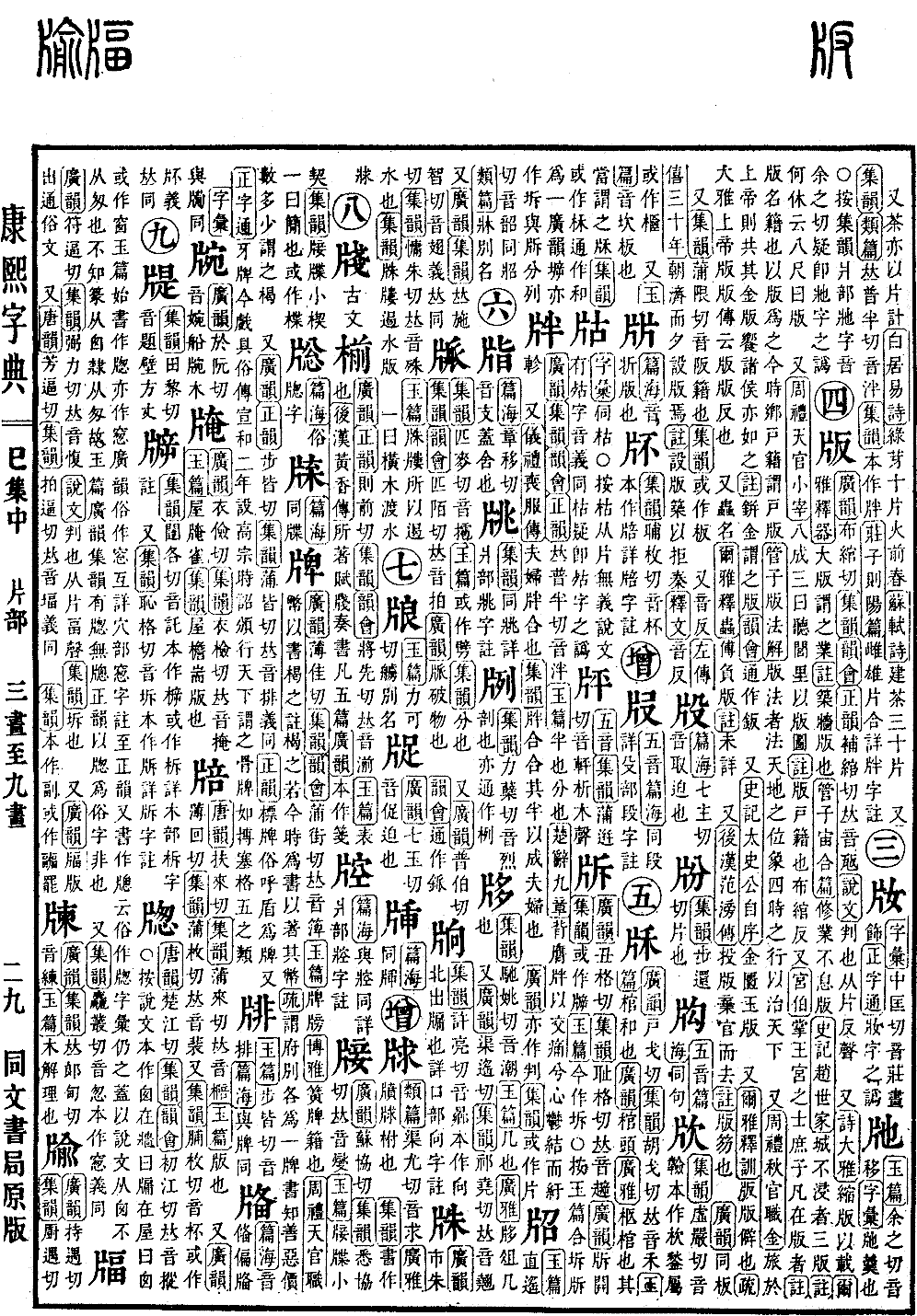
Si Collection, Middle Volume
Radical: Fragment (piàn)
Kangxi Strokes: 13
Page 693, Entry 45
Pronounced zhu. According to the Book of Rhymes (Guangyun) and Collection of Rhymes (Jiyun), it means a short board used for building walls. In the Records of the Grand Historian (Shiji), Biography of Lord Wanshi, it is written: Jian served as a gentleman; when granted leave to bathe and visit his parents, he would privately ask the attendants for his parents' undergarments or latrine garments to wash them himself. The commentary by Xu Guang states: A shou is a short board used for building earth walls. Pronounced zhu, it refers to cleaning garments near the wall of the latrine.
Also pronounced zhu according to the Jade Compendium (Yupian) and Collection of Rhymes (Jiyun). Also pronounced yu according to the Collection of Rhymes (Jiyun) and Classified Texts (Leipian), with the same meaning.
Also pronounced dou according to the Collection of Rhymes (Jiyun). The commentary to the Records of the Grand Historian (Shiji), Biography of Lord Wanshi, notes that Xu Guang suggests reading shou as dou, meaning to wash out the latrine drain. The latrine drain is the hole through which waste is removed. Lu Jing defines it as a vessel for filth. Also written as yu.
Also pronounced tou according to the Tang Book of Rhymes (Tangyun), Collection of Rhymes (Jiyun), Rhyme Meetings (Yunhui), and Orthodox Rhymes (Zhengyun). Defined by the Jade Compendium (Yupian) as a short board for building walls. Also written as a variant form (tong).
According to the commentary to the Records of the Grand Historian (Shiji), Su Lin states that shou is also written as a variant form, pronounced tou. Jia Kui explains in the Rites of Zhou (Zhouguan) that a latrine vessel is a tiger-shaped urinal, and a yu is a channel for drainage. Meng Kang states that a latrine drain is for flushing, and a yu is for receiving waste. People in the southeast call hollowed-out timber troughs a variant form.
According to the commentary to the Records of the Grand Historian (Shiji), Jin Zhuo states that people nowadays refer to garments with small, inverted sleeves as a variant form, and these are garments worn close to the body. In the commentary to the Book of Han (Hanshu), Yan Shigu states that a latrine garment is a small undergarment worn close to the body, similar to a modern undershirt, and Su Lin's explanation is correct.
Also pronounced yu according to the Book of Rhymes (Guangyun) and Collection of Rhymes (Jiyun). According to the Explaining Graphs and Analyzing Characters (Shuowen Jiezi), it is composed of the radical fragment and the phonetic element yu. The Book of Rhymes (Guangyun) also defines it as a short board used for building earth walls.
According to the Explaining Graphs and Analyzing Characters (Shuowen Jiezi), it is also read as niu, with the same meaning.