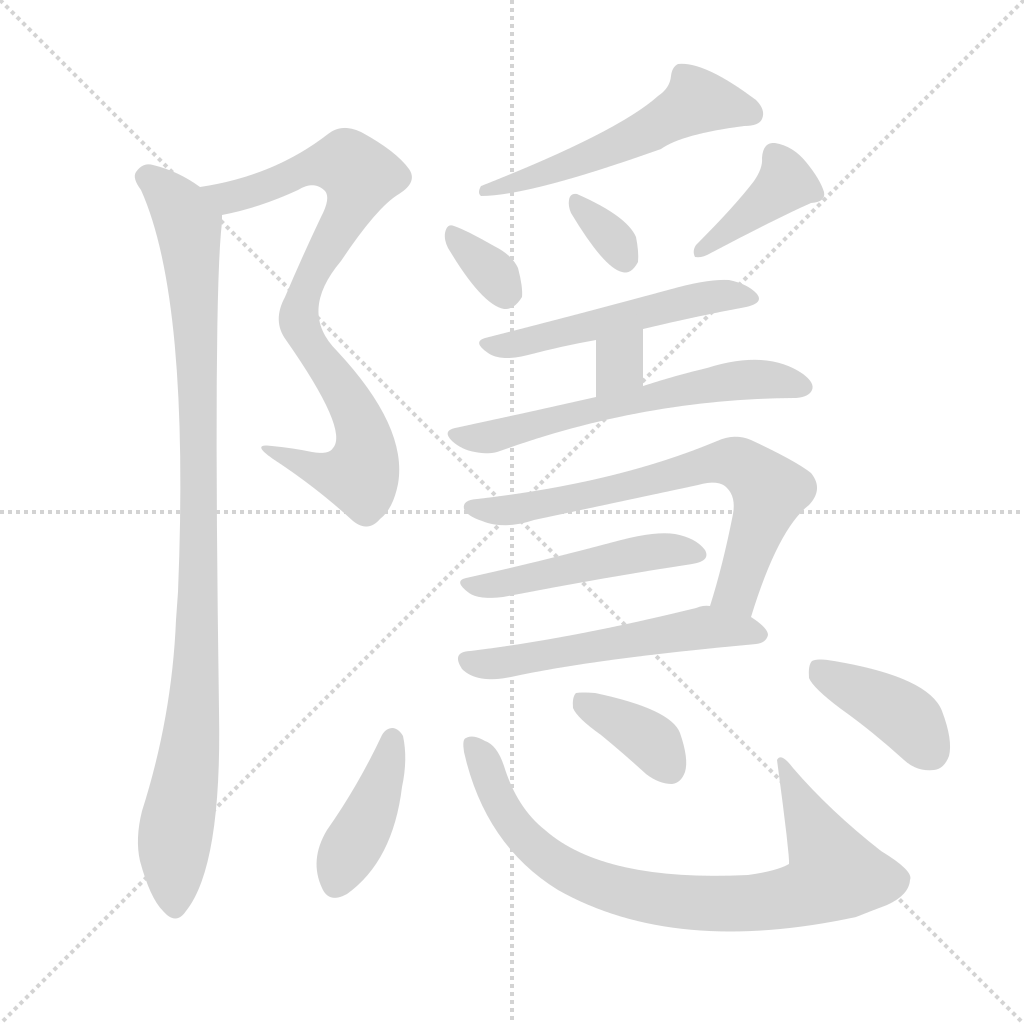
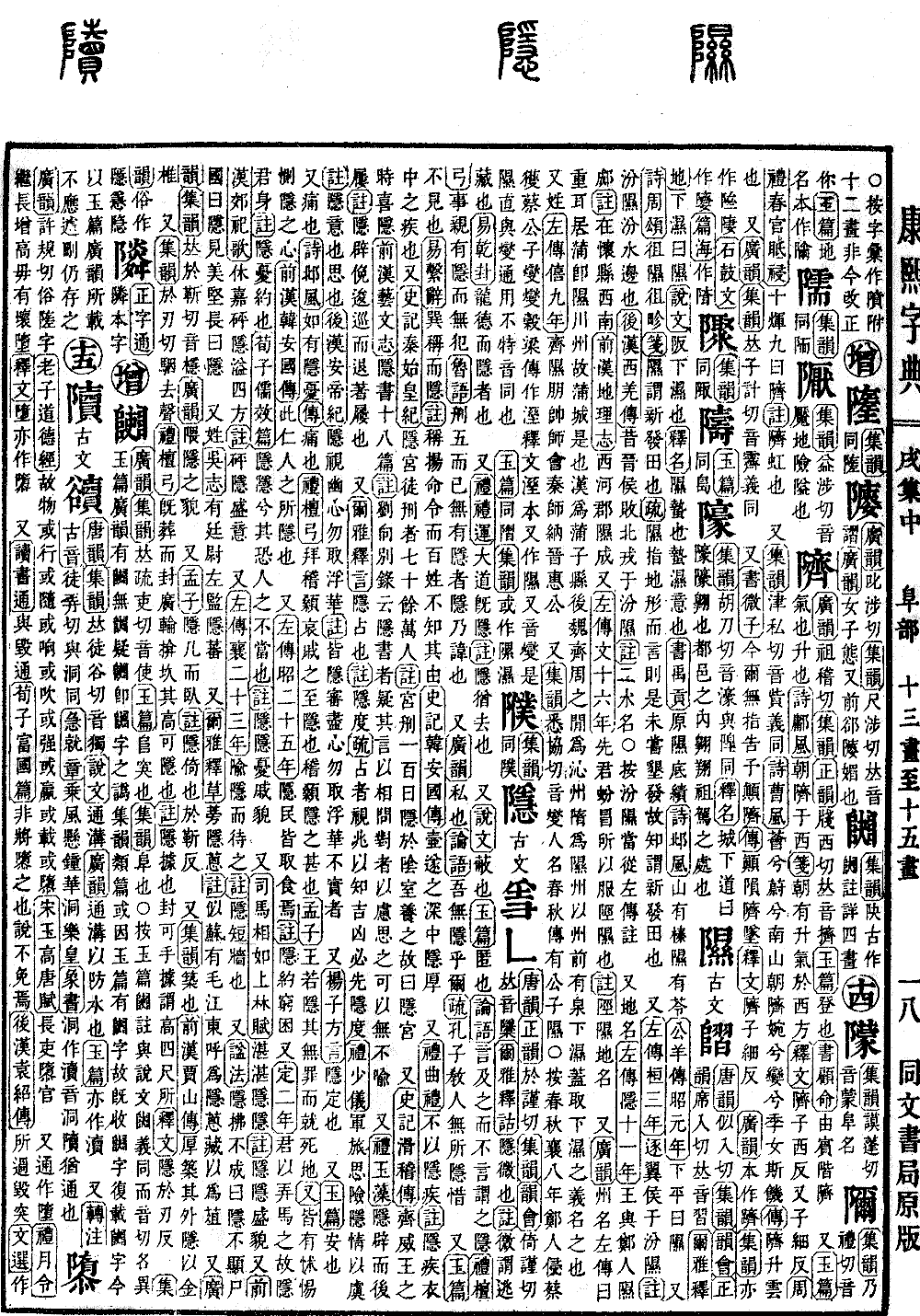
Xu Collection, Middle Volume; Radical: Mound (fù); 隱; Kangxi strokes: 22; Page: 1362, entry 15
Ancient form. According to Tangyun (Tangyun) and Zhengyun (Zhengyun), pronounced "yū jǐn qie". According to Jiyun (Jiyun) and Yunhui (Yunhui), pronounced "yǐ jǐn qie". The sound is similar to yìn.
Erya (Erya) - Explanation of Ancient Words (Shigu): "Yǐn means subtle or minute." Annotation: "Subtle means to escape and hide."
I Ching (Yijing) - Qian Hexagram: "A dragon with virtue who remains hidden."
Also, Book of Rites (Liji) - Evolution of Rites (Liyun): "When the Great Way is hidden." Annotation: "Hidden here means gone or departed."
Also, Shuowen Jiezi (Shuowen Jiezi): "To cover." Yupian (Yupian): "To conceal."
Analects (Lunyu): "To speak of something but not speak it fully is called yǐn (concealing)."
Book of Rites (Liji) - Tangong (Tangong): "In serving one's parents, there should be things concealed, but no transgression."
Discourses of the States (Guoyu) - Discourses of Lu (Lu Yu): "There are only five, none hidden; 'hidden' here means taboo."
Also, Guangyun (Guangyun): "Private." Analects (Lunyu): "I conceal nothing from you." Commentary: "Confucius taught people to conceal nothing."
Also, Yupian (Yupian): "Unseen." I Ching (Yijing) - Appended Remarks (Xici): "Gently praised, yet hidden." Annotation: "To praise and command, but the people do not know the reason why."
Records of the Grand Historian (Shiji) - Biography of Han Anguo: "Hu Sui's profound and hidden magnanimity."
Also, Book of Rites (Liji) - Summary of Rites (Quli): "Not to reveal a hidden ailment." Annotation: "A hidden ailment is an illness within the clothing."
Also, Records of the Grand Historian (Shiji) - Basic Annals of Qin Shihuang: "Those castrated in hidden chambers (yǐngōng) numbered over seven hundred thousand." Annotation: "Castration: for one hundred days, they were hidden in a dark room to recuperate, hence called hidden chambers."
Also, Records of the Grand Historian (Shiji) - Humorous Biographies: "During the time of King Wei of Qi, he enjoyed riddles." History of the Former Han (Hanshu) - Treatise on Literature: "Eighteen chapters of 'hidden books' (yǐnshū)." Annotation: Liu Xiang's (Liu Xiang) Separate Records (Bielu) states: "'Hidden books' are those where words are posed as questions to each other, and the respondent considers them thoughtfully, so that none can fail to understand."
Also, Book of Rites (Liji) - Jade Pendants (Yuzhao): "To retreat and then put on one's shoes." Annotation: "To retreat (yǐnpì) means to bend down, hesitate, and then step back to put on one's shoes."
Also, Erya (Erya) - Explanation of Words (Shiyan): "Yǐn means divination." Annotation: "To estimate or measure (yǐndù)." Commentary: "Divination involves observing omens to know good and bad fortune, which must first be estimated." Book of Rites (Liji) - Minor Rites (Shaoyi): "In military campaigns, considering dangers, one should ponder the situation to anticipate." Annotation: "Yǐn means intention and thought." History of the Later Han (Hou Hanshu) - Annals of Emperor An: "To approach with hidden care and utmost sincerity, not pursuing superficiality." Annotation: "All should thoroughly examine and exhaust their hearts, not pursuing superficial or insubstantial things."
Also, Yangzi Fangyan (Yangzi Fangyan): "Yǐn means to settle or establish."
Also, Yupian (Yupian): "Peaceful." Also, "Painful." Book of Odes (Shijing) - Airs of Bei (Beifeng): "If there are hidden sorrows." Commentary: "Painful."
Book of Rites (Liji) - Tangong (Tangong): "Bowing and knocking the head to the ground, the utmost manifestation of grief and sorrow. Knocking the head to the ground is an extreme form of yǐn (hidden sorrow)."
Mencius (Mengzi): "If the king were to feel compassion for their innocence and their going to their death." Also: "All have a mind that feels alarm and compassion."
History of the Former Han (Hanshu) - Biography of Han Anguo: "This is what a benevolent person keeps hidden."
Also, Zuo Commentary (Zuozhuan) - Twenty-fifth Year of Duke Zhao: "All the suffering people (yǐnmín) took food there." Annotation: "Hidden, distressed, and impoverished."
Also, Zuo Commentary (Zuozhuan) - Third Year of Duke Ding: "Because of playing with horses, the ruler endangered himself." Annotation: "Yǐn means worry and restraint."
Xunzi (Xunzi) - The Accomplishments of the Ru (Ruxiao): "Hiddenly (yǐnyǐn), he fears that people are not proper." Annotation: "Yǐnyǐn describes an appearance of worry and distress."
Also, Sima Xiangru (Sima Xiangru) - Rhapsody on the Imperial Park (Shanglinfu): "Deep and vast, grand and imposing (zhànzhàn yǐnyǐn)." Annotation: "Yǐnyǐn describes a magnificent appearance."
Also, History of the Former Han (Hanshu) - Songs for Suburban Sacrifices (Jiaosi Ge): "Auspicious and beautiful, resounding and overflowing (pēngyǐn) in all directions." Annotation: "Pēngyǐn means a flourishing intention."
Also, Zuo Commentary (Zuozhuan) - Twenty-third Year of Duke Xiang: "He crossed the low wall (yǐn) and waited for them." Annotation: "Yǐn means a low wall."
Also, Rules for Posthumous Titles (Shifa): "If one retreats and does not achieve, it is called yǐn (hidden). If one does not conspicuously govern the state, it is called yǐn (hidden). If one sees beauty and is steadfastly enduring, it is called yǐn (hidden)."
Also a surname. History of Wu (Wuzhi): "There was Yin Fan (Yǐn Fān), Left Supervisor of the Court of Judicial Review."
Also, Erya (Erya) - Explanation of Plants (Shicao): "Bàng (burdock), also yǐncōng." Annotation: "It resembles Perilla, is hairy, and people in Jiangdong call it yǐncōng, storing it to make pickled vegetables (zū)."
Also, according to Guangyun (Guangyun) and Jiyun (Jiyun), pronounced "yū jìn qie", sound similar to wěn. Guangyun (Guangyun): "The appearance of being winding and hidden."
Also, Mencius (Mengzi): "Leaning on a small table and lying down." Annotation: "Yǐn means to lean on." Pronounced "yū jìn fan."
Also, Jiyun (Jiyun): "To ram." History of the Former Han (Hanshu) - Biography of Jia Shan: "To build thickly on its exterior, ramming it with golden mallets."
Also, Jiyun (Jiyun): "Pronounced 'yū rèn qie', with the departing tone (qùshēng) of yīn." Book of Rites (Liji) - Tangong (Tangong): "After burial, the mound is erected, its width and circumference covering the pit, and its height can be leaned upon." Annotation: "Yǐn means to lean on or rest upon. A mound that can be leaned upon by hand means it is about four feet high." Shiyi (Explanation of Words): "Yǐn is pronounced 'yū rèn fan.'" Jiyun (Jiyun): "Commonly written as this character (隱)."
Correction: In History of the Later Han (Hou Hanshu) - Annals of Emperor An: "隐视幽心, 勿取浮华" should be corrected according to the original text as "隐亲悉心, 勿取浮华".
Correction: In Zuo Commentary (Zuozhuan) - Second Year of Duke Ding: "君以弄马之故,隐君身", the text "Second Year" should be corrected to "Third Year" according to the original text.
Correction: In Zuo Commentary (Zuozhuan) - Twenty-third Year of Duke Xiang: "隃隐而待之", the characters "隃隐" should be corrected to "逾隐" according to the original text.
Correction: In Erya (Erya) - Explanation of Plants (Shicao): "蒡,隐蔥." Annotation: "It resembles Perilla, is hairy, and people in Jiangdong call it 隐蔥", the two characters "蔥" should be corrected to "葱" according to the original text.