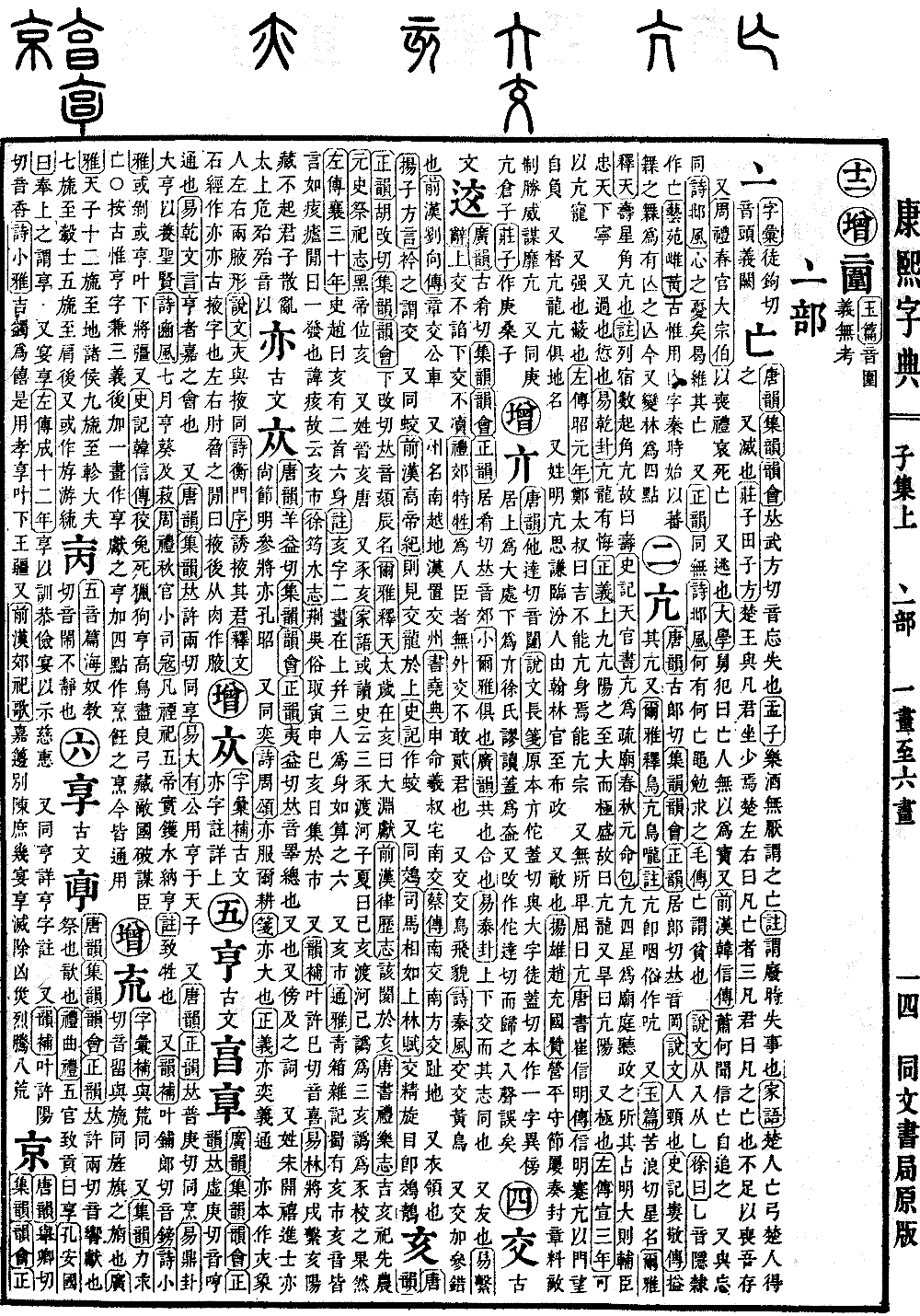
Zi Collection, Page Position: Upper
Radical: Lid (tóu)
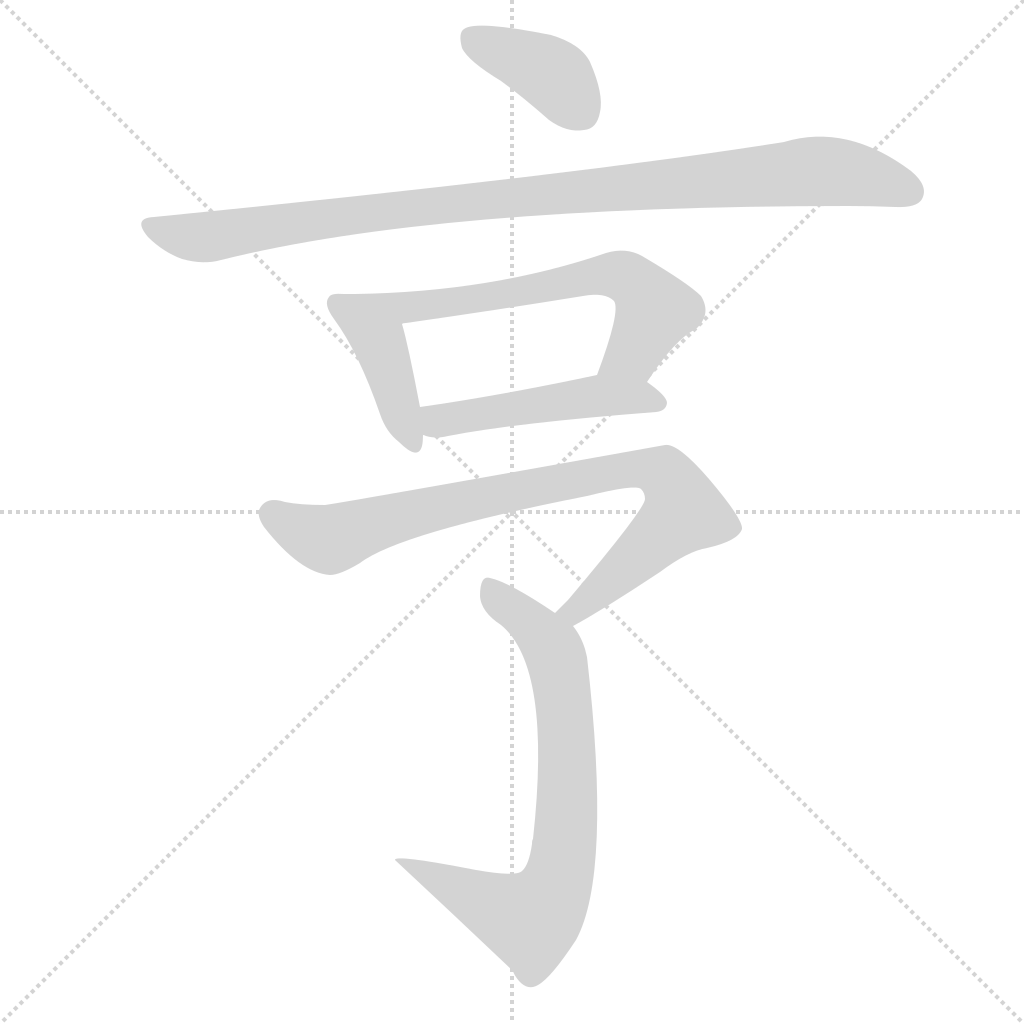
亨
Kangxi strokes: 7
Page 88, Entry 12
Ancient form: 亯
According to Broad Rhymes (Guangyun), Collected Rhymes (Jiyun), Rhyme Meetings (Yunhui), and Orthodox Rhymes (Zhengyun), the pronunciation is heng. It means to pass through or to be successful.
Book of Changes (Yijing), Qian hexagram: Success is the gathering of auspicious elements.
Also, according to Tang Rhymes (Tangyun) and Collected Rhymes (Jiyun), pronounced xiang. Equivalent to the character meaning to offer.
Book of Changes (Yijing), Dayou hexagram: Feudal lords offer tribute to the Son of Heaven.
Also, according to Tang Rhymes (Tangyun) and Orthodox Rhymes (Zhengyun), pronounced peng. Equivalent to the character meaning to cook.
Book of Changes (Yijing), Ding hexagram: Great cooking to provide for sages and virtuous men.
Book of Odes (Shijing), Bin customs: In the seventh month, cooking mallow and beans.
Rites of Zhou (Zhouli), Autumn Official: Whenever sacrificing to the Five Emperors, the sacrificial animals placed in the cauldron for cooking are treated in the same manner. Note: Refers to offering the sacrificial animal.
Also, according to Rhyme Supplements (Yunbu), rhyming with the sound bang.
Book of Odes (Shijing), Lesser Odes: Some are skinned, some are cooked, rhyming with the following characters in the text.
Records of the Grand Historian (Shiji), Biography of Han Xin: When the crafty rabbit dies, the hunting dog is cooked. When the birds that fly high are gone, the good bow is hidden away. When the enemy state is destroyed, the wise counselor is destroyed.
Note: In ancient times, only the character heng was used for all three meanings. Later, a stroke was added to create the character meaning to offer, and four dots were added to create the character meaning to cook. Now, all are in general use.
Textual research: Rites of Zhou (Zhouli), Autumn Official: Whenever sacrificing to the Five Emperors, the sacrificial animals are placed in the cauldron for cooking. I have added the phrase meaning it is also like this to the original text to complete the meaning. In ancient times, only the character heng was used for all three meanings. Later, a stroke was added to create the character meaning to offer. I have corrected the text to reflect this distinction.