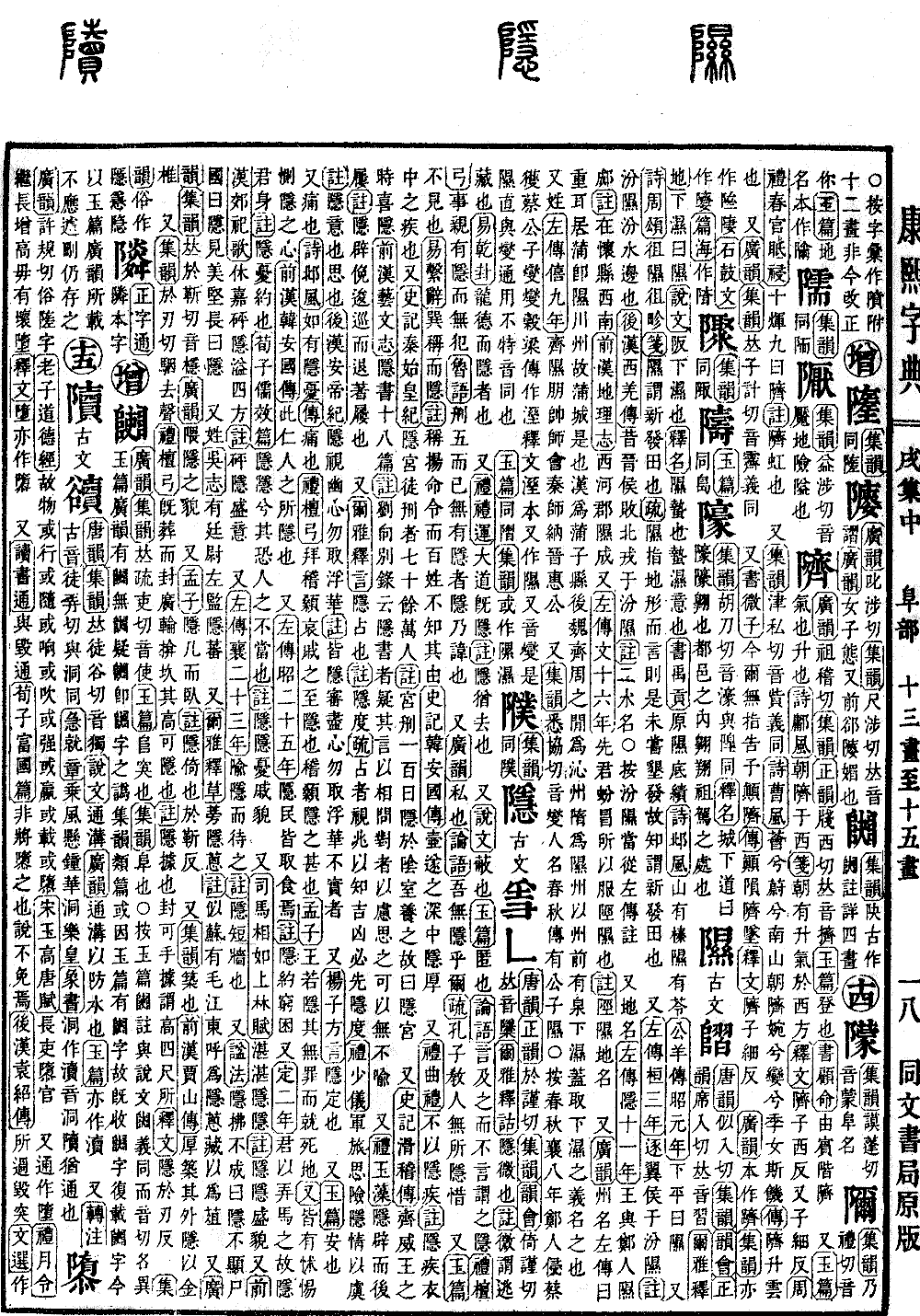
Xu Collection, Middle Volume
Radical: Mound (fù)
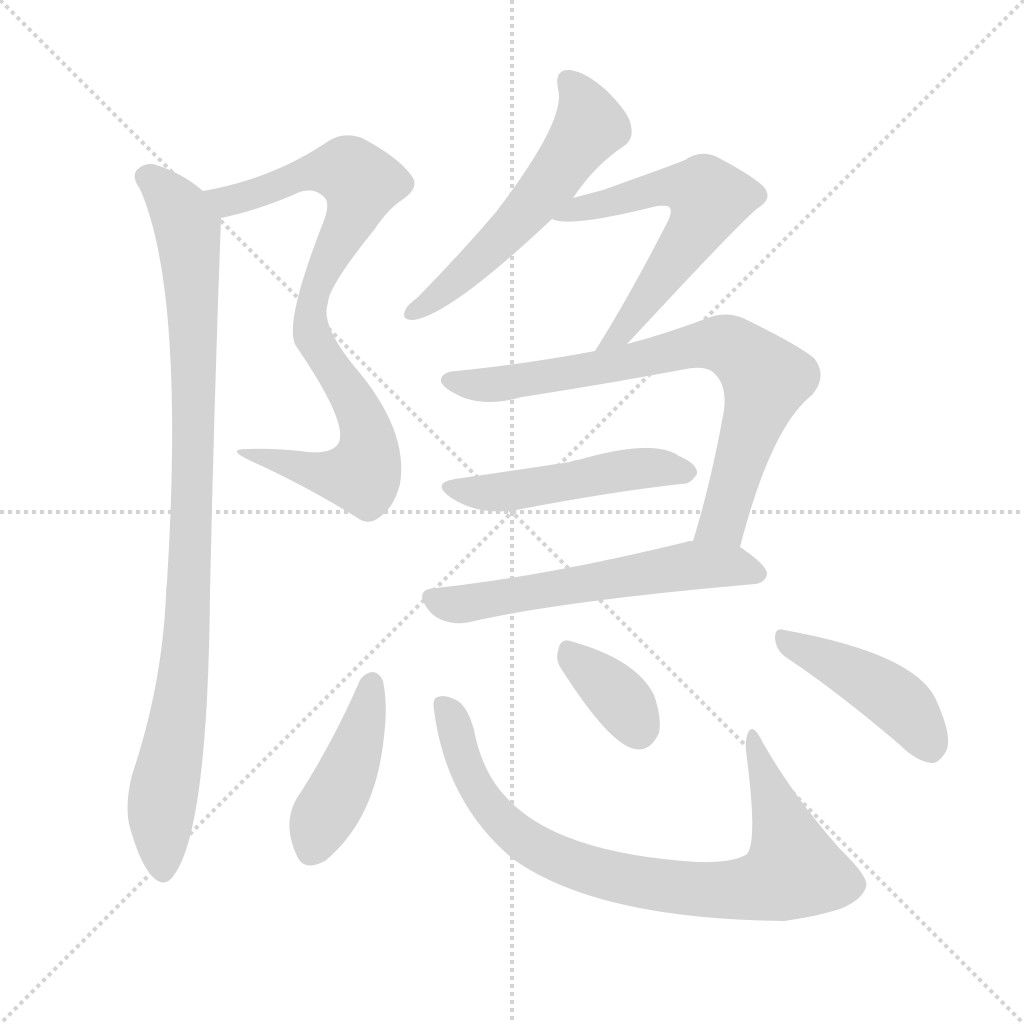
隐
Kangxi Strokes: 22
Page: 1362
Ancient form
Yú jǐn qiè (Tangyun, Zhengyun), Yǐ jǐn qiè (Jiyun, Yunhui), pronounced yǐn (sound of 檃).
Erya, Explanation of Words (Ěryǎ, Shìgǔ): "Yǐn means subtle or minute." The commentary states: "Subtle refers to escaping and hiding."
Book of Changes, Qian Hexagram (Yì, Qián Guà): "A dragon of virtue, yet remaining hidden."
Book of Rites, Evolution of Rites (Lǐjì, Lǐyùn): "When the Great Way is hidden." The commentary states: "Hidden here means like departing."
Shuowen Jiezi (Shuōwén Jiězì): "To cover." Yupian (Yùpiān): "To conceal."
Analects (Lúnyǔ): "To speak of something and then not speak of it is called yǐn (concealing)."
Book of Rites, Tangong (Lǐjì, Tánggōng): "In serving one's parents, there should be things concealed, but no transgressions."
Discourses of Lu (Lǔyǔ): "There were only five; there were no hidden ones; yǐn means to taboo or avoid."
Guangyun (Guǎngyùn): "Private."
Analects: "I have nothing hidden from you." The sub-commentary states: "Confucius taught people not to conceal or be stingy about anything."
Yupian: "Not visible."
Book of Changes, Xici Commentary (Yì, Xìcí): "When Xùn (Gentle) is proclaimed, it is hidden." The commentary states: "Proclaiming commands, yet the common people do not know their origin."
Records of the Grand Historian, Biography of Han Anguo (Shǐjì, Hán Ānguó Zhuàn): "Hu Sui's profound and hidden magnanimity."
Book of Rites, Quli (Lǐjì, Qǔlǐ): "Do not reveal hidden ailments." The commentary states: "Hidden ailments refer to diseases covered by clothing."
Records of the Grand Historian, Annals of Qin Shihuang (Shǐjì, Qín Shǐhuáng Jì): "Those confined to the yǐn gōng (hidden palace) numbered over 700,000." The commentary states: "Castration was the punishment; after suffering it, one had to recuperate in a dark room for a hundred days, hence it was called yǐn gōng."
Records of the Grand Historian, Biographies of the Jesters (Shǐjì, Huájī Zhuàn): "King Wei of Qi liked yǐn (riddles) during his reign."
Book of Han, Treatise on Literature (Qiánhàn, Yìwén Zhì): "Eighteen chapters of yǐn shū (books of hidden meanings/riddles)." The commentary states: "Liu Xiang's Bielu (Biélù) says: yǐn shū are books that use doubtful language to ask questions of each other; the respondent then relies on thought to answer, and there is nothing that cannot be clarified."
Book of Rites, Yuzao (Lǐjì, Yùzǎo): "To stoop down and retreat before donning shoes." The commentary states: "Yǐn pì refers to bending down and carefully stepping back before putting on shoes."
Erya, Explanation of Words: "Yǐn means to divine." The commentary refers to yǐn dù (to secretly ponder or estimate). The sub-commentary states: "Divination involves observing omens to foretell good or bad fortune, which necessarily requires first secretly estimating."
Book of Rites, Shaoyi (Lǐjì, Shǎoyí): "In military campaigns, contemplate dangers, and conceal situations to prepare." The commentary states: "Yǐn refers to deliberation and planning."
Book of the Later Han, Annals of Emperor An (Hòuhàn, Āndì Jì): "Carefully and thoroughly examine with full heart, do not choose the superficial." The commentary states: "One must secretly examine and give full effort, not selecting those who are superficial and insincere."
Yangzi Fayan (Yángzǐ Fāngyán): "Yǐn means to settle or determine."
Yupian: "To be at peace."
Also, pain.
Book of Odes, Beifeng (Shījīng, Bèifēng): "If there is hidden sorrow." The commentary states: "Pain."
Book of Rites, Tangong: "Bowing and knocking the head to the ground is the utmost yǐn (grief) of sorrow." Knocking the head to the ground is the extreme of hidden pain.
Mencius (Mèngzǐ): "If the King felt pity for their innocence as they faced death."
Mencius: "All have a mind of commiseration and pity."
Book of Han, Biography of Han Anguo: "This is what a benevolent person pities."
Zuo Commentary, Duke Zhao 25th Year (Zuǒzhuàn, Zhāo Èrshíwǔ Nián): "The distressed people all took food from it." The commentary states: "Distressed people refer to those suffering hardships in life."
Zuo Commentary, Duke Ding 3rd Year (Zuǒzhuàn, Dìng Sān Nián): "Due to the horse-play, the lord worried for himself." The commentary states: "Yǐn refers to inner anxiety and unease."
Xunzi, On the Achievements of the Ru (Xúnzǐ, Rúxiào Piān): "Deeply saddened and fearful that people might not be upright." The commentary states: "Yǐnyǐn describes an appearance of sorrow and grief."
Sima Xiangru, Rhapsody on the Imperial Park (Sīmǎ Xiāngrú, Shànglín Fù): "Deep and flourishing." The commentary states: "Yǐnyǐn describes a flourishing appearance."
Book of Han, Songs for the Suburban Sacrifices: "Auspicious blessings, grandly overflowing in all directions." The commentary states: "Pēngyǐn describes a grand appearance."
Zuo Commentary, Duke Xiang 23rd Year (Zuǒzhuàn, Xiāng Èrshísān Nián): "They climbed over the low wall and waited for him." The commentary states: "Yǐn is a low wall."
Posthumous Titles (Shìfǎ): "One who obstructs but fails is called Yǐn; one who does not clearly govern the state is called Yǐn; one who is perceived as beautiful, steadfast, and enduring is called Yǐn."
Also, a surname. Records of Wu (Wú Zhì): "There was Yin Fan, Left Supervisor of the Court of Judicial Review."
Erya, Explanation of Plants (Ěryǎ, Shìcǎo): "Bàng, also yǐn cōng." The commentary states: "It resembles perilla, has hairs, and in the Jiangdong region is called yǐn cōng; it can be pickled as a vegetable."
Also, Yú jìn qiè (Guangyun, Jiyun), pronounced yǐn (sound of 檼). Guangyun describes the winding and hidden appearance of mountains or terrain.
Mencius: "He leaned on his desk and lay down." The commentary states: "Yǐn means to lean on." It is pronounced as Yú jìn fǎn.
Also, Jiyun means "to ram or pound." Book of Han, Biography of Jia Shan (Qiánhàn, Jiǎ Shān Zhuàn): "They thickly rammed the outside, pressing it with golden mallets."
Also, Yú rèn qiè (Jiyun), pronounced yìn (departing tone).
Book of Rites, Tangong: "After burial and mounding, the breadth and circumference cover the pit, and its height can be leaned upon." The commentary states: "Yǐn means to lean on." The height of the mound allows for leaning with the hand, referring to a height of approximately four chǐ (Chinese feet). The Shìwén (explanation of text) states: "Yǐn is pronounced as Yú rèn fǎn."
Jiyun: "Commonly written as 隐."
Correction: In Book of the Later Han, Annals of Emperor An, the original text "Yǐn shì yōu xīn" should be "Yǐn qīn xī xīn".
Correction: In Zuo Commentary, Duke Ding 2nd Year, the original text "2nd Year" should be "3rd Year".
Correction: In Zuo Commentary, Duke Xiang 23rd Year, the original text "yú yǐn" should be "yú yǐn".
Correction: In Erya, Explanation of Plants, the two instances of the character "蔥" should be "葱".