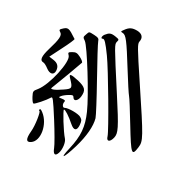
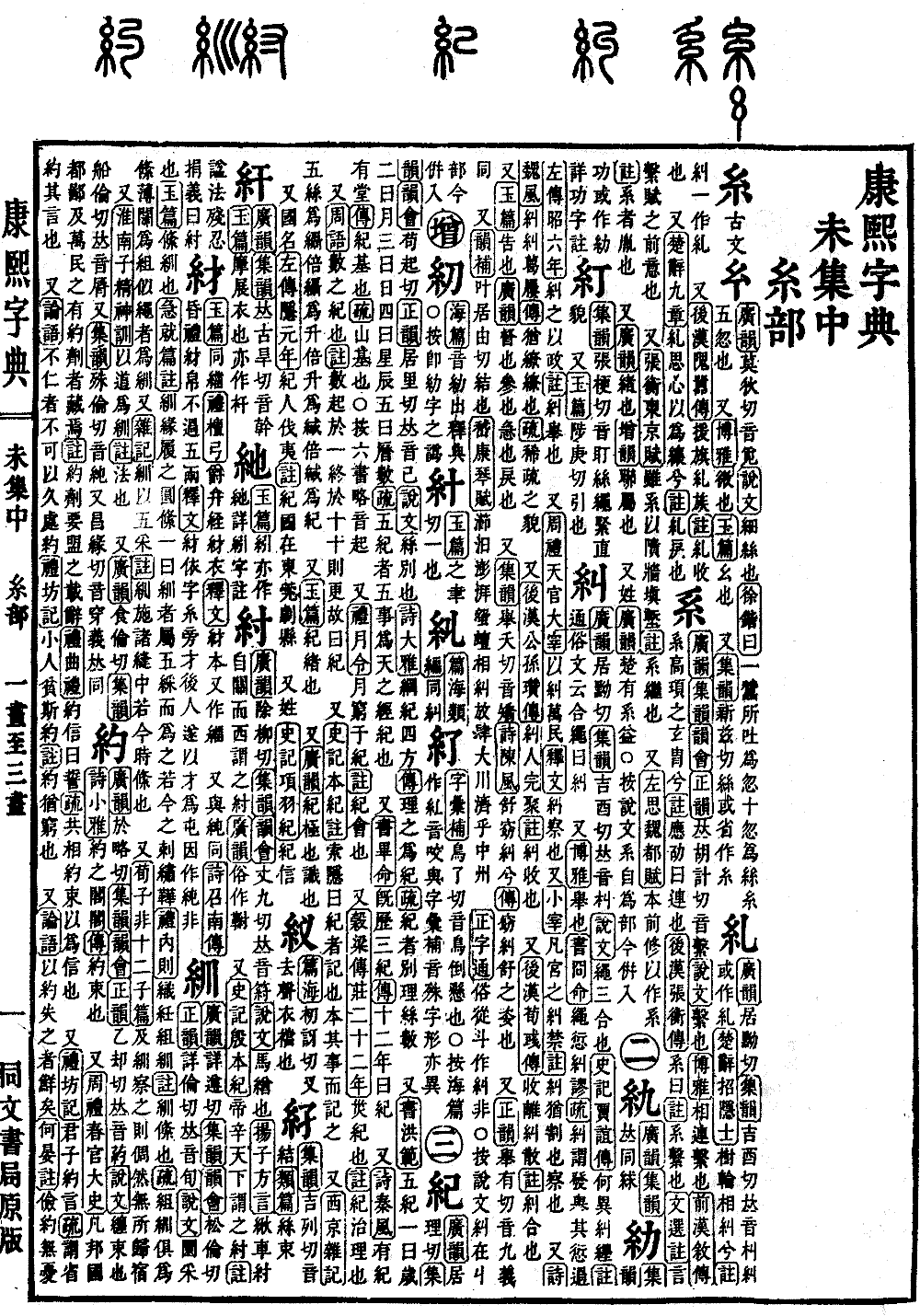
Wei Collection, Middle Volume. Radical: Silk (mì). Kangxi stroke count: 9. Page 915, Entry 20.
Pronounced xun. In Broad Rhymes (Guangyun), Collected Rhymes (Jiyun), and Rhyme Meeting (Yunhui), the pronunciation is xun; in Correct Rhymes (Zhengyun), the pronunciation is xun. Explained in Explaining Graphs and Analyzing Characters (Shuowen Jiezi) as a circular colored ribbon. Jade Chapter (Yupian) defines it as a silk woven ribbon or trim. Notes to the Emergency Handbook (Jijiupian Zhu) states that this is a circular silk ribbon used to decorate the edges of shoes. Another interpretation suggests it is woven from five-colored threads, similar to decorations found on modern embroidered boots. Book of Rites (Liji), Inner Chapters, records the practices of weaving cloth and braiding ribbons and trimmings. The commentary notes that this refers to a silk ribbon. The sub-commentary explains that both braids and trimmings are silk ribbons; wide and thin ones are called braids, while those resembling cords are called trimmings. Book of Rites, Miscellaneous Records, records that it is made from five-colored threads. The commentary notes it is used at the seams of garments, similar to a modern ribbon. Also, in Xunzi, Not Twelve Masters Chapter, it is used in the sense of finding nothing to rely upon when examining something closely. Also, in Huainanzi, Spiritual Training, it is used in the sense of a principle or law. Pronounced chun. Also pronounced chun. Also pronounced chuan. The meanings remain consistent.