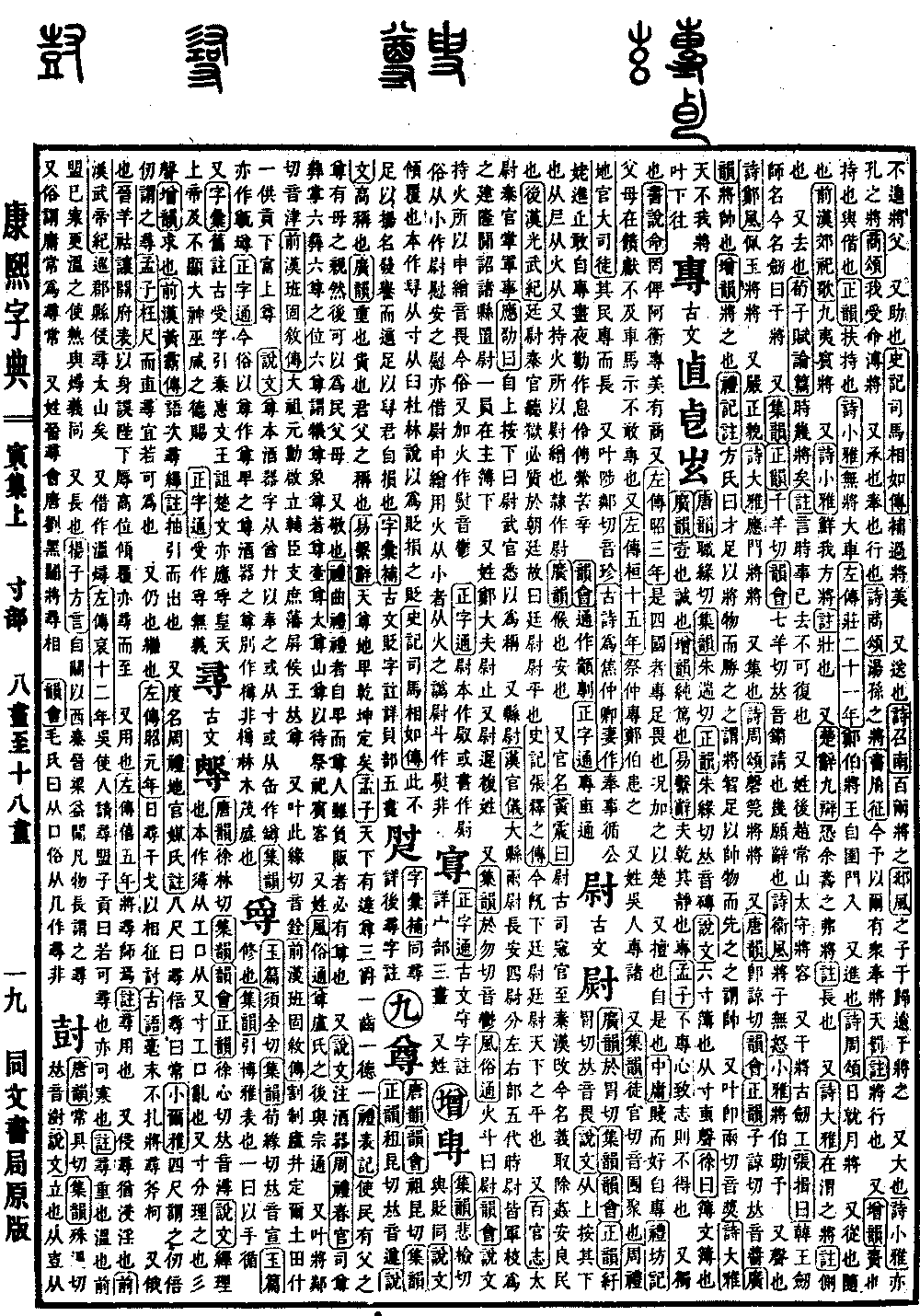
Yin Collection, Upper Volume
Radical: Inch (cùn)
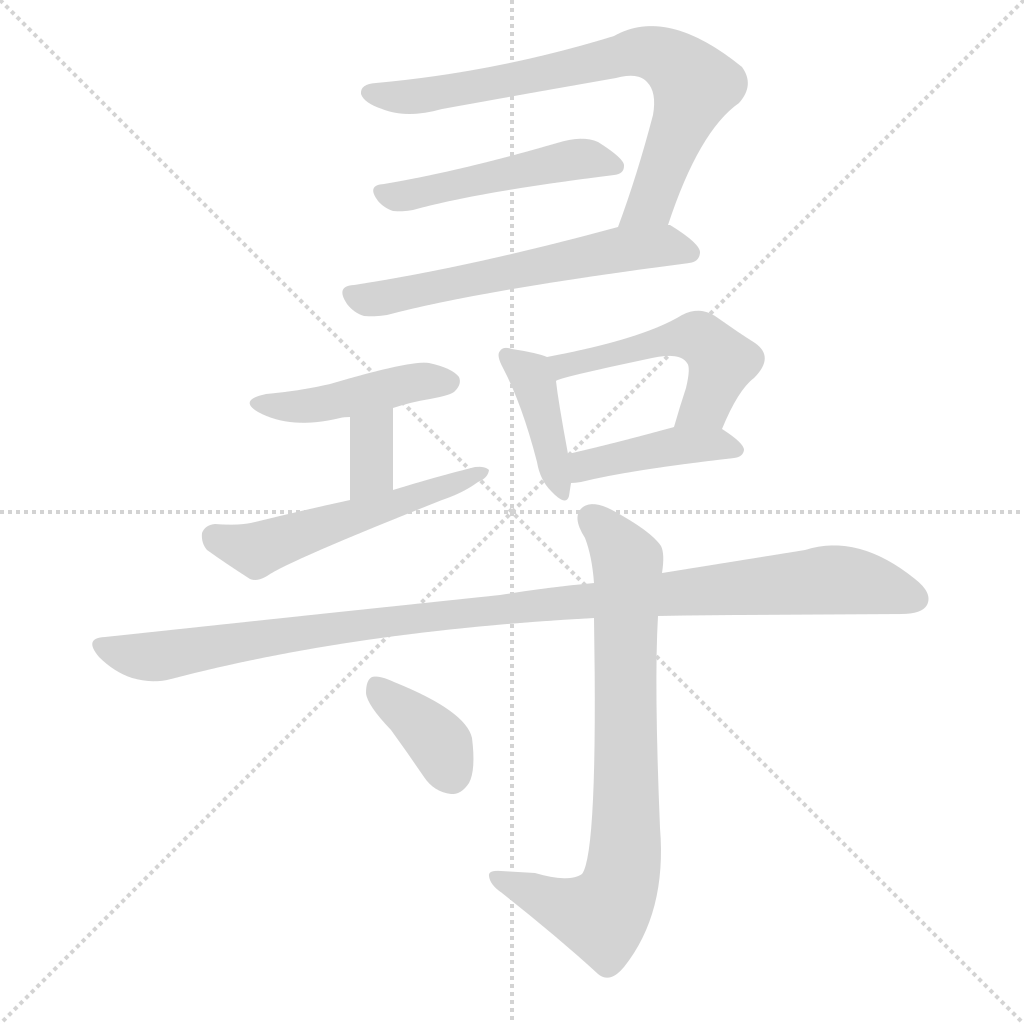
Entry: Xun
Kangxi Dictionary stroke count: 12
Page 295, Entry 12
Archaic script.
Pronounced xun (rising tone).
In the Explaining Graphs and Analyzing Characters (Shuowen Jiezi), it is defined as the unraveling of principles. Originally written as a character composed of the elements for work and mouth, and the elements for hand and inch. Work and mouth together indicate disorder; hand and inch indicate separating and organizing those principles. The phonetic component is shan.
In the Extended Rhymes (Zengyun), it means to seek.
In the History of the Former Han (Qianhan Shu), biography of Huang Ba, it is used in the phrase to seek and unravel. The commentary explains this as pulling out and drawing forth.
Also a unit of measurement. In the Rites of Zhou (Zhouli), Earth Officials, Master of Matchmaking section, the commentary notes that eight feet is called a xun, and double that is called a chang. In the Lesser Literary Encyclopedia (Xiao Erya), four feet is called a ren, and double that is called a xun. In the Mencius (Mengzi), it states to bend a foot to straighten a xun; it seems as though it might be doable.
Also means to continue or follow. In the Zuo Tradition (Zuo Zhuan), first year of Duke Zhao, it states day after day continuing the use of shields and spears to launch punitive expeditions against one another. An old saying goes: if one does not trim the hair-thin sprout, it will eventually require an axe to fell the tree.
Also means suddenly. In the memorial by Yang Hu of the Jin dynasty declining the office of senior minister, he writes: because I have mistakenly disgraced a high position for Your Majesty, downfall will also suddenly arrive.
Also means to use. In the Zuo Tradition (Zuo Zhuan), fifth year of Duke Xi, it states that he will use the army. The commentary explains that xun here means to use.
Also qinxun, meaning to soak into or spread gradually. In the History of the Former Han (Qianhan Shu), Annals of Emperor Wu, it states that while touring the commanderies and counties, he gradually reached Mount Tai.
Also borrowed to mean warm or reheat. In the Zuo Tradition (Zuo Zhuan), twelfth year of Duke Ai, the state of Wu sent someone to request a reheating of the alliance. Zigong said: if it can be reheated, it can also be cooled. The commentary explains that xun means to repeat or to warm; the previous alliance had already gone cold, so they wished to warm it up again to make it hot. It shares the same meaning as the character for warming or heating.
Also means long. In Yang Xiong's Dialects (Fangyan), it states that west of the mountain passes, in the regions of Qin, Jin, Liang, and Yi, when something is long, it is called xun.
Also commonly used in the phrase meaning mediocre or ordinary.
Also a surname. Xun Hui of the Jin dynasty, and Xun Xiang, a general under Liu Heita of the Tang dynasty.
The Rhyme Collection (Yunhui) notes that Mr. Mao says: it follows the mouth radical. It is common practice to follow the table radical and write it as a different character, which is incorrect.