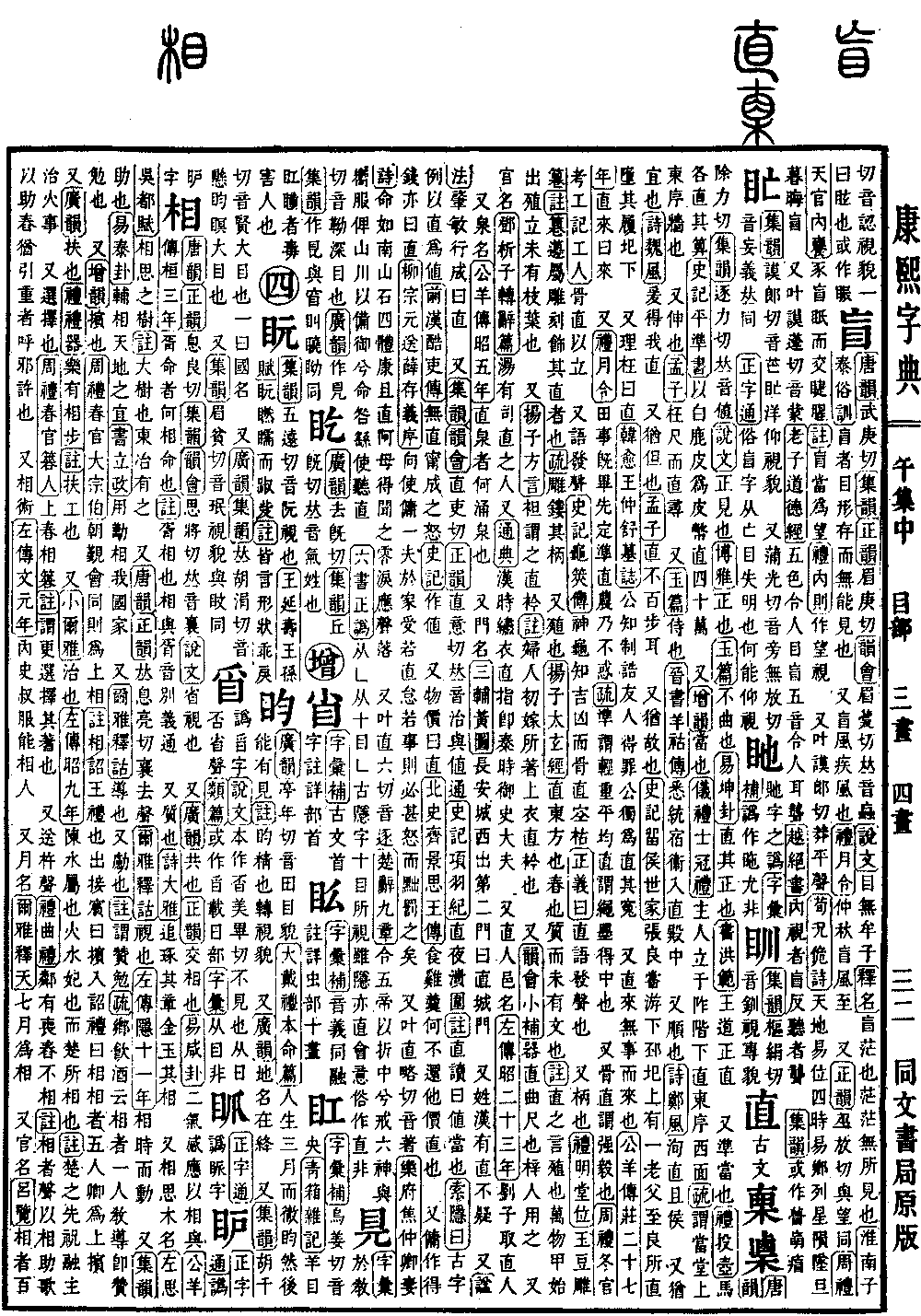
Wu Collection, Middle Volume
Radical: Eye (mù)
Page 800, Entry 18
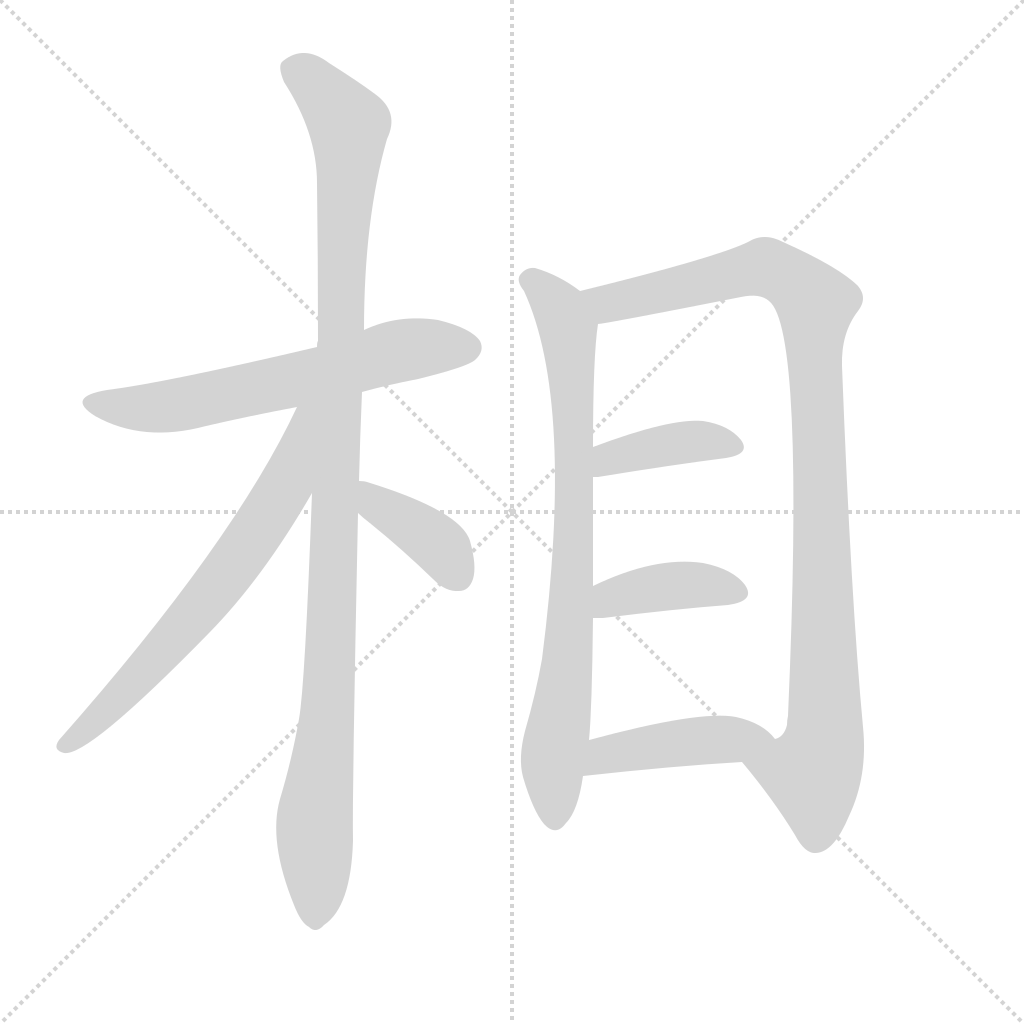
Pronounced xiang. In Tang Yun and Zheng Yun, the pronunciation is given as xiang (level tone); in Jiyun and Yunhui, the pronunciation is given as xiang (level tone). The sound is identical to the character xiang.
Shuowen Jiezi defines it as: to observe carefully.
Guangyun defines it as: together.
Zheng Yun defines it as: mutually.
Book of Changes (Yijing), Hexagram Xian: Yin and yang qi interact and give to one another.
Gongyang Zhuan, Third Year of Duke Huan: Question: What is the meaning of xu ming? Answer: It refers to mutual swearing of oaths.
Note: Xu means the same as xiang. While xiang and xu have different pronunciations, their meanings are identical.
It also means: essence.
Book of Odes (Shijing), Daya: Carve those patterns; the essence is gold and jade.
Xiangsi (lovesickness) is the name of a tree.
Zuo Si, Wu Capital Rhapsody (Wudu Fu), mentions the xiangsi tree.
Note: It is a large tree found in the region of Dongye.
Also pronounced xiang (departing tone). In Tang Yun and Zheng Yun, the sound is identical to the departing tone of xiang.
Erya, Explaining Glosses: Defined as: to look.
Zuo Zhuan, Eleventh Year of Duke Yin: Observe the opportunity before acting.
Also defined in Jiyun as: to assist.
Book of Changes (Yijing), Hexagram Tai: To assist in completing the harmony of heaven and earth's transformation.
Book of Documents (Shujing), Establishment of Government: Used to strive to assist our state.
Erya, Explaining Glosses: Defined as: to guide.
Defined as: to praise or encourage.
Note: It means to praise and encourage.
Commentary: The Book of Etiquette and Ceremonial (Yili), Section on Village Drinking Rituals, mentions that xiang is a person responsible for guiding, which is to say, praising and encouraging.
Also defined in Zeng Yun as: master of ceremonies.
Rites of Zhou (Zhouli), Spring Offices, Great Minister of Rites: When feudal lords meet the Son of Heaven, one acts as the senior assistant (shangxiang).
Note: Xiang means to inform the ruler of ritual protocols. Going out to welcome guests is called bin, while coming inside to report ritual protocol is called xiang. There are five types of officials designated as xiang, and the minister is the senior assistant.
Defined in Guangyun as: to support.
Book of Rites (Liji), Ritual Vessels: When music is performed, there is the xiang bu, where someone supports the musicians.
Note: This refers to supporting the blind musicians.
Defined in Xiao Erya as: to govern.
Zuo Zhuan, Ninth Year of Duke Zhao: Water belongs to the yin category; fire is the spouse of water, and what the state of Chu governs is the affairs of fire.
Note: The ancestors of Chu, Zhu Rong, were officials in charge of fire affairs.
Defined as: to select.
Rites of Zhou (Zhouli), Spring Offices, Diviner of Yarrow: In early spring, select the yarrow stalks used for divination.
Note: This means to re-select the yarrow stalks.
Refers to the rhythmic sound made while pounding grain.
Book of Rites (Liji), Section on Regulations: When a neighbor is in mourning, do not shout rhythms while pounding grain.
Note: Xiang refers to using sound to assist in exerting force, singing to aid in pounding, just as people pulling heavy loads cry out xie-xu.
Refers to the art of physiognomy.
Zuo Zhuan, First Year of Duke Wen: Neishi Shufu was skilled at reading the physiognomy of others.
Refers to a name for a month.
Erya, Explaining Days: The seventh month is called xiang.
Refers to an official title.
Lvshi Chunqiu (Lushi Chunqiu): The xiang is the head of the hundred officials.
Gu Sanfen: During the time of Fuxi, the senior assistant was Gonggong, and the junior assistant was Huanghuan.
Book of the Former Han, Table of Officials: Chancellor of State and Chancellor were official titles established during the Qin dynasty.
Also refers to the jixiang (finance minister).
Records of the Grand Historian (Shiji), Biography of Chancellor Zhang: Zhang Cang was promoted to jixiang.
Note: An official specifically in charge of national household registers and statistical accounts.
Also refers to neixiang (inner minister).
Old Book of Tang, Biography of Lu Zhi: When Lu Zhi served as a Hanlin scholar, he was known as the inner minister.
Also refers to jiaxiang (household minister).
Book of Rites (Liji), Section on Regulations: Scholars do not directly call the names of their household ministers.
Note: These are the officials in charge of domestic affairs.
Rites of Zhou (Zhouli), Spring Offices, contains the official title Fengxiang Shi. The Summer Offices contains the official title Fangxiang Shi.
Refers to a musical instrument.
Book of Rites (Liji), Record of Music: Use the xiang to regulate the order and disorder of music.
Note: Xiang is the same as fu. It is used to regulate music; it is made of leather on the outside and filled with chaff. Chaff is also called xiang, hence the name.
Refers to a star name.
Shi Shen Star Classic: The xiang star is located south of the Di asterism in the Northern Pole.
Also a river spirit named Qixiang, found in Boya.
The Grand Historian's department has a xiangfeng gan (wind-watching pole).
Fu Xiuyun, Rhapsody on the Wind-Watching Pole: Uses a spirit bird as an emblem and a golden tiger for protection. It is used to sense auspicious winds and divine good or bad fortune.
Gujin Zhu: Written as "bird that monitors the wind," created by Yu the Great.
Refers to a medicinal name.
Compendium of Materia Medica (Bencao Gangmu): Xiang is another name for ephedra. Xiangniao is another name for horse orchid.
Refers to a place name.
Preface to the Book of Shang: He Danjia resided in Xiang.
Note: Located north of the Yellow River. The present-day Weijun has a Xiang County.
Refers to a provincial name. The Later Wei established Xiang Province; during the Tang dynasty, it was called Yedu.
Refers to a surname.
Book of the Later Han, Biography of the Southern Barbarians: In the Wuluo Zhongli Mountains, there were four surnames, one of which was Xiang.
Later Qin had Xiang Yun.
Northern Qi had Xiang Yuan.
Also exists as compound surnames: Xiangli, Wuxiang, Kongxiang, Xiongxiang, Yixiang, Jingxiang, Yixiang.
In Zibu Bu, the pronunciation is identical to xiang (warding off).
Book of Rites (Liji), Law of Sacrifice: The xiangjin at the altar is for sacrificing to the gods of heat and cold.
Note: Xiangjin should be interpreted as sacrificial prayer; Wang Su also writes it as zuying.
Also, the entering tone is pronounced xi (entering tone).
Du Fu, Random Verses: It seems as if the spring wind deliberately bullies me, blowing off several branches of flowers in the night.
Lu You's Notes on Poetry: Bai Juyi often used the character xiang with the pronunciation xi (entering tone). For example, "I ask the moon over Chang'an, why are we not separated?" is read this way. In this poem, "bullying" (xiangqi) should also be read in the entering tone.
Shuowen Jiezi, quoting the Yiyi: Among things on earth that can be observed, none are more worth observing than trees; therefore, the character is composed of eye and wood.
Zhengzitong: Xiang is commonly written as the variant character [X]. This is a zhuanzhu (derivative character). Xiang, pronounced xiang, means to observe carefully. [X], pronounced mo, refers to unclear vision. Dividing xiang into two separate characters is incorrect.