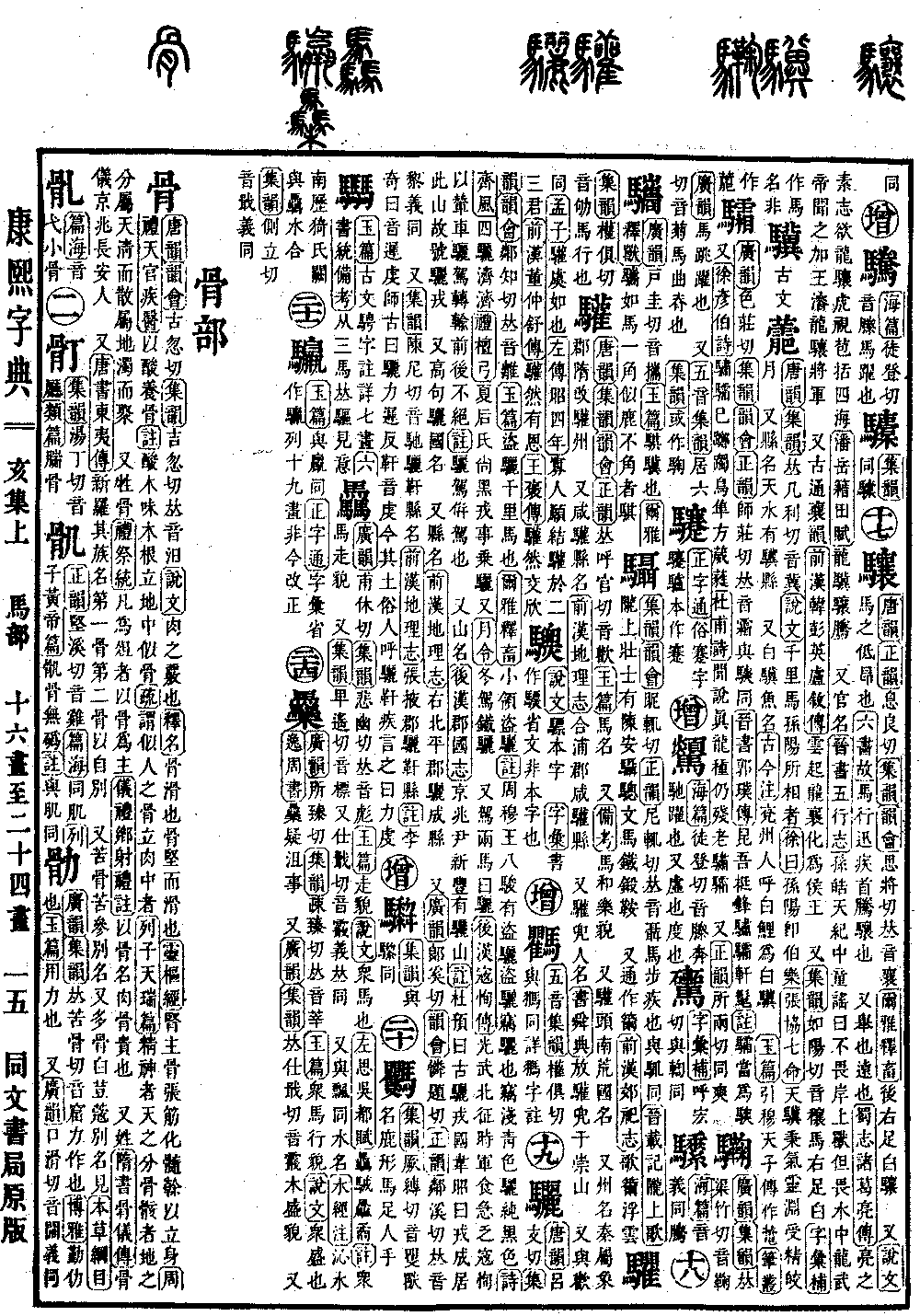
Hai Collection, Upper Volume
Radical: Horse (mǎ)
Entry: Xiang
Kangxi brush strokes: 27
Page 1447, Entry 03
Pronounced xiang.
According to the Erya (Erya), a horse with its right hind leg white is called xiang.
According to the Shuowen (Shuowen), it refers to the manner of a horse raising and lowering its head.
According to the Liushu Gu (Liushu Gu), it refers to a horse running swiftly with its head held high and leaping. It also refers to high-spirited movement or traveling to distant places.
According to the Records of Shu (Shu Zhi), the biography of Zhuge Liang, his lifelong ambition was to stand tall like a dragon or tiger and encompass the world.
According to the Rhapsody on Tilling the Fields (Jitian Fu) by Pan Yue, the steed galloped with its head held high like a dragon.
It also refers to a military rank. According to the Book of Jin (Jin Shu), a folk song during the Tianji era of Sun Hao said: Do not fear the beasts on the bank, fear only the dragon in the water. Upon hearing this, Emperor Wu of Jin promoted Wang Jun to General of Dragon Xiang.
In ancient texts, it is also used interchangeably with the character xiang.
According to the History of the Former Han (Qian Han Shu), the wind and clouds rose like a leaping dragon, and he transformed into a feudal lord.
Pronounced rang. Refers to a horse's right foot being white.
The Zihui Bu (Zihui Bu) defines this as a horse's name, which is incorrect.