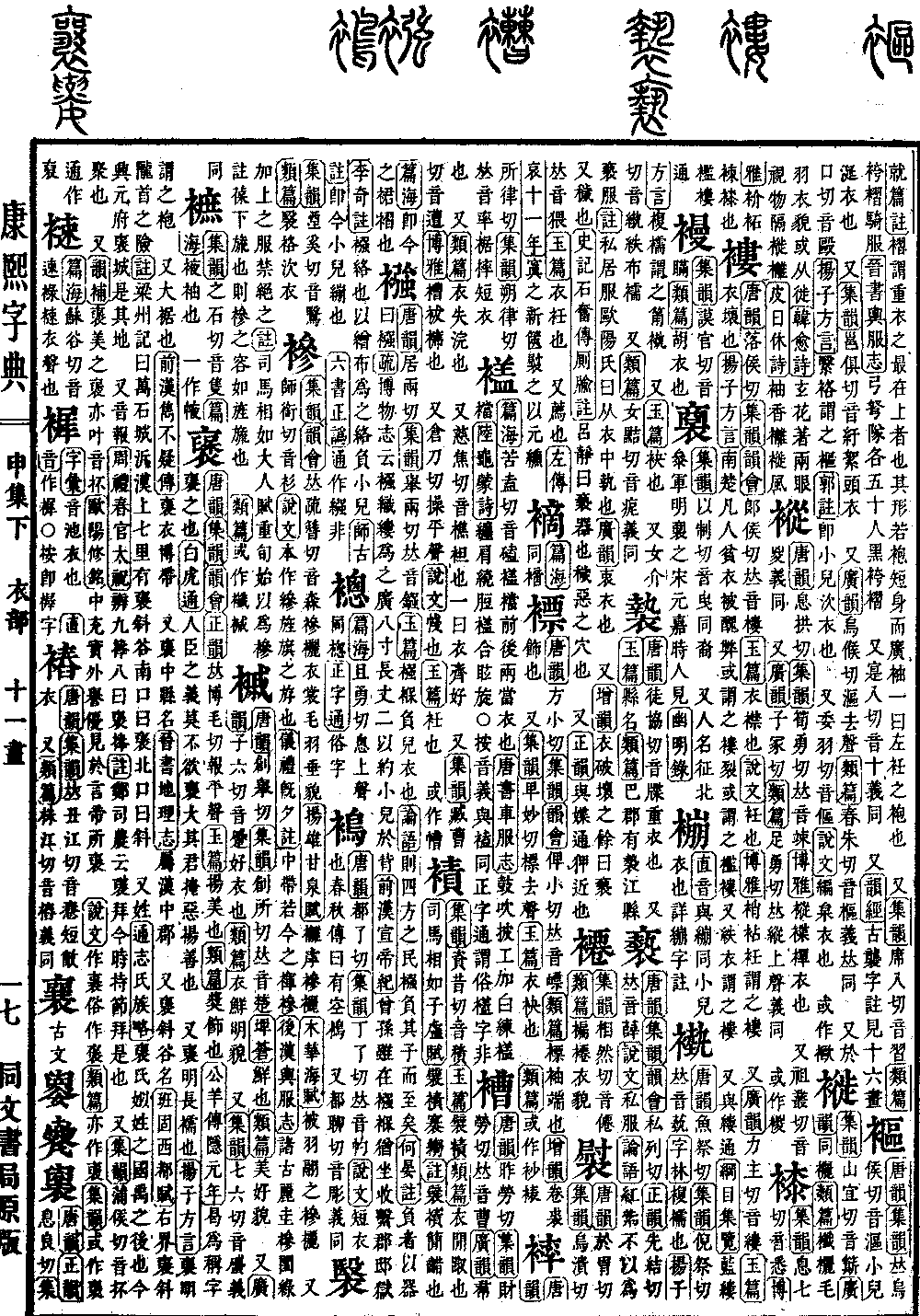
Shen Collection, Lower Volume
Radical: Clothing (yī)
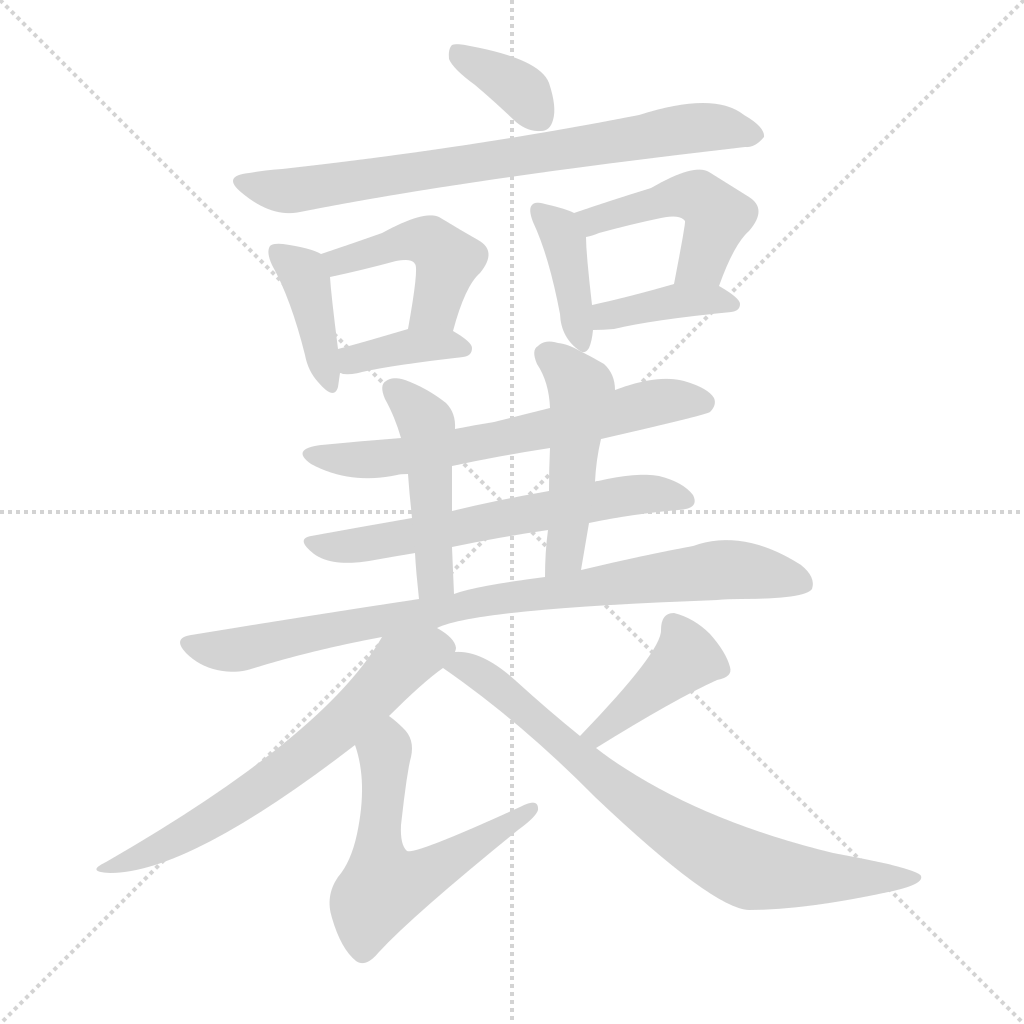
Character: Xiang
Kangxi stroke count: 17
Page 1123, Entry 31
Ancient form. Pronounced xiang.
According to the Explaining Graphs and Analyzing Characters (Shuowen Jiezi), a Han dynasty ordinance states that taking off one's outer garment to plow is called xiang. It also means to ascend.
In the Book of Documents (Shujing), specifically the Canon of Yao (Yao Dian), it is written: The waters encompassed the mountains and ascended the hills. The commentary notes that this means to cover the mountains and ascend the hills. Also, in the Counsels of Gao Yao (Gaoyao Mo), it is written: Considering the task, assist and ascend. The sub-commentary explains that this refers to praising and stating the affairs of the ancients.
Also means to remove. In the Book of Odes (Shijing), specifically the Odes of Yong (Yongfeng), it is written: There are creepers on the wall, they cannot be removed.
Also means to complete. In the Zuo Tradition (Zuo Zhuan), under the fifteenth year of Duke Ding, it is written: When burying Duke Ding, it rained, and the rites could not be completed, which was in accordance with ritual.
Also means to yoke horses. In the Book of Odes (Shijing), specifically the Odes of Zheng (Zhengfeng), it is written: The two inner horses are yoked upward. The commentary notes that to yoke upward refers to the best of horses.
Also, in the Lesser Odes of the Kingdom (Xiaoya), it is written: That Weaving Maid (the star Vega) stands, all day long she shifts seven times. The commentary explains that shifting refers to changing the positions of the stars. From dawn to dusk, there are seven shifts of the celestial positions, each shift is called a shift.
Also, in the Records of the Grand Historian (Shiji), in the Explanation of Posthumous Titles (Shifa Jie), it is stated: One who expands territory and possesses virtue is titled Xiang; one who has achieved merit through military armor and helmets is titled Xiang.
Also a place name. In the Records of the Grand Historian (Shiji), in the Table of Marquises among the Meritorious Officials of Emperor Gaozu, there is Xiangping. The commentary states that it belonged to Linhuai. In the Treatise on Geography from the Book of the Later Han (Hou Han Shu), it is listed as Xiangyuan in Shangdang Commandery.
Also, according to the Broad Rhymes (Guangyun), it is the name of a prefecture. It was originally the Xijin of the state of Chu. The Wei dynasty established Xiangyang Commandery, and the Western Wei changed it to Xiang Prefecture, naming it after the river. The Dictionary of Rhymes (Yunhui) notes that the Song dynasty elevated it to Xiangyang Prefecture.
Also a surname. In the commentary to the Biography of Xiang Kai in the Book of the Later Han (Hou Han Shu), the Comprehensive Customs (Fengsu Tong) states: The Xiang surname is descended from Xiang Lao, a great officer of Chu. The Explaining Graphs and Analyzing Characters (Shuowen Jiezi) writes the character as a variant form.