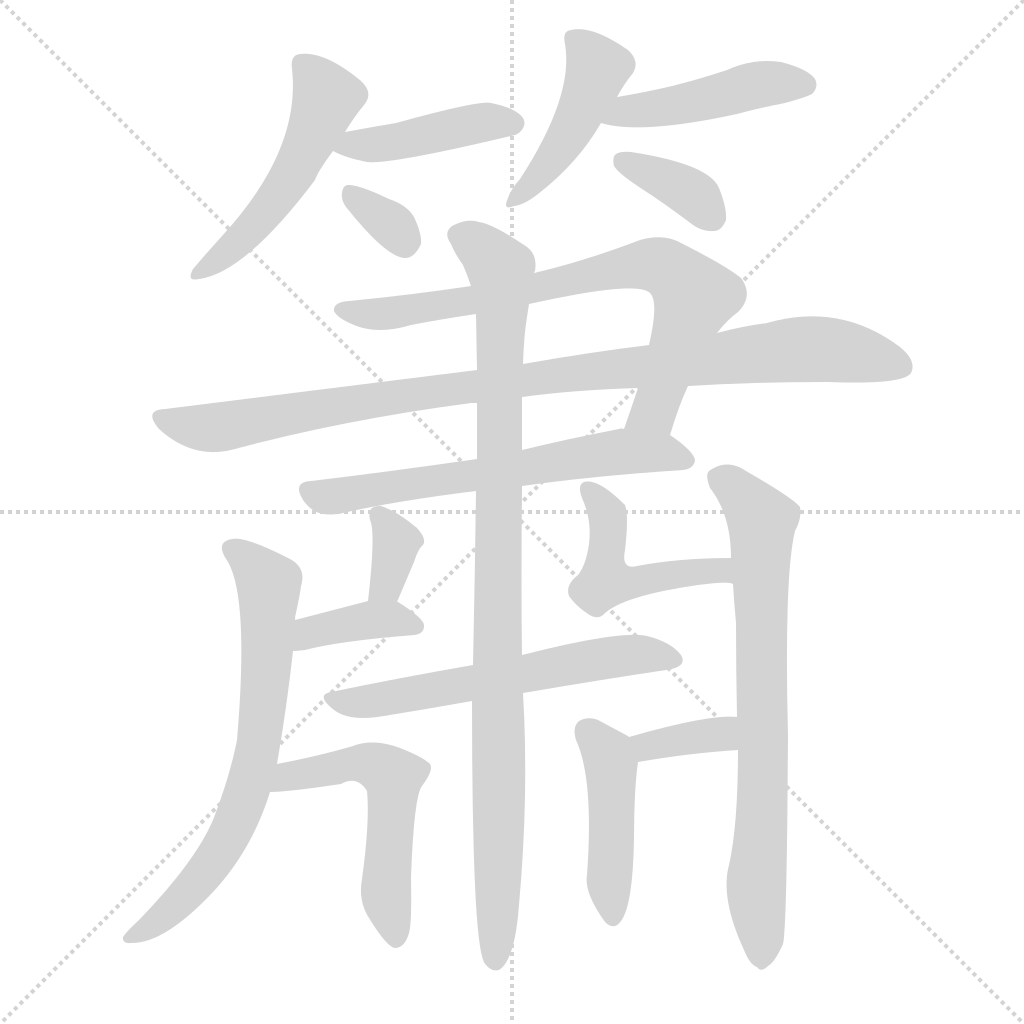
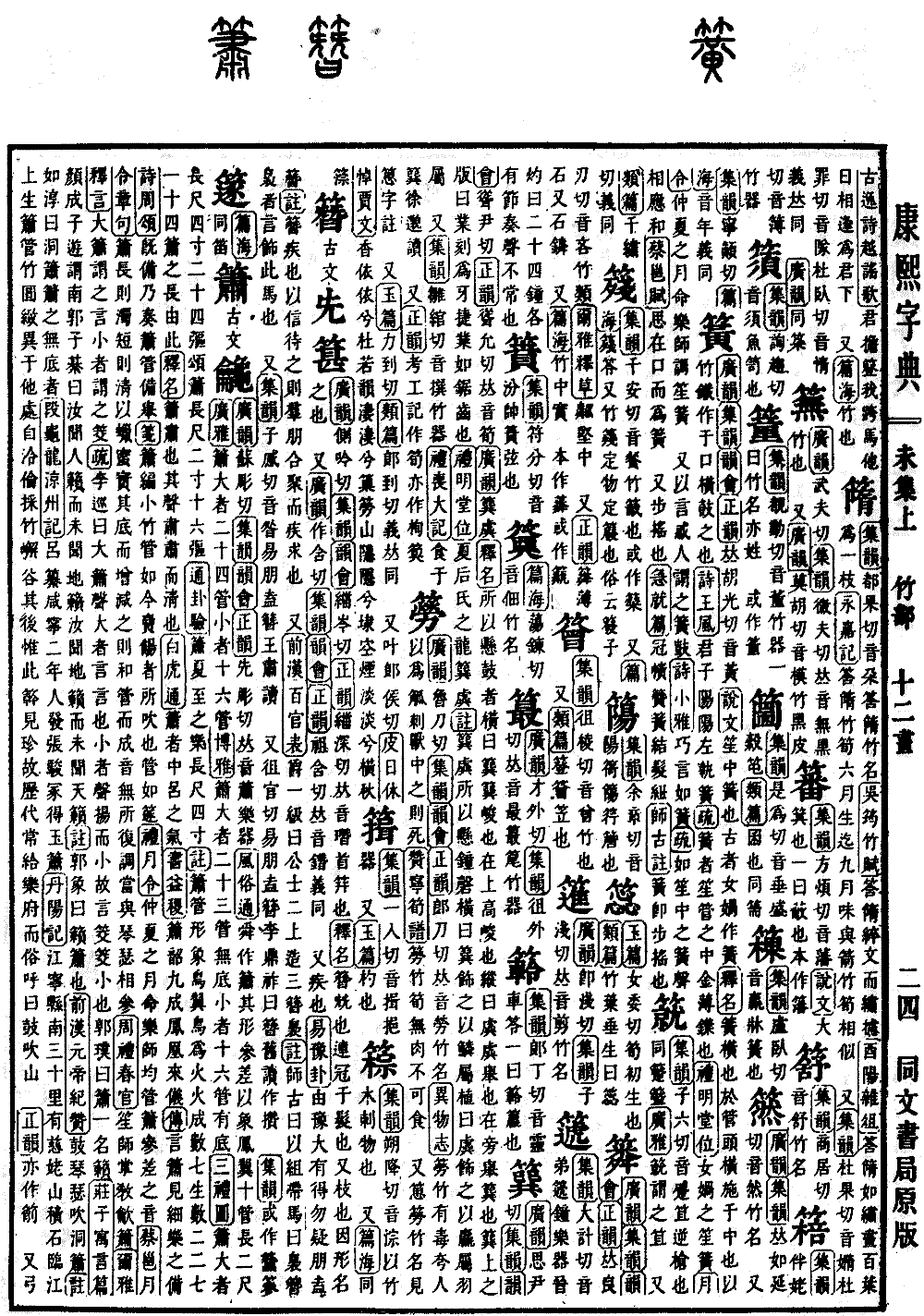
Wei Collection, Upper Volume
Radical: Bamboo (zhú)
Xiao (panpipe)
Kangxi Radical Strokes: 18
Page 900, Entry 32
Ancient text. According to Extensive Rhymes (Guangyun), it is pronounced xiao. According to Collected Rhymes (Jiyun), Rhyme Meetings (Yunhui), and Correct Rhymes (Zhengyun), it is pronounced xiao. It is a musical instrument.
Popular Customs (Fengsu Tong): Shun created the xiao. Its shape is irregular in length, imitating the wings of a phoenix. It has ten pipes, measuring two feet in length.
Extensive Encyclopedia (Guangya): The large xiao has twenty-four pipes; the small one has sixteen pipes.
Extensive Encyclopedia (Boya): The large xiao has twenty-three pipes and lacks a base. The small one has sixteen pipes and possesses a base.
Illustrated Rites (Sanli Tu): The large xiao is one foot and four inches long with twenty-four holes. The song xiao is one foot and two inches long with sixteen holes.
Verification of the Hexagrams (Tonggua Yan): The xiao is an instrument used during the summer solstice, measuring one foot and four inches long. Commentary: The xiao pipes are shaped like bird wings. Birds belong to the element of fire. The consummation number of fire is seven, and the generating number is two. Two times seven equals fourteen, from which the length of the xiao is derived.
Explanations of Names (Shiming): Xiao implies solemnity, as its sound is solemn and clear.
White Tiger Hall Discussions (Baihu Tong): The xiao corresponds to the energy of the middle-lu (a musical pitch).
Book of Documents (Shujing): When the music of the Xiao-Shao was performed nine times, the phoenixes came to participate in the court rituals. Commentary: It is said that the xiao signifies the perfection of ensemble music.
Book of Odes (Shijing): Once all is prepared, the performance begins, and the xiao and the guan (flute) are played together. Commentary: The xiao is made by arranging small bamboo pipes, similar to those blown by street candy sellers today. The guan resembles a flute.
Book of Rites (Liji): In the month of midsummer, the Master of Music is ordered to tune the qin, se, guan, and xiao.
Cai Yong: Chapter and Sentences on the Monthly Ordinances (Yueling Zhangju): When xiao pipes are long, the sound is deep; when they are short, the sound is clear. By using wax and honey to plug the bottom and adjusting the amount, it can harmonize with the guan to form a musical scale without further tuning; it should be used in coordination with the qin and se.
Book of Zhou (Zhouli): The sheng master is responsible for teaching the playing of the xiao.
Approaching Elegance (Erya): The large xiao is called yan, and the small one is called jiao. Commentary: Li Xun stated: The large xiao, whose sound is loud, is called yan-yan. The small one has a high-pitched, thin sound, hence it is called jiao. Jiao means small. Guo Pu stated: Another name for xiao is lai.
Zhuangzi: In the chapter on Allegories (Yuyan), Yancheng Ziyou said to Nanguo Ziqi: You have heard the human lai, but you have not heard the earth lai. You have heard the earth lai, but you have not heard the heavenly lai. Commentary: Guo Xiang stated: Lai is the xiao.
History of the Former Han (Qianhan Shu): In the annals of Emperor Yuan: Plucking the qin and se, playing the dongxiao. Commentary: Ru Chun stated: The dongxiao is a xiao without a base.
Duan Guilong: Records of Liangzhou (Liangzhou Ji): In the second year of Xianning, during the reign of Lu Zuan, someone excavated the tomb of Zhang Jun and discovered a jade xiao.
Records of Danyang (Danyang Ji): Thirty li south of Jiangning County is Mount Cimu. The mountain stones are piled high near the river, and bamboo suitable for making xiao pipes grows there. It is round and delicate, different from other regions. Since Ling Lun gathered bamboo in Xie Valley to create musical pitch pipes, only the bamboo from this location has been highly valued. Thus, it was often supplied to the Music Bureau, and the mountain is colloquially known as Guchui Mountain.
Correct Rhymes (Zhengyun): Also written in a variant form.
Also, the ends of a bow are called xiao. Book of Rites (Liji): When presenting a bow to someone, hold the end of the bow (xiao) with the right hand, and support the middle of the handle (fu) with the left hand. Commentary: Xiao refers to the ends of the bow. It is called xiao because the tips are slanted. Commentary: The xiao is the head of the bow; the head is slightly shaved into a slant like a xiao, hence the name.
Also, it is used interchangeably with the character xiao (referring to a type of bamboo). Ma Rong: Rhapsody on the Long Flute (Changdi Fu): The forest xiao and creeping vines. Commentary: It is used interchangeably with xiao.
Also, it has the rhyming sound xiu. Liu Shao: Rhapsody on the Capital of Zhao (Zhao Du Fu): Striking the spirit drums, sounding the lai-xiao. Riding the white waves, taking the clear water as a mirror.
Textual Research: Book of Rites (Liji): In the month of midsummer, order the Master of Music to tune the qin, se, guan, and xiao. I note that the four characters concerning the uneven sound are not in the original text of the Monthly Ordinances; accordingly, they have been corrected to read as the original text.