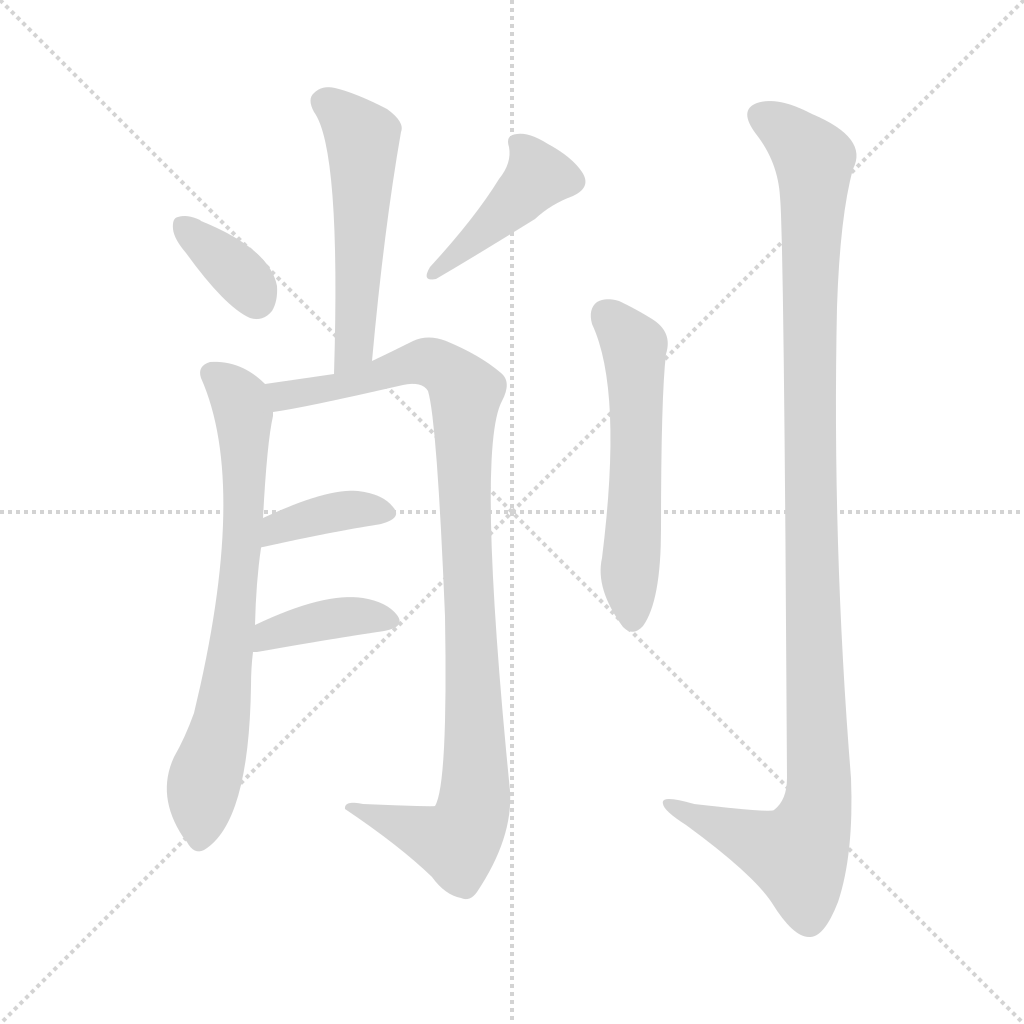
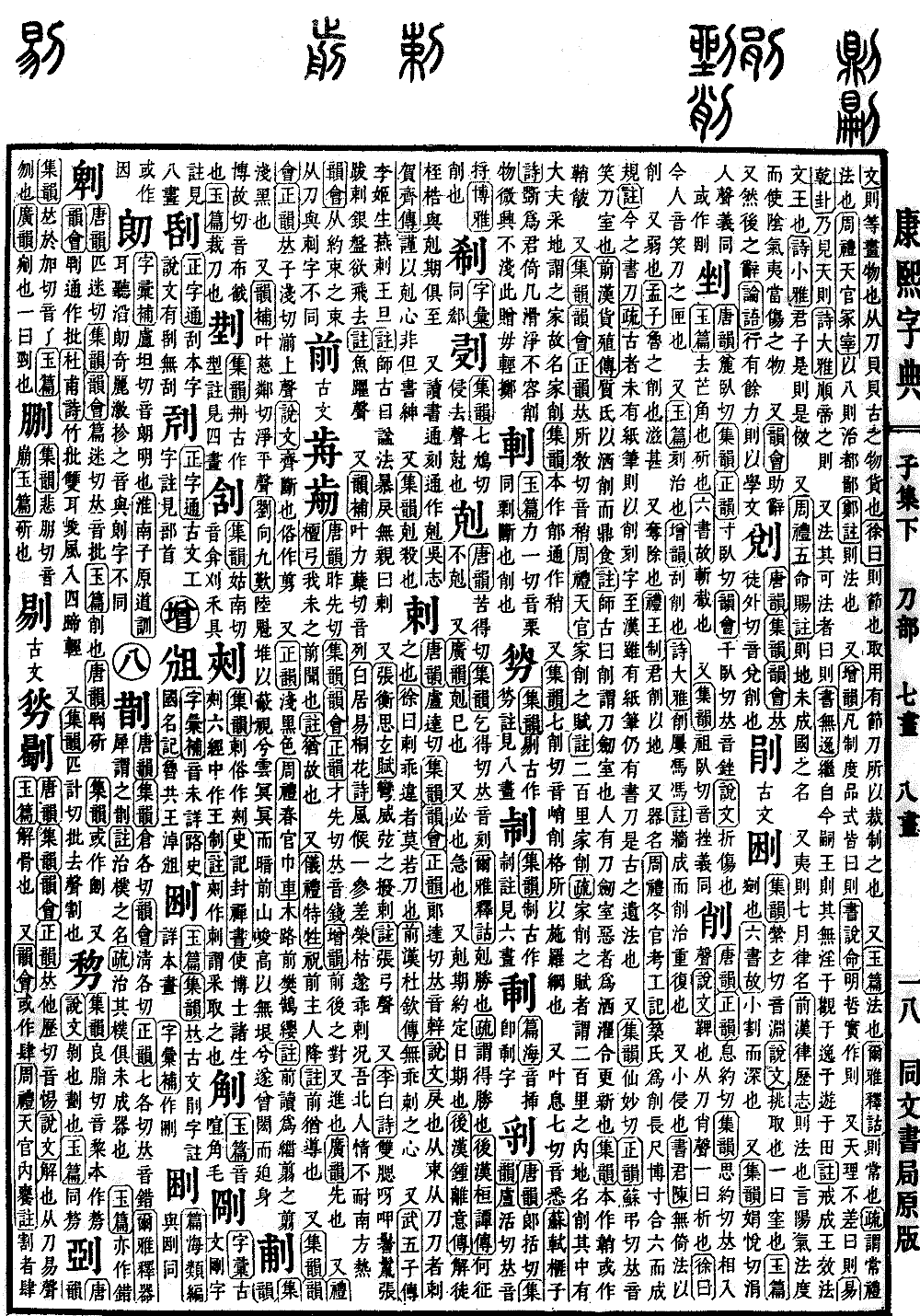
Zi Collection, Page Position: Lower, Radical: Knife (dāo)
xue; Kangxi stroke count: 9; Page: Page 140, Entry 05
Pronounced xi jue (entering tone) in Tangyun and Zhengyun, pronounced si yue (entering tone) in Jiyun. Pronounced as xiang in entering tone. In Shuowen, it refers to a knife sheath. The character is composed of the radical "knife" (dāo) and the phonetic component "xiao". Another explanation is the meaning of to divide. Xu said: Today people pronounce it as xiao. It refers to the sheath of a knife.
Also in Yüpian, it refers to carving and refining. In Zengyun, it refers to scraping and paring. In the Book of Odes (Shijing), Part: Greater Odes (Daya), "xue lü feng feng." (Note: refers to repeatedly scraping and trimming walls after they were built.)
It also refers to gradual erosion. In the Book of Documents (Shu), "Jun," "Do not rely on laws and decrees to erode."
It also refers to weakness. In Mencius, "The weakness of the state of Lu became increasingly severe."
It also refers to deprivation and reduction. In the Book of Rites (Li), "King's enfeoffments were reduced."
It also refers to a type of artifact. In the Rites of Zhou (Zhouli), "Winter Official," "The artisan Zhi made a xue, one chi long and one cun wide; six of them could form a circle." (Note: Equivalent to a modern book knife.) (Commentary: In ancient times, without paper and brush, characters were carved with a xue. Although paper and brush existed in the Han Dynasty, the book knife was still retained as an ancient method.)
Also in Jiyun, pronounced xian miao (entering tone) in Jiyun and su diao (entering tone) in Zhengyun. Pronounced as xiao. Refers to a knife sheath. In the Former Han Dynasty, "Biographies of Merchants" (Qian Han - Huozhi Zhuan), "Zhi Shi relied on washing and polishing knife sheaths to eat from tripod vessels." (Note: Shigu said: Xue refers to the sheath of a knife or sword. People had knife and sword sheaths; rough ones were washed with wine to make them look new.) In Jiyun, the original character is written as 韒, or sometimes as 鞘.
Also in Jiyun, Yunhui, and Zhengyun, pronounced suo jiao (entering tone). Pronounced as shao. In the Rites of Zhou (Zhouli), "Heavenly Official," "The tribute of jia xue." (Note: Refers to jia xue within two hundred li.) (Commentary: The tribute of jia xue means that within two hundred li there is a place named Xue, which contains the fiefs of high officials, called jia, hence jia xue.) In Jiyun, the original character is written as, and is used interchangeably with shao.
Also in Jiyun, pronounced qi xue (entering tone). Pronounced as qiao. Xue ge, refers to a tool used to place nets.
Also, the rhyme matches xi qi (entering tone), pronounced xi. In Su Shi's poem "On a Yew Nut," "For you, I lean on the armrest, smooth and clean, not to be xue. Though the object is small, its significance is not shallow; do not discard this gift lightly."