Xu Collection, Upper Volume
Radical: Gold (jīn)
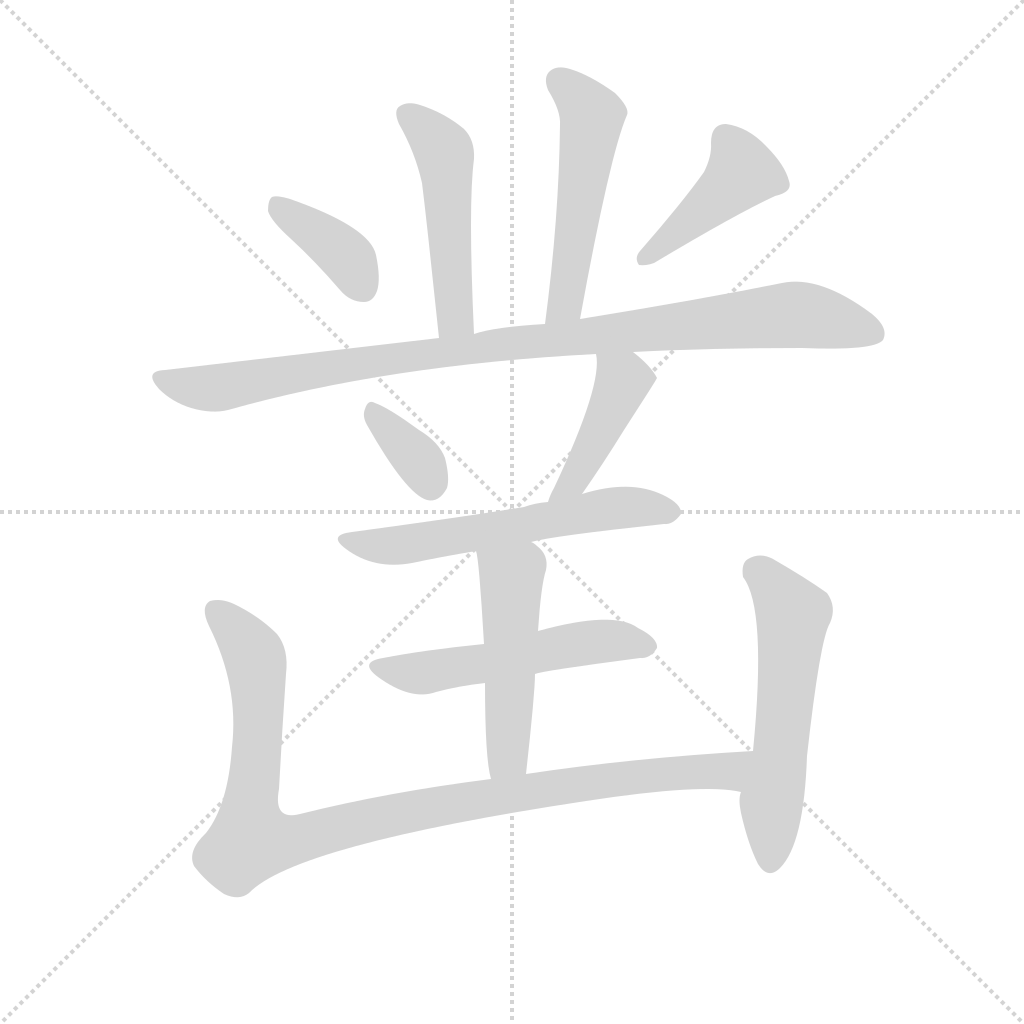
Character: Zao
Kangxi stroke count: 27
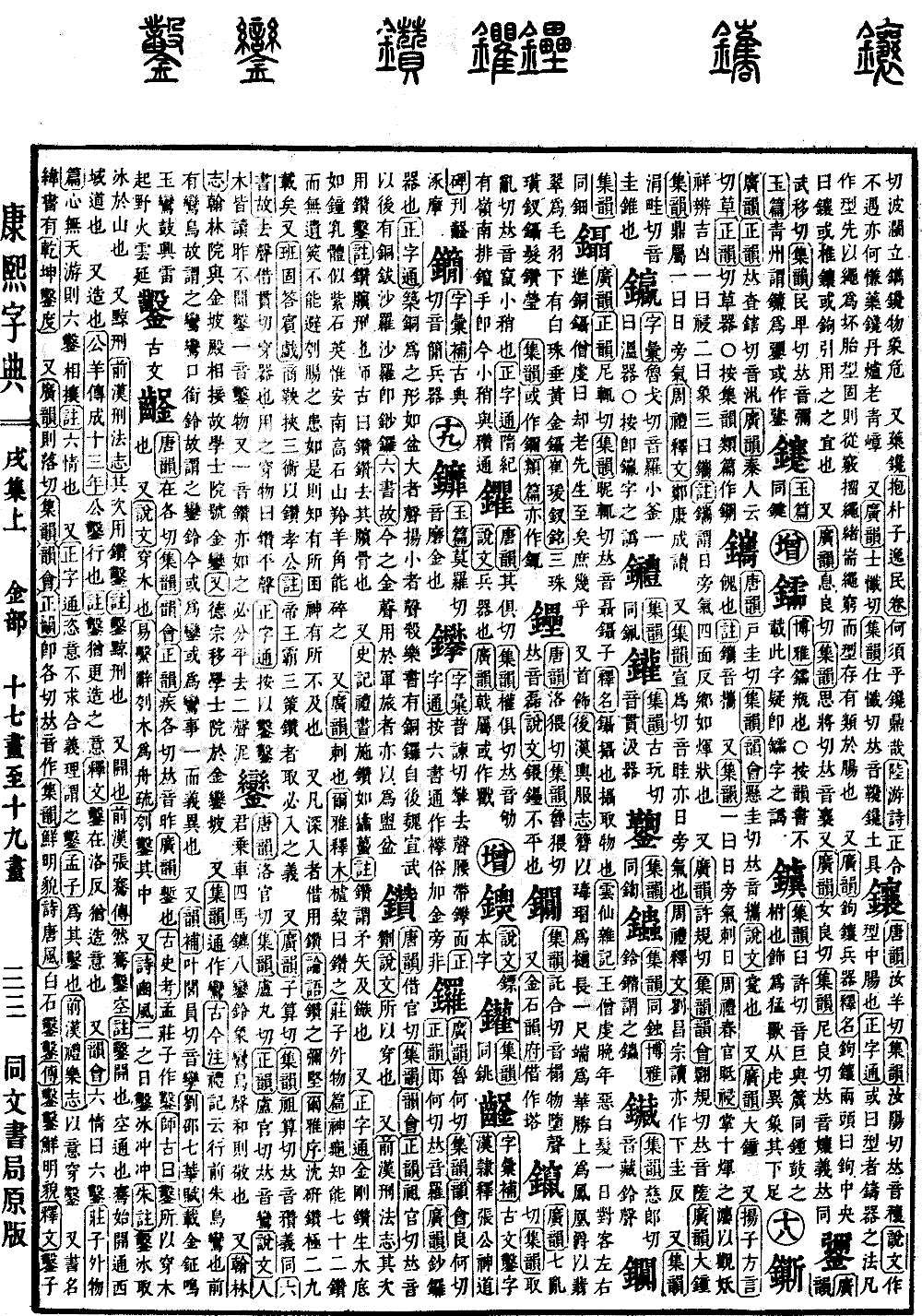
Page 1327
Ancient form. According to the Tang Rhymes (Tangyun), it is the fanqie pronunciation of zaigé. According to the Collected Rhymes (Jiyun), Rhyme Assembly (Yunhui), and Correct Rhymes (Zhengyun), it is the fanqie pronunciation of jígé. It sounds like zuó.
Extensive Rhymes (Guangyun) defines it as a chisel.
The Examination of Ancient History (Gushikao) states that Meng Zhuangzi invented the chisel.
Yan Shigu says a zao is a tool used for boring through wood.
Explaining Graphs and Analyzing Characters (Shuowen) defines it as boring through wood.
The Book of Changes (Yijing), in the commentary to the Xici section on hollowing wood to make a boat, mentions hollowing and boring out its center.
The Book of Odes (Shijing), in the Odes of Bin, says that in the second month the ice is cut with echoing blows. Zhu Xi's commentary notes that cutting ice refers to taking ice from the mountains.
It also refers to the punishment of branding. The History of the Former Han (Qianhan Shu), Treatise on Law, mentions that the next level of punishment involves the use of the drill and chisel. The commentary explains that chisel here refers to branding.
It also means to open up or clear a path. In the History of the Former Han, Biography of Zhang Qian, it is said that Zhang Qian opened up the way. The commentary explains that zao means to open and kong means to pass through, referring to Zhang Qian beginning to open the roads to the Western Regions.
It also means to manufacture or alter. The Gongyang Commentary (Gongyangzhuan), in the thirteenth year of Duke Cheng, says the Duke altered his conduct. The commentary notes that zao implies remaking or reinventing. The phonetic gloss says it is the fanqie pronunciation of zàiluò, meaning to create a new intention.
The Rhyme Assembly states that the six emotions are called the six perforations. In the Zhuangzi, Outer Things chapter, it says that if the mind does not wander in the natural, the six perforations will conflict with each other. The commentary identifies these as the six types of emotions.
The Correct Character Mastery (Zhengzitong) states that acting arbitrarily without seeking to conform to principles is called being forced or zao. Mencius (Mengzi) mentions acting because of such forced interpretations. The History of the Former Han, Treatise on Ritual and Music, mentions using one's own ideas to force an interpretation.
It is also a book title. Among the divination texts, there is the Measure of the Chisel of Heaven and Earth (Qiankun zaodu).
According to the Extensive Rhymes, it is the fanqie pronunciation of zéluò. According to the Collected Rhymes, Rhyme Assembly, and Correct Rhymes, it is the fanqie pronunciation of jígé. It sounds like zuò.
The Collected Rhymes defines it as a bright or clear appearance. The Book of Odes, Odes of Tang, says the white stones are bright and clear. The commentary notes that zaozao means bright and clear. The phonetic gloss says it is the fanqie pronunciation of zǐluò.
The Nine Chapters on the Mathematical Art (Jiuzhang suanshu) mentions that the ratio for unhusked grain is fifty and for polished rice is twenty-four. This means five decaliters of unhusked grain yields two decaliters and four liters of rice.
The Zuo Commentary (Zuozhuan), in the second year of Duke Huan, says the sacrificial grain was not finely polished. The commentary explains this as not being finely pounded or polished. The phonetic gloss says it is the fanqie pronunciation of zǐluò.
A poem by Du Fu says that autumn wild rice yields black grains, while fine polishing produces white rice.
According to the Extensive Rhymes and Collected Rhymes, it is the fanqie pronunciation of zuómù, sounding like zú. The Extensive Rhymes mentions engraving flowers and leaves.
According to the Collected Rhymes, Rhyme Assembly, and Correct Rhymes, it is the fanqie pronunciation of zàidào, sounding like the departing tone of cáo. The Collected Rhymes defines it as boring a hole. The Supplemented Rhymes (Zengyun) defines it as a hole or cavity.
The Rites of Zhou (Zhouli), Winter Offices, Records of Artificers, section on the wheelwright, states that for all spokes, one should measure the depth of the socket to determine the width of the spoke. The phonetic gloss says it is the fanqie pronunciation of cáobào, though it is also read with its standard pronunciation.
The History of the Former Han, Biography of Prince Yuan of Chu, mentions a sheep entering a burial pit. Yan Shigu's commentary says zao is read as the fanqie pronunciation of zàidào, referring to an excavated burial pit.
The Songs of the South (Chu Ci), Nine Arguments, asks when the craftsmen of this age, who destroy the compass and square to change the socket, will be gone, and expresses a wish to admire the teachings left by the ancient sages rather than follow the crowd.
According to the Collected Rhymes, it is the fanqie pronunciation of qīdào, sounding like cāo, meaning redundant or miscellaneous.
According to the Corrected Tang Rhymes (Tangyun Zheng), it is read in the level tone, sounding like cáo. The Commentary on the Water Classic (Shuijing Zhu) mentions that Huan had ambitions to seize the throne, so he excavated an island to complete the count of one hundred. Cáo is used here as a variant of the character zao.
According to the Rhyme Supplement (Yunbu), it rhymes as the fanqie pronunciation of cuǒwǔ, sounding like the rising tone of zū. The Forest of Changes (Yilin) says a lead knife attacking jade never fails to drill or chisel; when the dragon's body is fully raised, Lu Ban acts as the assistant.